
TL;DR
LinkedIn content intelligence is the practice of using AI, machine learning, and data analytics to understand not just how your LinkedIn content performs, but why it performs that way and what to do next. It goes beyond native analytics by adding diagnostic and prescriptive layers. With organic reach on LinkedIn dropping 50% in recent years, content intelligence has become essential for B2B marketers who want to make data-backed creative decisions instead of guessing.
Posting on LinkedIn without content intelligence is like driving with your dashboard lights off. You might arrive somewhere, but you won’t know how much fuel you burned, whether you took the fastest route, or why the engine started knocking halfway through.
Most B2B marketers already track basic LinkedIn metrics. Impressions, reactions, follower counts. That’s table stakes. LinkedIn content intelligence is what happens when you move past counting and start understanding.
If you’re building a social commerce or content strategy across multiple platforms, cross-platform content intelligence is the broader framework that makes LinkedIn intelligence even more powerful.
LinkedIn content intelligence is the process of analyzing LinkedIn content using AI, machine learning, and performance data to understand why posts succeed, predict future performance, and recommend improvements. Unlike traditional LinkedIn analytics, content intelligence identifies patterns across content format, audience demographics, posting time, engagement quality, and business outcomes to help marketers create higher-performing content consistently.
In practice, LinkedIn content intelligence helps answer questions such as:
– Which post formats generate the highest-quality engagement?
– Which industries respond best to specific topics?
– What publishing schedule maximizes reach?
– Which posts influence leads and revenue instead of simply generating likes?
– Which content themes establish topical authority over time?
This moves content strategy from reporting past performance to making evidence-based publishing decisions.
What Is LinkedIn Content Intelligence?
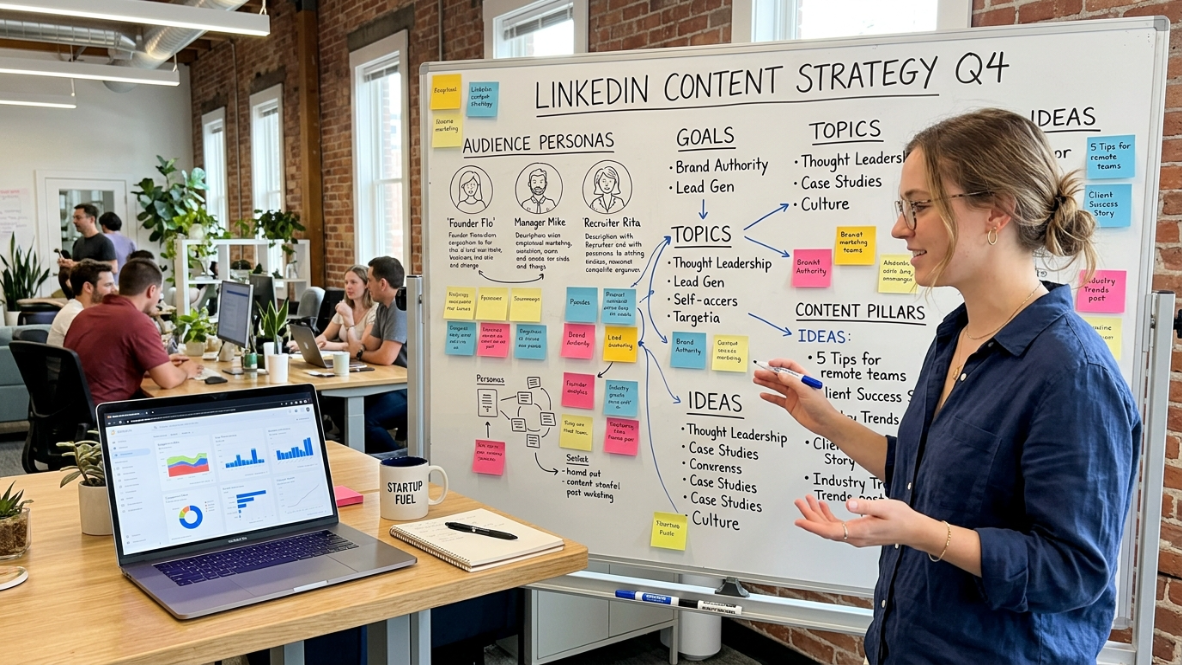
Content intelligence is the process of using data, artificial intelligence, and analytics to guide and optimize content creation, distribution, and performance measurement. It combines machine learning, natural language processing (NLP), and AI to analyze what types of content actually work, why they work, and how to replicate those results.
When applied to LinkedIn specifically, content intelligence means analyzing your professional content through the lens of LinkedIn’s unique audience signals: job function, seniority level, industry, company size. No other social platform gives you this kind of professional demographic granularity, and that’s exactly what makes LinkedIn content intelligence a distinct discipline.
The term “content intelligence” appears in two contexts. In enterprise settings, it refers to managing and classifying document libraries through semantic tagging and governance. In marketing and social media, which is the focus here, it means optimizing published content for engagement, reach, and business outcomes. The LinkedIn application falls squarely in the second camp.
The global content intelligence market is estimated at $3.36 billion in 2026 and is expected to reach $20.44 billion by 2033, growing at a 29.4% CAGR. This is not a niche experiment. It’s a category with serious momentum.
How LinkedIn Content Intelligence Works at a Glance
Step | What Happens | Outcome |
|---|---|---|
Collect | Gather engagement, audience, and post data | Complete dataset |
Analyze | AI detects patterns across posts | Performance insights |
Diagnose | Explain why content succeeded or failed | Actionable understanding |
Recommend | Suggest topics, timing, and formats | Better future posts |
Measure | Compare new results against predictions | Continuous improvement |
Content Intelligence vs. Content Analytics vs. Social Listening
These three terms get conflated constantly. Most ranking pages for LinkedIn analytics topics treat them as interchangeable. They aren’t, and the distinction matters for how you make decisions.
Discipline | Core Question | Output | Example |
|---|---|---|---|
Content Analytics | What happened? | Metrics and dashboards | “This post got 12,000 impressions and a 4.2% engagement rate” |
Content Intelligence | Why did it happen, and what should we do next? | Hypotheses and recommendations | “Carousel posts about hiring trends get 3x the save rate among VP-level followers. Test a carousel on retention data next Tuesday at 8 AM.” |
Social Listening | What are people saying about us? | Brand sentiment and conversation tracking | “Mentions of our brand spiked 40% after the CEO’s keynote, mostly positive” |
Content analytics is descriptive. Content intelligence is diagnostic and prescriptive. Social listening monitors what others say about you; content intelligence analyzes what works when you speak.
As one practitioner put it: “Analytics tell you what happened. Influence systems determine what happens next.” That progression from observation to action is the entire point.
For a parallel example of how analytics and intelligence differ in social commerce, the framework behind TikTok Shop competitor analysis follows the same logic: raw data becomes valuable only when it explains the “why.”
Where LinkedIn Content Intelligence Fits in a Marketing Stack
Many marketers assume content intelligence replaces analytics or social listening. In reality, it complements multiple marketing systems.
Tool | Primary Purpose |
|---|---|
LinkedIn Analytics | Performance reporting |
CRM | Lead tracking |
Marketing Automation | Campaign execution |
Social Listening | Brand monitoring |
Content Intelligence | Content optimization |
Business Intelligence | Executive reporting |
A mature marketing operation combines all of these rather than relying on one platform.
How LinkedIn Content Intelligence Works
A content intelligence system for LinkedIn operates across three layers: data inputs, an AI analysis layer, and actionable outputs.
Data Inputs
The system pulls from multiple sources:
Engagement metrics: impressions, clicks, reactions, comments, shares, saves
Audience demographics: job title, seniority, industry, company size, location
Content attributes: format (text, carousel, video, poll), length, topic, hook type, tone
Timing data: day of week, time of day, posting frequency
Competitive benchmarks: how similar content from peers or competitors performs
LinkedIn defines impressions as the number of times a post is visible for at least 300 milliseconds with at least 50% in view on a signed-in member’s screen. Engagement rate is calculated as interactions plus clicks and followers acquired, divided by impressions. These are the raw ingredients.
The AI and Machine Learning Layer
This is where intelligence separates from analytics. Machine learning models identify patterns across hundreds or thousands of posts. NLP analyzes the text itself: hook structure, vocabulary, sentiment, readability. Predictive models forecast likely performance based on historical patterns.
The output isn’t a prettier dashboard. It’s a set of hypotheses. A pattern detected is not a rule. Before executing based on an insight, it pays to test: change one variable, measure the result, confirm or discard. This distinction between correlation and causation is something most vendor content glosses over, but it’s critical for honest practice.
Types of AI Used in LinkedIn Content Intelligence
Most platforms combine several AI technologies rather than relying on a single model.
Machine Learning
Identifies recurring performance patterns across hundreds or thousands of posts.
Natural Language Processing (NLP)
Evaluates readability, topics, sentiment, writing style, keyword usage, and audience relevance.
Predictive Analytics
Forecasts likely engagement based on historical trends.
Recommendation Engines
Suggest publishing times, content formats, and topic clusters.
Generative AI
Assists with drafting content but should always be guided by intelligence insights rather than replacing human expertise.
Actionable Outputs
A mature LinkedIn content intelligence system should produce:
Diagnostic explanations: why a particular post outperformed (hook type + format + timing + audience match)
Prescriptive recommendations: what to post next, in what format, at what time
Audience shift alerts: changes in who engages with your content by seniority or industry
Content-to-revenue connections: linking engagement to downstream business outcomes like leads and pipeline
Key Metrics LinkedIn Content Intelligence Tracks

Not all metrics carry equal weight. Here’s what matters most in a LinkedIn content intelligence framework, ordered by diagnostic value.
High-Value Metrics
Save rate (save-to-impression ratio): LinkedIn’s algorithm now treats saves as a high-value engagement signal. A post that gets saved is one that readers consider worth returning to. This metric is underused because LinkedIn’s native analytics don’t emphasize it, but it’s one of the strongest indicators of content resonance.
Comment quality: Not all comments are equal. LinkedIn’s algorithm filters out generic AI comments 45% of the time, according to the Social Media Today 2026 Forecast. Thoughtful, substantive comments from relevant professionals signal genuine value.
Engagement rate by audience segment: Knowing your overall engagement rate is useful. Knowing that your engagement rate among Director-level professionals in SaaS is 3x your average, that’s intelligence.
Standard Metrics (Still Important)
Impressions: reach baseline
Click-through rate (CTR): especially for posts linking to external content
Follower demographics: industry, seniority, function, geography
Content velocity: how quickly a post accumulates engagement after publishing
LinkedIn-Specific Nuances
LinkedIn’s analytics emphasize professional signals that other platforms simply don’t have. When your content intelligence system can tell you that carousel posts about leadership generate disproportionate engagement among C-suite followers in financial services, you have something Instagram or TikTok analytics will never provide.
To see how content analytics works in a commerce-driven context, TikTok Shop analytics tools track a completely different set of signals, like GMV attribution and creator conversion rates, which illustrates why platform-specific intelligence matters.
Why LinkedIn Content Intelligence Matters in 2026
Three forces are converging to make LinkedIn content intelligence more critical than ever.
Organic Reach Is Collapsing
According to Richard van der Blom’s 2026 research, organic reach on LinkedIn dropped 50%. Engagement fell 25%. Follower growth crashed by 59%. The days of posting casually and expecting growth are over. Every post needs to earn its reach, and content intelligence tells you which bets are worth making.
The Algorithm Rewards Expertise, Not Volume
LinkedIn’s algorithm now identifies subject-matter experts and boosts their content to relevant audiences. Consistent posting within a defined expertise area builds algorithmic recognition over time. This means content intelligence needs to track topic consistency and expertise signals, not just individual post metrics.
B2B ROI Attribution Is Still Broken
According to the Content Marketing Institute’s research, 56% of B2B marketers struggle to attribute ROI to content, and another 56% can’t track the full customer journey. LinkedIn content intelligence won’t solve this overnight, but it’s the diagnostic layer that connects content performance to business outcomes. Without it, you’re spending budget on content without knowing what’s actually driving pipeline.
Organizations using content intelligence platforms report 40 to 70% faster creation cycles and higher relevance scores, according to market research from Coherent Market Insights. Speed and relevance together create a compounding advantage.
Benefits of LinkedIn Content Intelligence
Organizations using content intelligence typically experience improvements in several areas:
Better content consistency
Faster content planning
Reduced guesswork
Higher audience relevance
Improved engagement quality
Stronger executive reporting
Better campaign attribution
More efficient testing
Faster identification of successful content themes
Improved cross-platform strategy
Instead of creating content based on assumptions, marketers make decisions backed by measurable evidence.
Content Intelligence Across Social Platforms
LinkedIn content intelligence doesn’t exist in isolation. Most B2B brands also publish on TikTok, Instagram, YouTube, and Facebook. Each platform rewards different signals.
Platform | Primary Intelligence Signals |
|---|---|
Professional demographics, expertise recognition, save rate, comment quality | |
TikTok | Watch time, creator authenticity, GMV attribution, content-to-purchase path |
Visual appeal, story completion rate, Reels engagement, DM conversions | |
YouTube | Watch time, subscriber conversion, suggested video performance |
The real power comes from cross-platform intelligence that compounds insights. A topic that drives high saves on LinkedIn might also perform well as a short-form video on TikTok, but you’d never know without a unified view.
For brands selling through social commerce, understanding creator analytics and affiliate ROI on TikTok alongside LinkedIn thought leadership metrics gives a complete picture of how content drives both reputation and revenue.
If you need to act on intelligence insights by publishing across platforms efficiently, cross-platform post scheduling is the operational layer that makes this possible.
Common Misconceptions About LinkedIn Content Intelligence
“Content Intelligence Is the Same as AI Content Generation”
It’s not. AI content generation produces drafts. Content intelligence analyzes and optimizes performance with methodology. They’re complementary but distinct. You can use AI to write a LinkedIn post and content intelligence to determine whether that format, topic, and timing combination is worth publishing at all.
AI-generated text tends to exhibit uniform sentence lengths, similar phrasing, and repetitive vocabulary. LinkedIn itself acknowledges that AI can be a useful catalyst for creation, but the platform’s algorithm is increasingly sophisticated at detecting purely AI-generated engagement. Content intelligence helps you understand what human-crafted elements actually resonate.
“More Data Means Better Decisions”
Not automatically. A content intelligence system that dumps 47 metrics into a dashboard hasn’t made you smarter. It’s made you busier. Intelligence means filtering data into hypotheses you can test. The question is never “how much data do I have?” but “what should I change about my next post, and why?”
“LinkedIn’s Native Analytics Are Enough”
LinkedIn’s built-in analytics are fine for surface-level reporting. You can see impressions, reactions, and follower count. But practitioners consistently point out that native tools don’t tell you why a post performed well, what content types drive the most engagement over time, or how your audience composition is shifting. The “what” is covered. The “why” and “what next” are not.
“Content Intelligence Only Matters for Big Companies”
The market’s growth to $3.36 billion in 2026 isn’t driven solely by enterprise buyers. Solo consultants, small agencies, and emerging brands all benefit from understanding which content actually moves the needle. In fact, smaller teams with fewer resources to waste arguably need intelligence more, because they can’t afford to post blindly.
For agencies managing multiple client accounts, agency-specific solutions provide the scaled intelligence layer needed to run content operations across brands.
How to Get Started with LinkedIn Content Intelligence
You don’t need a six-figure platform to begin. Here’s a practical progression.
Level 1: Manual Pattern Recognition
Export your last 90 days of LinkedIn post data. Sort by engagement rate. Look for patterns in format, topic, posting time, and hook style. This takes a few hours and will reveal obvious patterns you’ve been missing.
Level 2: Structured Tracking
Build a simple spreadsheet that tags each post by content attributes: format (text, carousel, video, poll), topic category, hook type (question, statistic, story, contrarian take), and length. Track these against engagement metrics weekly. After 30 days, you’ll have a basic content intelligence system.
Level 3: Tool-Assisted Intelligence
Scale your analysis with tools that automate pattern detection, audience segmentation, and competitive benchmarking. At this stage, you’re looking for platforms that don’t just show metrics but explain performance and recommend next steps.
If your content strategy spans LinkedIn and social commerce channels like TikTok Shop, an AI social commerce platform can unify content intelligence across discovery, creation, publishing, and revenue attribution in a single workflow.
Level 4: Content-to-Revenue Attribution
Connect your content intelligence to CRM and pipeline data. Which LinkedIn posts generated profile visits that became connection requests that became discovery calls? This is the hardest step, and it’s where the 56% of B2B marketers struggling with ROI attribution are stuck. But it’s also where content intelligence delivers its highest value.
Ready to see how content intelligence works across LinkedIn and social commerce platforms?
Explore plans and pricing to find the right starting point for your team.
Best Practices for LinkedIn Content Intelligence
Successful teams typically follow several best practices:
Measure quality instead of vanity metrics.
Compare posts published under similar conditions.
Track content themes over months rather than weeks.
Test one variable at a time.
Connect engagement data with CRM outcomes.
Review audience changes quarterly.
Combine AI recommendations with human expertise.
Maintain a documented experimentation process.
Frequently Asked Questions
What is LinkedIn content intelligence in simple terms?
LinkedIn content intelligence is the practice of using AI and data analysis to understand why your LinkedIn content performs the way it does and what you should post next. It goes beyond basic metrics like impressions and likes to provide diagnostic explanations and prescriptive recommendations.
How is content intelligence different from LinkedIn analytics?
LinkedIn analytics tells you what happened: how many people saw your post, how many reacted, who your followers are. Content intelligence explains why those numbers look the way they do and recommends specific actions, like which format, topic, or posting time to try next.
Does LinkedIn offer content intelligence natively?
No. LinkedIn’s built-in analytics provide descriptive metrics (impressions, engagement rate, follower demographics), but they don’t include diagnostic or prescriptive capabilities. For actual content intelligence, you need third-party tools or manual analysis that goes deeper than the native dashboard.
What metrics matter most for LinkedIn content intelligence?
Save rate, comment quality, and engagement rate segmented by audience demographics (seniority, industry, job function) are the highest-value signals. These tell you more about content resonance than raw impression counts or total reactions.
Is LinkedIn content intelligence only useful for large companies?
No. Any professional or brand publishing regularly on LinkedIn benefits from understanding what works and why. Smaller teams with limited content budgets arguably need intelligence more, because they have less room for trial and error.
How does AI content detection affect LinkedIn content intelligence?
LinkedIn’s algorithm filters out generic AI-generated comments roughly 45% of the time, and it increasingly recognizes formulaic AI-written posts. Content intelligence helps you identify which human-crafted elements, authentic perspectives, and creative choices actually drive engagement, so you can use AI as a starting tool without producing generic output.
Can content intelligence span LinkedIn and other platforms?
Yes. Cross-platform content intelligence tracks how the same content themes perform across LinkedIn, TikTok, Instagram, and YouTube. Since each platform rewards different signals, a unified view reveals opportunities you’d miss by analyzing each channel in isolation.
How much does LinkedIn content intelligence cost?
It ranges widely. Manual analysis costs nothing but time. Third-party tools vary from free tiers to enterprise pricing. The global content intelligence market is valued at $3.36 billion in 2026, reflecting growing investment across businesses of all sizes. The right investment depends on your posting volume, team size, and how tightly you need to tie content to revenue.
Author


