
TL;DR
TikTok Shop product validation is the process of testing whether a product has real demand, content potential, and profit viability on TikTok’s discovery-driven commerce platform before committing to inventory or ad spend. It differs from compliance testing (meeting TikTok’s regulatory requirements) and from traditional e-commerce validation (keyword research on Amazon). Successful validation on TikTok requires proving both product-market fit and product-content fit, because a product that can’t stop the scroll in three seconds will fail regardless of how useful it is.
Direct Answer: What Is TikTok Shop Product Validation?
TikTok Shop product validation is the process of determining whether a product will generate profitable sales on TikTok by testing three factors: real market demand, content performance potential, and unit economics before investing in inventory or ads. Unlike Amazon validation, it requires proving that a product can succeed in short-form video-driven discovery, where attention is earned in the first 3–5 seconds. A product is considered “validated” when it shows strong sales velocity, high engagement-driven conversion rates (typically 8–12%), and sustainable creator adoption without heavy reliance on a single influencer.
What TikTok Shop Product Validation Actually Means
Product validation in the TikTok Shop context is straightforward: it’s the work you do to confirm that a product can actually sell profitably on TikTok before you buy inventory, recruit creators, or run ads.
That sounds obvious. But TikTok Shop is not Amazon, not Shopify, and not a traditional marketplace. The platform generated over $33 billion in global GMV in 2024, tracking toward $66 billion in 2025. With that kind of growth, sellers are rushing in, and most of them are skipping validation entirely.
The result? Products that looked promising based on Amazon research or supplier recommendations fail because they can’t generate compelling short-form video content. Or they succeed briefly, then collapse under saturation. TikTok Shop product validation exists to prevent these expensive mistakes.
Explore Trenz’s product research tool to start validating product opportunities with real TikTok Shop data.
Why Validation on TikTok Shop Is Fundamentally Different
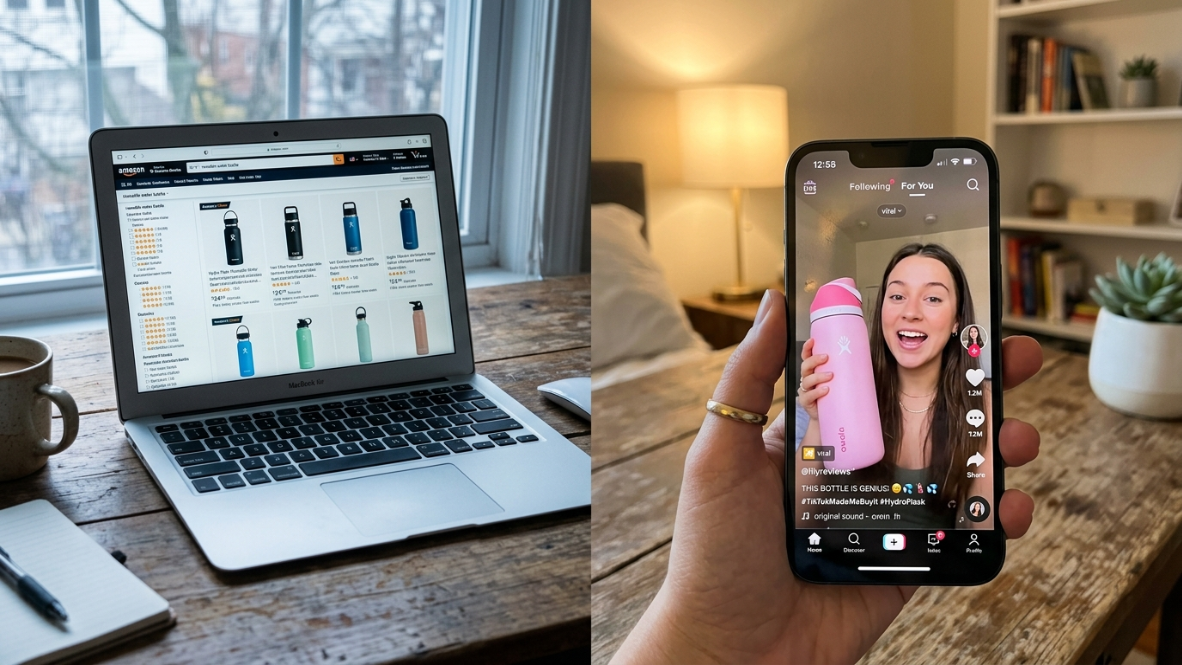
Amazon runs on search commerce. Shoppers type what they want, and the algorithm matches their query to products. Validation on Amazon means confirming that enough people are searching for your product and that the competitive field is winnable.
TikTok runs on discovery commerce. Nobody searches for your product. Instead, the algorithm pushes content to users based on engagement signals, and purchases happen because a video created desire that didn’t exist thirty seconds earlier. According to research, 70% of TikTok users discover new brands and products on the platform, and 83% say TikTok influences their purchase decisions.
This changes what validation means. On TikTok, you need to prove two things simultaneously:
Product-market fit — People actually want this product and will pay for it.
Product-content fit — This product can generate compelling 15 to 60 second video content that stops the scroll and triggers an impulse buy.
A product can have strong market demand and still fail on TikTok if it looks boring on camera. A kitchen gadget that saves time but has no visual “wow” moment is a bad TikTok product. A cleaning solution that shows a dramatic before-and-after transformation in five seconds is a great one. Content-market fit is the concept that separates successful TikTok sellers from confused ones.
Product Validation vs. Compliance Testing: A Critical Distinction
If you search for “TikTok Shop product validation,” you’ll notice that half the results are actually about compliance testing. TikTok’s Seller Center documentation covers regulatory requirements: FDA registration for beauty products, lab testing documentation, quality policy certifications. This is compliance validation, meaning proving your product meets platform rules so you’re allowed to list it.
That’s important, but it’s a completely separate exercise from market validation. Here’s a quick comparison:
Market Validation | Compliance Testing | |
|---|---|---|
Question answered | “Will this product sell profitably on TikTok?” | “Does this product meet TikTok’s listing requirements?” |
What you test | Demand, content potential, saturation, unit economics | Safety certifications, ingredient documentation, regulatory filings |
When it happens | Before you commit to inventory or creator partnerships | Before or during listing setup |
Data sources | GMV trends, creator analytics, content engagement metrics | FDA databases, lab reports, TikTok Seller Center policies |
Failure cost | Wasted inventory, ad spend, and time | Listing removal or account suspension |
Both matter. But this article focuses on market validation, the commercial viability question that determines whether you should enter a product category at all.
Key Validation Signals for TikTok Shop Products
Sales Velocity and GMV Trends
GMV (Gross Merchandise Value) equals the sale price multiplied by the number of units sold. It’s the most visible performance metric on TikTok Shop, and it’s the first thing most sellers check.
But practitioners consistently warn against taking GMV at face value. As Dashboardly’s analysis notes, most sellers see a big GMV number and assume things are going well, but GMV doesn’t account for the 8 to 15% that disappears to platform fees, refunds, and affiliate commissions.
What matters more than absolute GMV is sales velocity and acceleration. A product showing rapid week-over-week growth in units sold often has more validation potential than a product with high but flat sales. When evaluating candidates, track GMV trends over 7, 14, and 30 day windows rather than relying on a single snapshot. Tools that provide TikTok Shop analytics can surface these trend lines automatically.
For a minimum benchmark, practitioners on forums suggest that products should have sold at least 5,000 to 10,000 units to confirm real demand. Below that threshold, the sample size is too small to distinguish a genuine opportunity from a temporary spike.
Saturation Signals
A product can be validated in terms of demand but still be a terrible opportunity if the market is already crowded. Saturation detection is the second pillar of TikTok Shop product validation.
Key saturation signals include:
Seller count: If dozens of stores are selling the same product with identical creatives, differentiation becomes nearly impossible.
Review volume concentration: When most listings have high review counts and similar product formats, latecomers face steep disadvantages.
Creative duplication: Multiple advertisers running the same style of video content signals that the market has been mined.
Engagement plateau: If growth in views and engagement for a product category has flattened over several weeks, the viral window may have closed.
The opportunity usually lies in catching products as they transition from emerging trend to proven performer, before the market becomes saturated. A strong approach is to identify niches with high content engagement but low product saturation: hashtags with billions of views where users are discussing a problem, but few shoppable videos are offering a solution. Running a thorough competitor analysis before entering any category prevents you from walking into a red ocean.
Creator Adoption and Concentration
This is one of the most underappreciated validation signals. Jonathan Snow, co-founder of Avenue Z, put it clearly in an interview: “How we judge TikTok Shop programs early on is how many affiliates are posting each month. As long as that number keeps going up, eventually you’re going to hit the tipping point where the shop is doing really well.”
But raw affiliate count isn’t enough. You also need to check creator concentration. If a product’s sales are driven by one or two dominant creators, the opportunity is fragile. That product hasn’t proven broad content-market fit; it’s just proven that a specific creator has a loyal audience. If those creators stop posting, sales evaporate.
The healthier signal is distributed creator adoption: many creators producing content, each driving meaningful conversions. This indicates the product itself is the draw, not any single personality. Monitoring creator analytics gives you visibility into whether a product’s sales depend on a few whales or a broad base of affiliates.
TikTok Shop’s affiliate program now has over 100,000 actively participating creators, with affiliate links achieving engagement rates 160% higher than Instagram’s. The pool is large enough that creator concentration analysis is both possible and necessary.
Content Engagement Metrics

Since TikTok is a content platform first and a commerce platform second, content performance metrics are direct validation signals.
Click-to-order rate (CTOR): This measures the percentage of product clicks that convert into orders. It reveals whether your traffic is actually buying, not just browsing. TikTok Shop typically shows conversion rates of 8 to 12% compared to 2 to 4% on traditional e-commerce. That means a 5% conversion rate that would be acceptable on Shopify is actually below average on TikTok.
Watch time: TikTok’s Shop recommendation algorithm weighs how long viewers watch product demonstrations. Longer watch time increases recommendations, which increases reach, which increases sales. Products that hold attention for the full video duration get exponentially more distribution.
Comment intent: Some of the strongest buying signals come from the comment section. Look for comments like “Where did you buy this?” or “Is there a dupe for this?” or users tagging friends. These organic purchase intent signals can’t be faked at scale and indicate genuine demand.
An engagement rate above 3% with sustained growth over 7 or more days is typically a strong validation signal. For deeper analysis of content performance patterns, content intelligence tools can help identify which angles and formats drive actual conversions versus mere views.
Price-to-Perceived-Value Alignment
TikTok Shop’s average order value tends to be lower than traditional e-commerce. The platform’s impulse-buy dynamic means products priced between $10 and $30 have the lowest friction to purchase. But price alone isn’t the deciding factor.
What matters is perceived value relative to price. A $25 product that looks like it should cost $60 based on its video presentation performs far better than a $25 product that looks like a $25 product. The visual medium amplifies this effect. Validation should include a gut check: when someone sees this product in a 15-second video, will they think “that’s a steal”?
Minimum Validation Criteria Before You Launch
Product shows 5,000–10,000+ units sold OR strong accelerating velocity
At least 3%+ engagement rate on product-related content
8–12% click-to-order rate (CTOR) benchmark met or exceeded
At least 5–10 creators actively promoting the product category
No dominant single creator controlling >50% of sales
Clear before/after or transformation hook in video content
Positive unit economics after fees (15–25% total deductions accounted for)
H2: TikTok Shop Product Validation Framework (3-Layer Model)
Layer 1 — Demand Validation (Market Fit)
Focus on:
GMV growth trends
Unit sales velocity
Category expansion signals
Goal: Confirm people already want the product
Layer 2 — Content Validation (Attention Fit)
Focus on:
Watch time retention
Hook performance (first 3 seconds)
Viral format compatibility (before/after, transformations)
Goal: Confirm the product can perform in TikTok’s algorithm
Layer 3 — Profit Validation (Economics Fit)
Focus on:
Margins after fees (5–8%)
Affiliate commissions
Return rates
Ad spend efficiency
Goal: Confirm the product is scalable profitably
How to Validate a Product for TikTok Shop: A 5-Step Framework
Sellers on Reddit’s r/TikTokshop have explicitly asked for a structured product validation framework. Here’s one built on the signals above.
Step 1: Check Category-Level Demand
Start with the big picture. Is this product category growing on TikTok Shop? Browse TikTok Shop category rankings to see which segments are generating real GMV and which are stagnating. TikTok’s own Creative Center also displays trending items by region and category with performance metrics pulled directly from the platform.
You’re looking for categories where GMV is growing and where there’s a clear connection between content activity and sales acceleration. Of the roughly 12,400 platform sellers on TikTok Shop in 2025 (up from 6,800 in 2024), only about 1,850 exceeded $100K in GMV. Concentration at the top is real, so category selection matters enormously.
Step 2: Assess Saturation
Once you’ve identified a promising category, zoom in. How many sellers are offering this exact product? How many creators are making content about it? What does the review distribution look like?
Check daily Radar trends to spot emerging opportunities where demand is building but competition hasn’t caught up. The best time to enter is when a product is transitioning from niche trend to mainstream awareness, not after every seller on the platform has already listed it.
Step 3: Evaluate Content-Market Fit
This is the step most sellers skip, and it’s arguably the most important for TikTok Shop product validation. Ask yourself:
Can this product demonstrate visible, dramatic results in under 60 seconds?
Does it have a natural “before and after” or “problem and solution” angle?
Is there a surprise element, transformation, or satisfying visual that would stop someone from scrolling?
Can multiple creators film it from different angles and still make compelling content?
If you can’t immediately imagine three different video hooks for the product, it probably lacks content-market fit. Desirability matters more than utility on TikTok. A product might be genuinely useful, but if it looks boring on camera, this platform isn’t where it belongs. For ideas on what’s working, explore guides on finding winning products that emphasize content potential alongside demand metrics.
Step 4: Run Small Content Tests
Before committing to large inventory orders or expensive creator partnerships, test with minimal investment. A common practitioner approach: launch 3 to 5 products priced between $10 and $30, post 10 to 15 organic videos testing different hooks and angles, and monitor performance over 7 to 14 days.
You can also use Spark Ads to boost organic content that’s gaining early traction, which accelerates the validation cycle. The goal isn’t to generate profit at this stage. It’s to collect real data on click-through rates, watch time, comment sentiment, and conversion.
Step 5: Analyze Results Against TikTok-Specific Benchmarks
Compare your test results to platform benchmarks, not to your experience on other channels. Remember: TikTok Shop conversion rates run 8 to 12%, so anything below 5% signals a problem. Engagement rates should exceed 3% and ideally show growth, not decline, over a 7-day window.
Also compute unit economics honestly. Subtract platform fees (typically 5 to 8%), affiliate commissions, shipping costs, refunds, and ad spend from your revenue per unit. If the contribution margin is positive at test scale, the product has passed validation. If it’s negative, consider whether scale would change the math or whether you’re forcing an unviable product.
Common TikTok Shop Product Validation Mistakes
Confusing Virality with Validation
A product can go viral without being a top seller. Views and shares are not the same as purchases. Conversely, a product with moderate view counts but strong CTOR and repeat purchases is better validated than a viral sensation with no conversion. Watch the sales data, not just the view counts.
Copying Amazon Strategies Directly
This is the most common mistake. Practitioners consistently report that product selection based on Amazon keyword volume, supplier recommendations, or traditional e-commerce frameworks fails on TikTok. The discovery commerce model requires completely different selection criteria, particularly around content-market fit and visual demonstrability.
Treating GMV as Profit
GMV is a vanity metric. It tells you nothing about profit because it excludes fees, refunds, cost of goods, and ad spend that typically consume 15 to 25% of gross revenue. Every product validation exercise should include a unit economics calculation, not just a GMV projection.
Skipping Content-Fit Testing
Some sellers validate demand through data analysis, confirm the economics work on paper, buy inventory, then discover the product can’t generate engaging video content. Always test content-market fit before scaling. Film a few test videos yourself or commission low-cost UGC samples and see if anyone engages.
Ignoring Creator Economics
When working with affiliates, measure contribution margin per creator, not GMV per creator. A creator who drives $50,000 in GMV but requires a 25% commission rate, generates 15% returns, and sells primarily through discounted offers may be less profitable than a creator driving $10,000 in GMV with a 10% commission and 3% return rate. The creator analytics approach matters as much as the product analytics.
TikTok as a Leading Indicator for Other Platforms
An emerging pattern worth noting: TikTok Shop product validation is increasingly useful beyond TikTok itself. Early demand signals often show up in creator content first (demos, comparisons, problem-solution clips) and only later translate into Amazon keyword demand.
Some Amazon sellers now use TikTok trend data as an early warning system for product research, identifying rising demand months before it appears in Amazon’s Search Query Performance reports. This cross-platform signal makes TikTok Shop validation a leading indicator for e-commerce more broadly.
For sellers operating across channels, the ability to discover products across TikTok, Amazon, and DTC from a single platform eliminates the need to cobble together data from multiple disconnected tools.
Frequently Asked Questions
What is TikTok Shop product validation?
TikTok Shop product validation is the process of confirming that a product has genuine market demand, strong content potential, and viable profit margins on TikTok’s discovery commerce platform before investing in inventory, creator partnerships, or advertising. It tests both product-market fit (do people want this?) and product-content fit (can this generate compelling short-form video?).
How is TikTok Shop product validation different from compliance testing?
Compliance testing confirms that a product meets TikTok’s regulatory and safety requirements for listing, such as FDA registration for beauty products or lab documentation for certain categories. Market validation is a separate exercise focused on whether the product can sell profitably. You need to pass both, but they answer completely different questions.
What metrics should I track when validating a TikTok Shop product?
The most important metrics are sales velocity (units sold over time, not just total GMV), click-to-order rate (CTOR), content engagement rate (aim for above 3%), watch time on product content, creator adoption trends, and saturation signals like seller count and creative duplication. Always compute unit economics including fees, commissions, and returns.
How many units should a product have sold to be considered validated?
Practitioners generally recommend looking at products that have sold at least 5,000 to 10,000 units as a baseline for confirming demand. Below that threshold, the data is too thin to distinguish genuine demand from a temporary spike or a single creator’s influence.
What is content-market fit and why does it matter for TikTok Shop?
Content-market fit means a product can generate compelling short-form video content that stops the scroll, holds attention, and drives purchases. A product might have real demand but fail on TikTok if it lacks visual appeal, a demonstrable transformation, or an emotional hook. Content-market fit is arguably the single most important validation factor unique to TikTok Shop.
Can I validate a TikTok Shop product for free?
Yes. TikTok’s Creative Center shows trending products by region and category with real performance data. You can also post organic test videos (10 to 15 videos across 3 to 5 products) to gauge engagement before spending on ads or inventory. Free tools won’t give you the depth of paid analytics platforms, but they’re sufficient for initial screening.
What conversion rate is considered good on TikTok Shop?
TikTok Shop conversion rates typically fall between 8 and 12%, significantly higher than the 2 to 4% common on traditional e-commerce platforms. This means a 5% conversion rate that would be acceptable on Shopify is actually below average on TikTok. Set your benchmarks accordingly.
How do I spot a saturated product on TikTok Shop?
Look for multiple sellers running identical creatives, high review volumes across competing listings, flat engagement growth over several weeks, and a product that has been active across many advertisers for an extended period. When these conditions exist together, differentiation becomes extremely difficult and margins compress.
Ready to validate your next product idea with real TikTok Shop data? Start with Trenz’s free plan to access category rankings, trend signals, and product intelligence, no credit card required.
Author


