
TL;DR
Kalodata is a cleaner research-first dashboard for TikTok Shop product, creator, and market analysis. FastMoss is a broader operator tool built for agencies, creator managers, and teams that need ad intelligence, LIVE analytics, and competitor monitoring at scale. Neither tool tracks your actual profit or replaces TikTok Seller Center for revenue data. If your bottleneck is turning analytics into content and sales, Trenz combines product discovery, AI video generation, and multi-platform publishing in one workflow.
Kalodata vs FastMoss: Quick Answer
Kalodata is best for TikTok Shop product and creator research with a clean, simple analytics dashboard. FastMoss is better for advanced users who need ad intelligence, livestream tracking, competitor monitoring, and agency-level workflows. Neither tool tracks actual profit or replaces TikTok Seller Center. If you need both analytics and content creation, an all-in-one tool like Trenz may be more efficient.
Kalodata vs FastMoss vs Trenz: Quick Comparison
Dimension | Kalodata | FastMoss | Trenz |
|---|---|---|---|
Best for | Research-first product and creator discovery | Operators, agencies, and creator managers needing ad/LIVE/competitor workflows | Sellers and agencies wanting discovery plus AI content creation and publishing |
Core workflow | Analyze TikTok Shop market signals | Monitor products, creators, ads, LIVE, and competitors | Discover opportunities, generate videos/scripts, publish, measure GMV |
Pricing (public references) | ~$40–$100/month (varies by source) | ~$29–$399/month (varies by source and tier) | Free plan with 50 credits; paid tiers use credit-based model |
Free trial | Commonly reported 7-day trial | Commonly reported 7-day trial | Free plan, no credit card required |
Key strength | Clean product/market exploration and historical trends | Broader toolkit: creator contacts, ad spy, LIVE monitoring, agency features | End-to-end: daily Radar, AI video/image/script gen, social scheduling, open API |
Main limitation | No content production or publishing | Steeper learning curve; mixed support reviews | TikTok-first; credit model requires budgeting |
A note on pricing: Public directories disagree on exact plan costs for both tools. SmartScout lists Kalodata at $49.99/month and FastMoss at $29/month, while other directories show FastMoss tiers at $49/$89/$139 or $59/$109/$399 depending on source and region. Always verify current pricing directly before subscribing.
The Kalodata vs FastMoss debate comes down to a straightforward question: do you need a research tool or an operating tool?
But most comparison pages stop there. They list features, show a pricing table, and declare a winner. The harder question is what happens after you find a trending product. Can you validate whether it is still winnable? Can you produce enough creative to test it? Can you publish fast enough to beat the wave of sellers entering the same niche?
This article compares Kalodata and FastMoss across nine dimensions that matter for TikTok Shop sellers, then explains when neither tool is enough.
1. Workflow Fit
This is the most important difference between Kalodata and FastMoss, and most comparison pages describe it correctly at a high level.
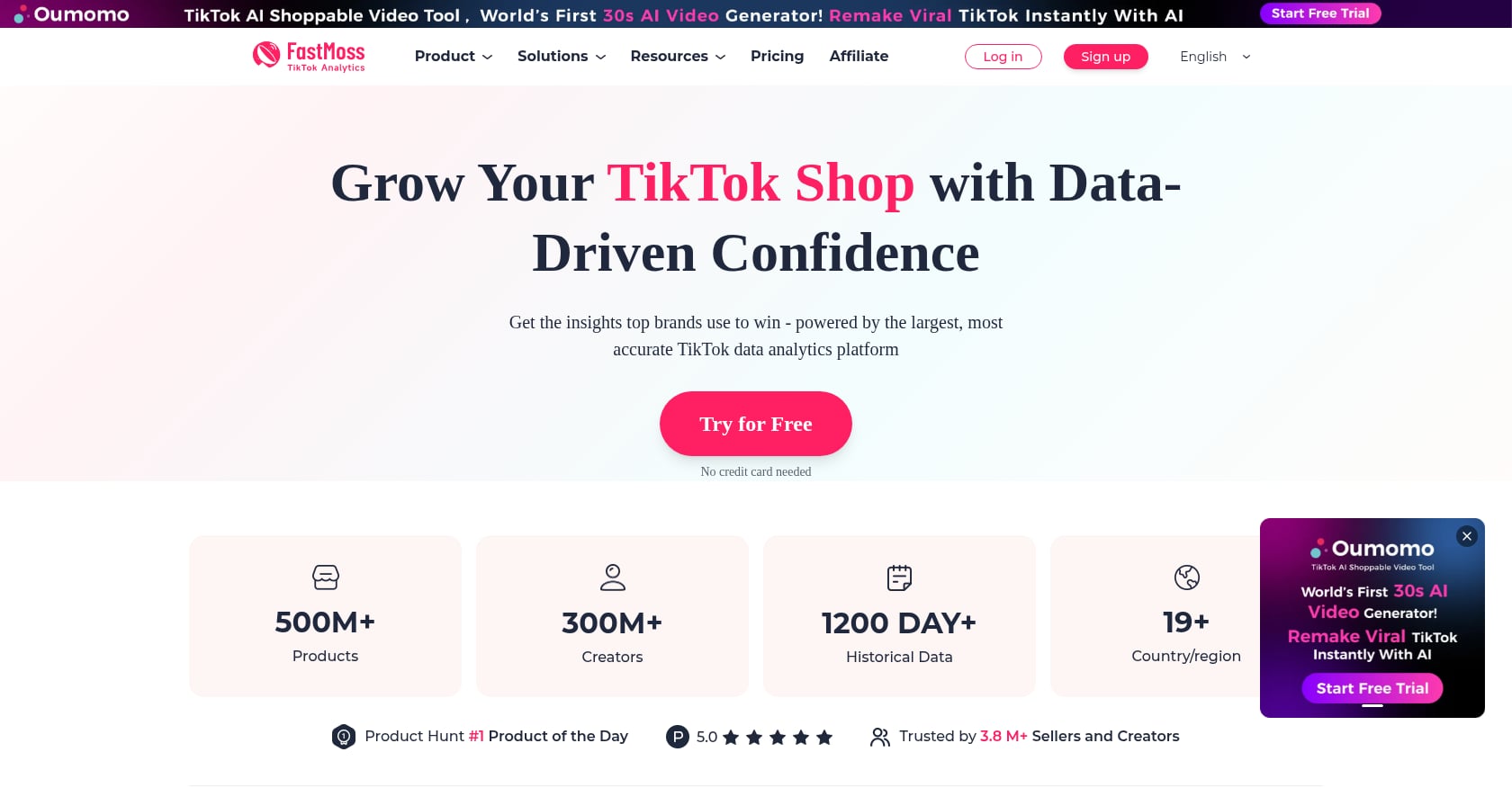
Kalodata is a research dashboard. You go there to explore what is selling on TikTok Shop, which creators are driving product sales, what videos are gaining traction, and how categories are trending. Its knowledge base describes coverage across 15 countries with features like trend spotting, creator contact export, livestream recording, competitor tracking, and ad traffic analysis. Kalodata recently introduced Kalopilot, an AI assistant that analyzes viral videos and extracts script structures from top-grossing products.
FastMoss is an operator suite. It covers similar territory (products, creators, shops, videos) but adds denser modules for ad intelligence, LIVE monitoring, agency rankings, and creator outreach workflows. Its pricing page lists search and ranking features for LIVE, products, creators, shops, videos, and ads, plus video monitoring credits, video transcription, and script generation on higher tiers.
PrintOnDemandBusiness.com frames this well: Kalodata is research-first, FastMoss is operator-first. If you are a solo seller doing early product validation, Kalodata’s interface is easier to navigate. If you manage multiple client shops or run a creator outreach operation, FastMoss gives you more operational controls.
But both tools stop at intelligence. They tell you what is happening. They do not help you produce the content or manage the publishing that turns insight into revenue. That is a gap worth understanding before you pay for either.
How to Choose Between Kalodata and FastMoss
Instead of comparing features alone, choose based on your workflow stage:
Use Kalodata if you:
Are validating TikTok Shop products
Focus on early-stage product research
Want a simple interface for trend discovery
Work as a solo seller or beginner affiliate
Use FastMoss if you:
Manage multiple creators or shops
Need ad, LIVE, and competitor tracking
Run an agency or scaling operation
Require deeper operational intelligence
Neither is ideal if you:
Need to turn insights into content and publishing
Want automated video creation and posting
Need a full end-to-end TikTok Shop workflow
How We Compared Kalodata vs FastMoss
This comparison is based on:
Official product documentation and feature pages
Public pricing references across multiple SaaS directories
User feedback from TikTok Shop seller communities
Functional testing of workflows (research, creator discovery, LIVE analytics, and ad tracking)
We evaluated each tool based on real-world seller workflows, not just feature lists.
2. Pricing
Pricing is one of the top reasons people search for FastMoss vs Kalodata, and public pricing for both tools is surprisingly inconsistent across sources.
Kalodata: One review site places plans at roughly $45.90 to $99.90 per month, with annual billing reducing the professional tier to about $83.20 per month. SmartScout cites a $49.99/month starting point. Capterra lists Kalodata as “contact vendor for pricing.” Expect to pay somewhere in the $40 to $100 range for a usable plan, but confirm the exact limits and features before committing.
FastMoss: The spread is even wider. Some sources show a $29/month starter, others list $49/$89/$139 tiers, and TrustRadius shows $59/$109/$399 with discounts for longer billing cycles. This level of inconsistency suggests regional pricing differences, frequent plan changes, or varying promotional rates. Test the exact tier that matches your workflow during a trial.
Trenz: The pricing model is credit-based. A free plan includes 50 welcome credits with no credit card required. Paid tiers (Growth, Pro, Scale) differ by monthly credits, data depth, social accounts, historical data access, and storage. Credits cost $10 per 100 on top-ups and never expire. The Scale tier supports team workspaces at $19 per seat per month.
See full Trenz pricing details
The real cost question is not the monthly subscription. A $49/month analytics tool is not expensive because of the fee itself. It is expensive if it leads you to buy the wrong inventory, recruit the wrong creators, or enter a saturated category. The tool’s value depends entirely on whether it helps you make better decisions faster, and whether you have a system for acting on those decisions.
3. Product Discovery
Product research is the primary reason most sellers consider either tool, and it is where Kalodata vs FastMoss gets genuinely interesting.
Kalodata is commonly praised for clean product exploration. You can browse categories, filter by sales velocity, study product/creator relationships, and review historical performance trends. SmartScout positions Kalodata as best for TikTok Shop product research and creator discovery, citing creator-to-sales attribution and large-scale datasets.
FastMoss connects product research to operational workflows. You can monitor competitor shops, track product rankings over time, and cross-reference product performance with ad and LIVE data. This makes FastMoss stronger for teams that want their product research directly linked to competitive intelligence and creator outreach.
Trenz approaches product discovery differently. Its Market Analyst agent scans products across TikTok Shop, Amazon, and DTC to identify Blue Ocean opportunities, sales spikes, and seasonal bestsellers. The daily Radar delivers five data-backed product opportunities per day with GMV, growth rates, and creator concentration analysis, so sellers get actionable leads rather than static dashboards.
The critical point that most comparison pages miss: the easiest product to find in any analytics tool is the easiest product for everyone else to find. One practitioner on Reddit put it bluntly, arguing that tracking what is already trending can be the shortest route into a saturated market and should be treated as supporting data, not the main reason to launch a product.
A smarter product validation checklist looks like this:
Is GMV growing faster than creator count?
Is revenue spread across many creators or concentrated in one viral account?
Are commissions rising, signaling increased competition for affiliates?
Are paid ads propping up the sales spike, or is organic demand real?
Can you produce a better content angle than what already exists?
Can you source profitably after fees, commissions, shipping, and returns?
For a deeper look at evaluating opportunities beyond surface-level trending lists, see our guide on finding winning products on TikTok Shop.
4. Creator Analytics and Affiliate ROI
Creator discovery and affiliate management is where the Kalodata vs FastMoss comparison gets more opinionated among users.
FastMoss is generally seen as stronger for creator-focused workflows. One Reddit user noted that FastMoss and Kalodata “do the same thing” but FastMoss has more bells and whistles, and creator managers they work with prefer FastMoss. The tool offers creator search, contact information exports (limited by tier), agency rankings, and creator performance data.
Kalodata also supports creator discovery, filtering, and bulk contact export for multiple contact types. But the emphasis leans more toward understanding which creators are driving sales for specific products rather than managing ongoing outreach operations.
Trenz frames creator analytics around concentration risk and content-to-GMV workflows. Its Radar includes creator concentration metrics, showing whether a product’s success depends on one mega-creator or is distributed across many affiliates. A product driven by a single viral creator is riskier than one with broad affiliate adoption.
But creator analytics is only the starting point. The harder workflow is: brief creators with winning hooks, generate derivative content quickly, publish consistently, and measure whether that content loop drives actual shop performance. Neither Kalodata nor FastMoss closes this loop completely.
For teams focused on measuring which creators actually convert rather than just drive views, TikTok Shop creator analytics can connect content performance back to revenue signals.
Real-World Use Cases for Each Tool
Example 1: Finding a Winning Product
A seller uses Kalodata to identify a rising product category, then validates:
Creator saturation
GMV growth trend
Video performance patterns
Example 2: Scaling a TikTok Shop Agency
An agency uses FastMoss to:
Track competitor shops
Analyze creator performance across campaigns
Optimize commission structures for affiliates
Example 3: Turning Data into Content
A growth team uses Trenz to:
Find trending products
Generate video scripts and hooks
Publish across TikTok, Instagram, and YouTube automatically
5. Ad, Video, and LIVE Intelligence
FastMoss has the broadest ad and LIVE coverage of the two, and this is a meaningful advantage for certain teams.
FastMoss tracks product-level ad metrics (views, conversion, spend, ROAS), livestream performance (units sold, GMV per session), and video analytics across markets. Higher tiers unlock video monitoring credits, LIVE monitoring, video transcription, and script generation. LinkedIn posts from FastMoss emphasize their focus on helping sellers identify which creators drive sales versus views and how to set commission rates based on data.
Kalodata offers livestream recording analysis, ad traffic analysis, and video script transcription with AI-assisted rewriting. This is useful for studying what works before you spend money, but the scope is narrower than what FastMoss provides.
Trenz takes a fundamentally different approach. Instead of just showing which ads and videos perform, its Creative Director agent generates scripts, hooks, images, and AI videos using models like Seedance 2.0, Veo 3.1, and Wan 2.6. The Social Manager then schedules and publishes content to TikTok, Instagram, YouTube, and Facebook with best-time-to-post recommendations.
FastMoss can show you which creative is working. Trenz helps you produce and deploy creative from those insights. For sellers who need volume and speed, cross-platform scheduling closes the gap between analysis and action.
6. Historical Data and Trend Depth
Both Kalodata and FastMoss offer historical data, though exact depth varies by plan and is not always clearly documented across public sources. Higher tiers generally unlock longer lookback windows and more granular category-level data.
Trenz makes historical access transparent by plan: 7 days on Free, 90 days on Growth, 180 days on Pro, and 365 days on Scale.
Historical data matters for identifying seasonal patterns, validating whether a spike is a one-time event or a sustained trend, and benchmarking your category against prior months. But it comes with a warning.
A product that has been trending for months is not necessarily an opportunity. It may be a sign that the market is already crowded. The better use of historical data is identifying when growth is accelerating, not when it has already peaked. Combine trend depth with creator concentration data and margin analysis before committing inventory or ad spend.
7. Data Accuracy
This is the most undercovered topic in the Kalodata vs FastMoss comparison, and it is arguably the one that matters most for your actual business decisions.
Both tools rely on estimated data. They do not have direct access to your TikTok Shop account, your actual orders, your settlement reports, or your creator payouts. They estimate sales based on public signals and proprietary models.
Practitioners on Reddit are blunt about this. In one TikTok Shop thread, a user explained that FastMoss, Kalodata, and similar apps estimate sales without API access to the user’s own account data and recommended using Creator Center as the source of truth. Another commenter in the same thread called the apps “highly inaccurate” for verifying actual sales numbers.
This does not make the tools useless. It means you should use them as lead-generation systems for product ideas, not as accounting software. A practical source-of-truth hierarchy:
TikTok Seller Center / Creator Center: Your actual GMV, orders, commissions, payouts, and returns.
Kalodata / FastMoss / Trenz market intelligence: Directional research for competitors, category trends, creator signals, and emerging opportunities.
Your own profit spreadsheet: Net margin after COGS, shipping, creator commission, ads, discounts, platform fees, and refunds.
Creative testing data: Whether a specific hook or angle actually converts for your offer.
If a tool says a product is doing $100K per week, treat that as a lead to investigate. Check whether the product is still growing, whether creators are concentrated, whether paid ads are sustaining the numbers, and whether you can make margin after all costs. TikTok’s own GMV Max documentation notes that operational costs like affiliate commissions, coupons, and platform fees all affect the real economics of a TikTok Shop product.
8. User Sentiment and Reviews
Independent review data for both Kalodata and FastMoss is limited, which is itself a useful data point.
Kalodata has a 4.0 rating on Capterra based on a single review. The reviewer, a digital marketing specialist, described it as useful for TikTok Shop insights and analytics but noted that a competitor offered more of what they needed overall. Value for money was rated 3.0. On Reddit, sentiment follows a pattern: users say tools like Kalodata save time by centralizing product velocity and competitor data, but warn that the real value depends on the seller’s ability to interpret data and avoid crowded categories.
FastMoss has a 2.5 out of 5 rating on G2 based on two reviews. One 5-star reviewer praised the ability to identify trending products, effective video hooks, and competitor collaborations, but said the interface felt overwhelming at first. One negative reviewer reported serious billing and support issues with no response from customer service. The small sample sizes mean these ratings are not statistically reliable, but they point to a consistent theme: FastMoss is more powerful but carries higher complexity and onboarding risk.
For a broader look at alternatives and how these tools compare to the wider market, see our FastMoss alternative breakdown.
Trenz does not yet have independent third-party reviews in the sources we reviewed. Its differentiation is best evaluated on workflow and feature fit rather than user ratings at this stage.
9. When Trenz Is the Better Choice
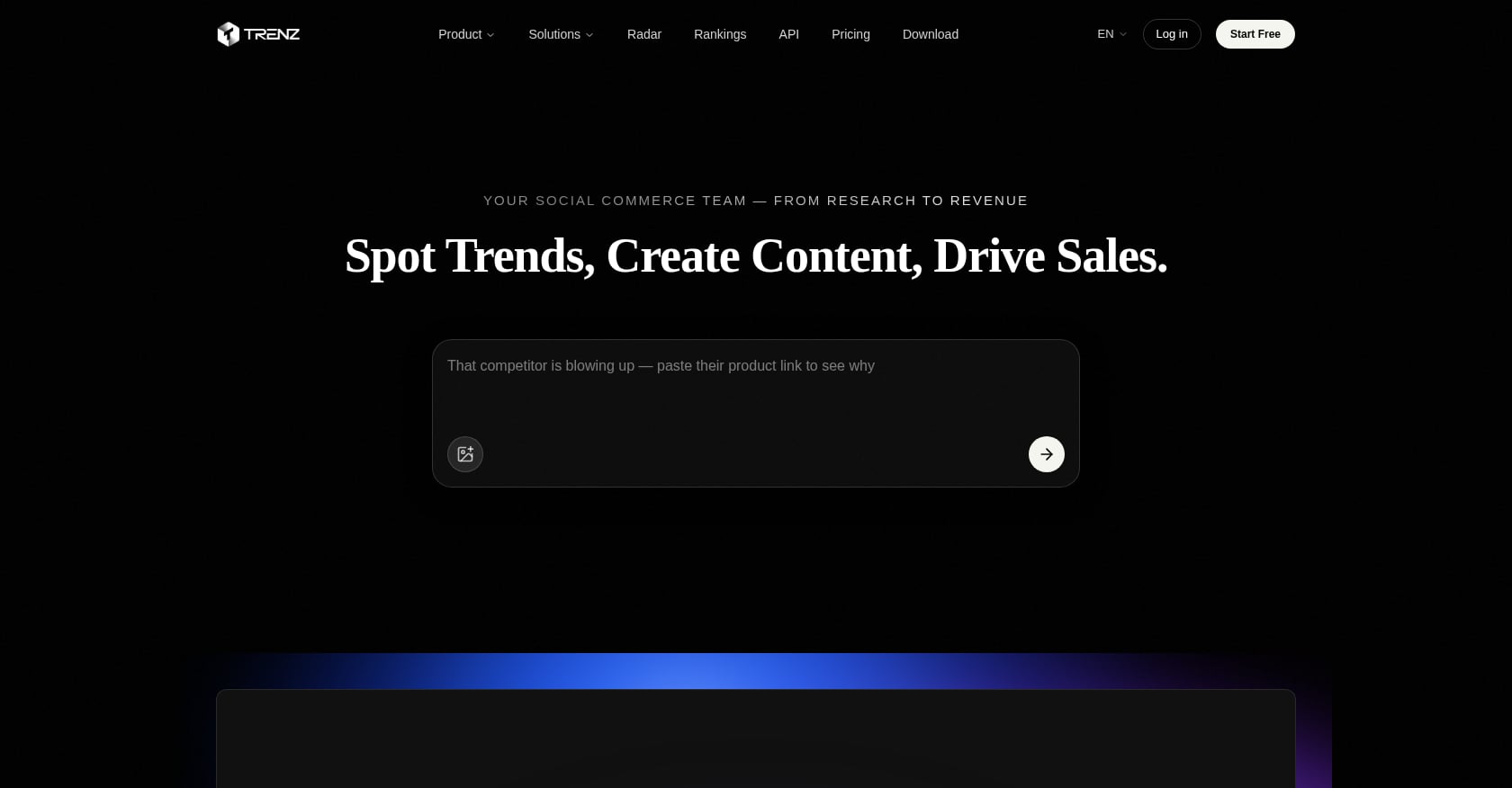
Most comparison pages introduce a third option after walking through Kalodata vs FastMoss, because both tools share a fundamental limitation: they stop at intelligence.
The gap between “I found a trending product” and “I am generating revenue from that product” is where most TikTok Shop sellers stall. That gap includes producing enough creative to test, publishing at the right times, briefing creators with differentiated angles, and measuring what actually drives shop performance.
Trenz is built for this full loop. As an AI social commerce platform, it combines:
Product discovery across TikTok Shop, Amazon, and DTC with Blue Ocean identification, sales spike detection, and seasonal bestseller tracking
Daily Radar delivering five fresh, data-backed opportunities per day with GMV, growth, and creator concentration signals
Monthly TikTok Shop rankings by category and region
AI video, image, and script generation using models like Seedance 2.0, Veo 3.1, and Wan 2.6, plus hook libraries, content angle templates, and AI avatars
Social Manager for scheduling and publishing to TikTok, Instagram, YouTube, and Facebook
Open API exposing TikTok products, shops, creators, videos, ads, and lives data alongside AI content generation and social publishing endpoints
Free plan with 50 welcome credits, no credit card required
The positioning is straightforward: Kalodata and FastMoss help you understand what is happening on TikTok Shop. Trenz helps you act on it.
This matters because, as one Reddit commenter pointed out, tools give you a lot of data but require expertise to interpret and act on. Another user in an older comparison thread mentioned they stopped using analytics tools entirely and built custom reports with SQL. For advanced teams like that, Trenz’s open API offers a middle path: structured data access and AI content generation without another dashboard to learn.
If your team already knows how to turn TikTok Shop data into content, Kalodata or FastMoss may be enough. If the bottleneck is writing hooks, generating videos, publishing at peak times, and tying content back to GMV, Trenz is the more complete workflow.
Which Tool Fits Your Situation
User type | Recommended path | Why |
|---|---|---|
New seller validating TikTok Shop | Free/low-cost research + Seller Center | Do not pay for heavy dashboards before you know your product economics |
Solo seller doing product research | Kalodata or Trenz Free | Kalodata for research only; Trenz if you also need content generation |
Affiliate creator choosing products | Kalodata or FastMoss + Creator Center | Useful for product signals; verify actual commissions in first-party tools |
Brand running creator outreach | FastMoss or Trenz | FastMoss for creator/operator data; Trenz if the team needs briefs, scripts, and publishing |
Agency managing multiple shops | FastMoss or Trenz Scale | FastMoss for dense monitoring; Trenz for multi-account AI workflow |
Content-heavy TikTok Shop seller | Trenz | AI scripts, videos, images, and publishing matter as much as analytics |
Developer or data team | Trenz API | Custom workflows beat another dashboard when you have engineering resources |
Buying Checklist: Test Before You Subscribe
Before paying for any TikTok Shop analytics tool, run this trial test:
Can you find 10 products that are growing but not yet saturated?
Can you see whether growth is creator-concentrated or distributed?
Can you identify 20 creators who match your niche and commission economics?
Can you export or save the data you actually need on the plan you are testing?
Can you validate at least one product against Seller Center, supplier cost, fees, commission, shipping, and returns?
Can you generate 5 to 10 testable creative angles from the data?
Can you publish and measure those tests without switching across five different tools?
Does the tool save enough hours to justify the annual cost?
Does support respond during the trial period?
Does the tool help you act, or does it just create more tabs to check?
If you want to test an end-to-end workflow that covers discovery, creative generation, and publishing, try Trenz product research free with no credit card required.
Final Verdict: Kalodata vs FastMoss
Kalodata is the better choice for clean TikTok Shop product and creator research, especially for beginners and solo sellers. FastMoss is better for advanced users who need deeper operational intelligence, including ads, LIVE tracking, and competitor monitoring.
However, both tools stop at analysis. They help you identify opportunities but not execute them.
For sellers who need to turn insights into content, publishing, and revenue generation, an integrated workflow tool like Trenz fills the gap between discovery and execution.
FAQ
Is Kalodata better than FastMoss?
Kalodata is better for clean, research-first TikTok Shop analysis: products, creators, videos, livestreams, and market trends. FastMoss is better for heavier operator workflows like creator discovery, competitor monitoring, ads, and LIVE analytics. Neither is universally better. The right choice depends on whether your bottleneck is understanding the market or managing ongoing operations across creators, ads, and live commerce.
Is FastMoss more accurate than Kalodata?
Neither should be treated as perfectly accurate. Both are third-party tools that estimate sales from public signals rather than direct account access. Users on Reddit report that both can be “highly inaccurate” for verifying actual sales. Use TikTok Seller Center or Creator Center as the source of truth for your own GMV, commissions, and payouts.
Which is cheaper, Kalodata or FastMoss?
Public sources disagree. Kalodata is commonly cited in the $40 to $100 per month range for standard plans. FastMoss references range from about $29/month to $399/month depending on the source, region, and tier. Verify pricing directly with each tool before subscribing, and pay attention to what is actually included in each plan level.
Do I need both Kalodata and FastMoss?
Most sellers do not. Pick one based on your primary bottleneck: Kalodata for product and market research, FastMoss for creator, ad, and operator workflows. If your real bottleneck is producing and publishing content from your research findings, consider Trenz instead, which covers discovery through execution in one platform.
Can Kalodata or FastMoss track my actual profit?
No. They estimate market-level signals. Actual profit requires your Seller Center data, product costs, shipping, platform fees, returns, creator commissions, discounts, and ad spend. Build a separate margin model and do not rely on any third-party analytics tool for financial reporting.
What is the best alternative to Kalodata and FastMoss?
For sellers who want analytics plus AI content creation, multi-platform publishing, and GMV-aware workflows in one platform, Trenz is the closest alternative. It covers product discovery, AI video and script generation, social scheduling, and TikTok Shop performance measurement. A free plan is available with no credit card required.
Are TikTok Shop analytics tools worth paying for?
It depends on whether you have the expertise and workflow to act on the data. Practitioners on Reddit report that tools save time by centralizing product velocity and competitor data, but they also warn that following trending lists without validating saturation risk, margin math, and creative differentiation can waste more money than the subscription saves. The tool is only as good as the decisions it informs.
Author


