
TL;DR
TikTok Shop is projected to hit $112.2 billion in global GMV in 2026, yet 45% of sellers still can’t track which videos drive sales. The right analytics tool depends on your specific bottleneck. Trenz is the strongest option for sellers who want product discovery, AI content creation, and publishing in one platform. FastMoss and Kalodata lead for market intelligence. Dashboardly and HiveHQ own profit tracking. This guide breaks down all 10 tools by what they actually do, what they cost, and where they fall short.
Explore Trenz free to see the full platform in action.
Best TikTok Shop Analytics Tool in 2026
For most sellers, the best TikTok Shop analytics tool in 2026 is Trenz because it combines product research, creator intelligence, AI content creation, social publishing, and analytics in one platform. Sellers focused solely on competitor research may prefer FastMoss or Kalodata, while those needing profit tracking should consider Dashboardly or HiveHQ.
Quick Recommendations
Need | Best Tool |
|---|---|
All-in-one workflow | Trenz |
Product research | FastMoss |
Beginner-friendly research | Kalodata |
Profit tracking | Dashboardly |
Profit + affiliate management | HiveHQ |
Ad creative analysis | PiPiADS |
Live-stream analytics | EchoTik |
Multi-channel brands | Conjura |
Free analytics | TikTok Seller Center |
Why TikTok Shop Analytics Matter More Than Ever
TikTok Shop generated roughly $64.3 billion in GMV in 2025, nearly doubling from $33.2 billion in 2024. The platform now hosts over 475,000 shops in the US alone, a 5,000% increase from just 4,450 in mid-2023. Short-form video content drives nearly 60% of US TikTok Shop GMV.
These numbers tell one story. The ground-level reality tells another: only 12% of sellers effectively use analytics to convert viral attention into revenue. Meanwhile, 72% of trending TikTok Shop products get copied by competitors within 48 hours. Speed matters. Data matters. But the tool you pick shapes whether you capitalize on that speed or just watch your competitors do it.
The average TikTok Shop operator now juggles three to five separate dashboards just to answer basic performance questions. A typical stack looks something like FastMoss for research, Dashboardly for profit, CapCut for content, Shoplus for creator outreach, and Seller Center for operations. That’s five logins, five billing cycles, and zero connection between what you discover, what you create, and what actually sells.
This guide organizes tools by the job they do, not alphabetically, so you can find the one that fixes your specific problem.
At-a-Glance Comparison Table
Tool | Best For | Starting Price | Data Scope | Free Tier | Content Creation | Publishing |
|---|---|---|---|---|---|---|
Trenz | End-to-end TikTok workflow | Free (50 credits) | 50M+ products, 2M+ creators | Yes | Yes (AI video/image/script) | Yes (multi-platform) |
FastMoss | Market intelligence | $49/mo | 500M+ products, 1,200-day history | 7-day trial | No | No |
Kalodata | Beginner product research | ~$38/mo | 200M+ products, 1,000-day history | 7-day trial | No | No |
PiPiADS | Ad creative spy | $77/mo | 50M+ ads | Limited | No | No |
Shoplus | Budget entry point | ~$49/mo | Hourly trend updates | Limited | No | No |
EchoTik | Live-stream analytics | $9/mo | Live-stream focus | Free trial | No | No |
Dashboardly | Profit tracking | Contact sales | Your own shop data (verified) | Free trial | No | No |
HiveHQ | Profit + affiliate mgmt | Free (250 orders) | Your own shop + affiliate data | Yes | No | No |
Conjura | Cross-platform analytics | Contact sales | TikTok + Shopify + Amazon | Demo | No | No |
Seller Center | Free baseline | Free | First-party only | Yes | No | No |
What TikTok Shop Analytics Actually Means in 2026
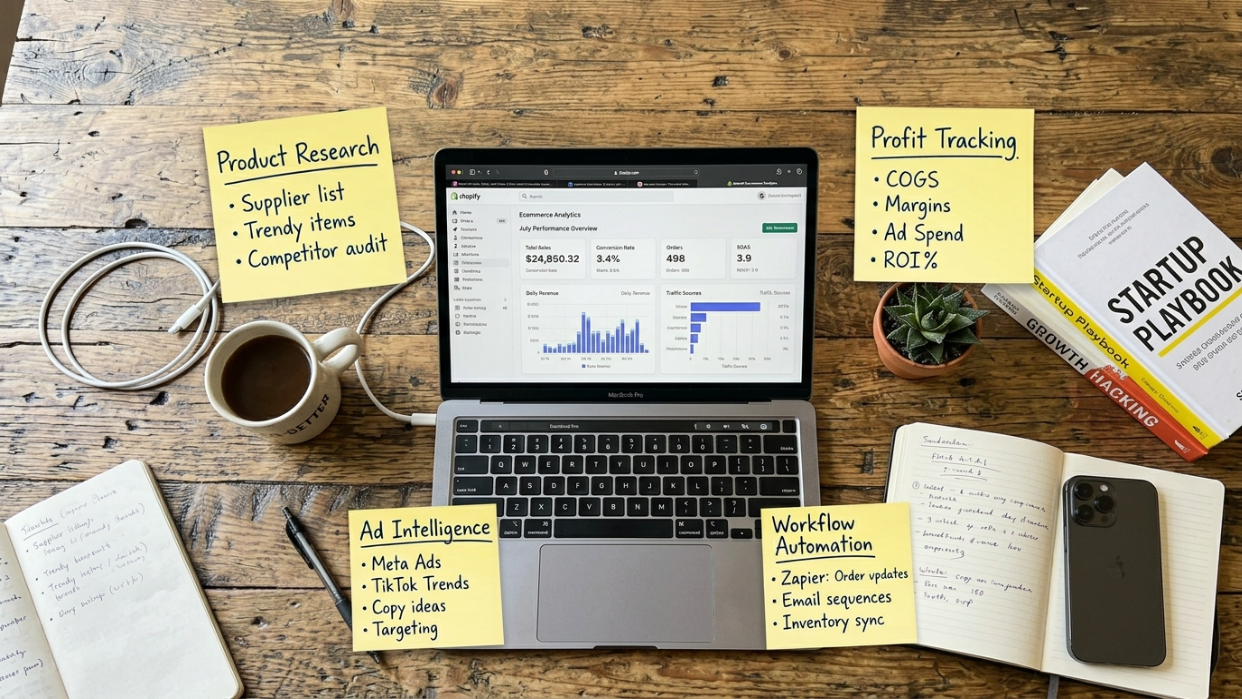
Most articles lump everything under “analytics.” That’s not useful. The tools in this space fall into four distinct categories:
Market intelligence tools (FastMoss, Kalodata) tell you what’s selling across TikTok Shop. They track competitors, surface trending products, and estimate GMV across categories. They answer the question: “What should I sell?”
Profit tracking tools (Dashboardly, HiveHQ) connect to your actual shop data and reconcile fees, refunds, ad spend, and payouts. They answer: “Am I actually making money?”
Ad creative intelligence tools (PiPiADS) show you which ad formats, hooks, and creatives are driving conversions. They answer: “What content patterns work?”
End-to-end workflow platforms combine discovery, content creation, publishing, and performance measurement in one place. This is the category no other roundup identifies, but it’s where the biggest efficiency gains live. Instead of switching between a research tool, a video editor, a scheduler, and an analytics dashboard, everything connects. You can browse the latest TikTok Shop rankings to understand how category-level GMV tracking fits into this workflow.
TikTok’s native Seller Center is free and mandatory, but it only shows what happened inside your shop. It can’t tell you what’s trending in the broader market, which content formats convert best, or what your real net margin is after all fees.
Common Reasons Sellers Use TikTok Shop Analytics Tools
Most sellers purchase analytics software for one of five reasons:
Finding Winning Products
Research tools help identify fast-growing products before they become saturated.
Monitoring Competitors
Track competitor shops, creators, product launches, and estimated sales performance.
Improving Content Performance
Analyze top-performing videos, ads, and livestreams to identify winning creative patterns.
Tracking Profitability
Understand true margins after TikTok fees, shipping, returns, commissions, and advertising costs.
Scaling Creator Programs
Identify affiliates, manage outreach, and measure creator ROI.
1. Trenz
Best for: End-to-end TikTok Shop workflow (discover, create, publish, measure)
Trenz is an AI-native platform that bundles market intelligence, content creation, multi-platform publishing, and analytics under one roof. It’s built around three AI agents: a Market Analyst for product discovery and competitive tracking, a Creative Director for generating videos, images, and scripts, and a Social Manager for scheduling, publishing, and engagement analytics across TikTok, Instagram, YouTube, and Facebook.
Pricing:
Free: 50 welcome credits, no credit card required
Growth: 250 credits/month, 3 social accounts
Pro: 650 credits/month, 10 social accounts, +20% bonus on credit top-ups
Scale: 1,800 credits/month, 50 social accounts, team workspace, $19/seat/month, +50% bonus on top-ups
Credits: $10 = 100 credits. API: $0.15/credit (pay-as-you-go), $0.10/credit (enterprise)
Compare plans in detail on the Trenz pricing page.
Key features:
Daily Radar: Five data-backed product and market opportunities per day with GMV, growth rates, and creator-concentration analysis. Browse today’s Radar picks or dig through the Radar archive for historical trends.
Monthly TikTok Shop Rankings by category and region, with tracked GMV around $408.7 million. See examples like the April 2026 US skincare rankings.
Product Discovery: Blue Ocean opportunities, sales spikes, and seasonal bestsellers across TikTok Shop, Amazon, and DTC, with 50M+ products and 2M+ creators indexed.
AI Content Creation: Generate videos (averaging about 60 seconds) using models like Seedance 2.0, Veo 3.1, and Wan 2.6. Script templates include hooks, angles, and formulas sourced from top-GMV videos.
Social Manager: Schedule and publish to TikTok, Instagram, YouTube, and Facebook from one calendar. Best-time-to-post insights and a unified comments/messages inbox.
Workspace Dashboard: “Today’s Performance” and “Today’s Opportunities” in a single daily operating view.
Open API: A single key for TikTok commerce data, AI content generation, social publishing, and ads management.
Tradeoffs:
TikTok-first platform. Other platforms are supported mainly for publishing, not full commerce data.
Credit-based pricing requires budget awareness. Video generation costs 3 credits per second, which can add up for longer content.
AI video quality depends on underlying third-party models, and availability can vary by region.
Base plan prices for Growth, Pro, and Scale tiers aren’t displayed publicly. You’ll need to test the free plan to estimate all-in spend.
Why it stands out: No other tool in this space connects what you discover to what you create to what you publish to what you measure. The typical TikTok Shop seller runs three to five separate tools. Trenz collapses that into one workflow. For a deeper look at how this compares to research-only platforms, read our breakdown of FastMoss alternatives.
2. FastMoss
Best for: Enterprise-grade market intelligence and competitor tracking
FastMoss is the deepest data tool in the TikTok Shop analytics space. If your main problem is product discovery, competitor mapping, ad tracking, or creator research, and you need maximum coverage, this is where most agencies and advanced operators start.
Pricing:
Basic: $49/month (90-day historical data, 150 daily detail page views)
Pro: $89/month (180-day data, 300 daily views, affiliate automation)
Ultimate: $139/month (1,200-day data, unlimited views)
Enterprise: custom pricing
7-day free trial, no card required
Key features:
Tracks over 500 million products with shop-level insights including total units sold, GMV, and national rankings
28-day product-level analytics and ad performance tracking with views, conversion rates, spend, and ROAS
1,200 days of historical data on the Ultimate plan
Creator Discovery Engine that exports up to 6,000 influencer contacts daily, filtered by region and engagement
Covers TikTok Shop analytics across 19+ countries and regions
Tradeoffs:
Not a profit tool. It tells you what’s selling across TikTok Shop, but it doesn’t connect to your store’s actual fees, ad spend, or refunds. Any profit estimate you build from it is a guess.
The interface can be overwhelming. A TikTok Shop practitioner noted on X: “FastMoss provides more info. It’s quite nice to see more detailed data and filter selections. But navigation is more confusing and I was very overwhelmed in the beginning.”
No mobile app. The website works on mobile but doesn’t offer a dedicated app.
At $139/month for the full dataset, it’s the most expensive research-only option.
Who should skip it: Solo creators doing basic product research. Much of FastMoss’s data granularity will feel like overkill if you’re not running an agency or managing multiple shops.
3. Kalodata
Best for: Beginner-friendly product research with a clean interface
Kalodata was built by former members of TikTok’s global e-commerce division, and the heritage shows. The interface is noticeably cleaner and simpler than FastMoss, making it the easier starting point for sellers who are still learning what TikTok shop analytics metrics matter most.
Pricing:
Subscription plans ranging from $38.30 to $75.00 per month
7-day free trial
Key features:
Tracks 200M+ products with up to 1,000 days of historical data
Influencer analysis and trending product identification
Competitive analysis and category-level market research
Daily model updates for data accuracy improvements
Tradeoffs:
Data accuracy questions persist. A detailed Reddit post in r/TikTokshop raised concerns about metrics not matching actual account performance, including discrepancies in units sold and leaderboard rankings. In some cases, products with reportedly zero sales appeared with significant volume.
Practitioners on Reddit describe the tool as useful but expensive for sellers still testing their first product or operating with limited capital.
Sometimes misses “shadow sales” from private livestreams, reportedly lagging behind EchoTik by 12 to 15% in live-stream GMV accuracy.
Like FastMoss, this is a market intelligence tool, not a profit tracker.
User perspective: Multiple users note that Kalodata has a cleaner UI and is easier to navigate after just a few minutes, making it the better pick for operators who value simplicity over data depth.
4. PiPiADS
Best for: Ad creative intelligence and swipe file building
PiPiADS earns its place if your workflow starts with creative analysis. Some TikTok Shop operators don’t begin with product databases. They begin by asking which hooks, formats, angles, and ad patterns are moving product right now. This is a visual-first tool.
Pricing:
Starter: $77/month
VIP: $155/month
Pro: $263/month (5 users)
Key features:
Library of over 50 million TikTok ads
Access competitors’ ad videos, titles, copy, and linked product pages
Track competitors’ ad spend, impressions, conversions, and orders
Filter by performance metrics to find winning creative patterns
Tradeoffs:
This is not a finance platform. It won’t tell your CFO whether you made money after all costs. PiPiADS can improve testing speed, but it doesn’t replace profit analytics or affiliate management.
No product discovery in the traditional sense. You’re analyzing what’s already running, not finding blue ocean opportunities.
At $77/month minimum, it’s expensive for a single-function tool. Most sellers pair it with a separate research platform.
Best paired with: A market intelligence tool like FastMoss or Kalodata for product validation, plus a profit tracker for financial clarity.
5. Shoplus
Best for: Budget-friendly entry point for new TikTok Shop sellers
Shoplus is the simpler starting point. For many teams, simpler is exactly the right first move. If you’re coming into TikTok Shop from Amazon, Shopify, or agency work, you don’t always need the broadest dataset first. You need a tool that helps you quickly understand products, shops, videos, and influencers without making onboarding feel like a project.
Pricing:
Starting around $49/month
Free tier available
Key features:
Trending product lists, sales estimates, and category analysis
Hourly data updates for timely trend visibility
Basic competitive scanning
Tradeoffs:
User reports mention inconsistent data accuracy, so treat findings as a starting point for ideas rather than a source of truth.
Once your shop reaches meaningful scale, you’ll outgrow it. Most operators eventually need a stronger profit layer and a more serious outreach system.
Limited depth compared to FastMoss or Kalodata.
Best for: New sellers under $1,000 per month in revenue who need basic trend visibility without a heavy financial commitment.
6. EchoTik
Best for: Live-stream analytics and affordable creator scouting
EchoTik is built for competitive intelligence around live shopping. Its core strength is tracking shops, products, creators, and live-stream trends across global markets, with a particular emphasis on settled sales versus intent signals.
Pricing:
$9 to $19/month, making it the most affordable paid option in this list
Key features:
Tracks actual settled sales versus intent signals for more reliable live-stream data
Multi-Platform Influence Score showing how a creator’s reach spreads beyond TikTok
AI Assistant that explains why products trend
Chrome extension for inline browsing insights
Tradeoffs:
Pricing tiers aren’t clearly listed on English marketing pages. Parts of the website mix Chinese and English, which complicates onboarding.
Data stays surface-level. Useful for quick checks, but not deep analysis.
During a Q1 2026 audit of a mid-sized electronics brand, an analytics tool (not specified as EchoTik exclusively, but representative of the category) over-reported competitor GMV by 350%, leading to nearly $40,000 in wasted ad spend. The lesson: don’t make spending decisions based solely on any single third-party estimate.
Best for: Sellers focused on live-stream commerce who want affordable access to creator scouting and live performance data.
7. Dashboardly
Best for: Verified profit tracking and payout reconciliation
Dashboardly is a verified TikTok Shop Partner built specifically for profit analytics at the order and SKU level. The platform pulls data through official APIs, meaning numbers reconcile against actual TikTok payouts rather than estimates.
Pricing: Contact sales for pricing. Free trial available.
Key features:
SKU-level profit tracking with every fee, refund, and payout adjustment matched to individual orders
Fee calculator for accurate margin projections
Multi-store dashboard for operators managing several shops
Agency mode for teams managing client accounts
Tradeoffs:
Not a product discovery or content tool. You’ll need to pair it with a market intelligence platform.
Requires a minimum volume of orders to justify the investment. Most useful once you hit 30+ daily orders.
No content creation or publishing features.
Why it matters: TikTok Shop sellers generated billions in GMV, yet most still can’t answer a basic question: how much profit did I actually make last month? The gap between revenue dashboards and real margins is where money disappears. Dashboardly exists to close that gap.
8. HiveHQ
Best for: Profit analytics combined with affiliate automation
HiveHQ covers two jobs at once: showing you real profit numbers and automating creator outreach. For scaling sellers who need both, this eliminates one tool from the stack.
Pricing:
Free: $0/month for up to 250 orders
Starter: $39/month for up to 1,500 orders
Growth: $99/month for up to 10,000 orders
Pro: $199/month for unlimited orders
Enterprise: $399/month
Key features:
Profit Dashboard that pulls in COGS, ad spend, and affiliate commissions for live shop-level and product-level profitability
Affiliate Bot for automated creator outreach and management
Moves beyond vanity metrics like GMV to show actual net margins
Tradeoffs:
No market intelligence or product discovery features. You still need a research tool.
No content creation capabilities.
The free tier at 250 orders is useful for testing but limits scale.
Best for: Sellers processing 500+ orders monthly who want profit clarity and affiliate management without running two separate platforms.
9. Conjura
Best for: Multi-channel brands needing unified cross-platform analytics
Conjura links TikTok Ads and TikTok Shop into one unified view, then extends that to Shopify and Amazon. If you’re selling across multiple channels and need to understand which platform, which ad, and which SKU is actually profitable, this is the tool.
Pricing: Contact sales for pricing. Demo available.
Key features:
Tracks SKU-level ad spend attribution across TikTok, Meta, and Google
Calculates Contribution Profit by factoring in ad spend, fees, fulfillment costs, and refunds per SKU
Unified view connecting ad spend to customer behavior to product performance
Tradeoffs:
Enterprise-oriented pricing likely puts it out of reach for small sellers.
No product discovery, creator outreach, or content creation features.
Requires significant data volume across channels to deliver meaningful insights.
Best for: Multi-channel brands doing $50,000+ monthly across TikTok, Shopify, and Amazon who need a single source of financial truth.
10. TikTok Seller Center
Best for: Free baseline analytics every seller should use
Seller Center is the starting point, not the finish line. Every TikTok Shop operator uses it because it’s built into the platform, and it does several things well.
Pricing: Free.
Key features:
Separates sales driven by videos, livestreams, and product cards
Compares channel performance against SKU-level outcomes: orders, cancellations, returns, reviews, and complaints
Shows what sold, where demand came from, and where customer experience is breaking
Tradeoffs:
Much less useful for deciding which sales produced healthy margin. The native analytics aren’t built for understanding net profit, just gross revenue.
No competitive intelligence. You can only see your own shop.
No content creation, scheduling, or multi-platform publishing.
No trend identification or product discovery.
Best for: Every seller, as the free foundation. But the moment you need to understand your actual profits or see what competitors are doing, you need a paid tool on top of it.
FastMoss vs Kalodata vs Trenz
Feature | Trenz | FastMoss | Kalodata |
|---|---|---|---|
Product Research | Yes | Yes | Yes |
Creator Discovery | Yes | Yes | Yes |
AI Content Creation | Yes | No | No |
Social Publishing | Yes | No | No |
Competitor Tracking | Yes | Yes | Yes |
Historical Data | Strong | Excellent | Very Good |
Beginner Friendly | High | Medium | High |
Free Plan | Yes | Trial Only | Trial Only |
Best For | Full workflow | Deep research | Simple research |
For sellers who want a complete workflow, Trenz provides the broadest feature set. FastMoss remains the strongest pure research platform, while Kalodata is often preferred by beginners due to its cleaner interface.
How to Choose the Right TikTok Shop Analytics Tool

Stop comparing feature lists. Start with your bottleneck.
If you’re under $1,000/month in revenue: Seller Center plus Shoplus or EchoTik. Keep costs minimal while you validate product-market fit.
If your bottleneck is product research: FastMoss for maximum data depth, or Kalodata for a cleaner interface and lower price. They overlap about 80%, as practitioners frequently note, so pick one.
If you can’t tell whether you’re profitable: Dashboardly for pure profit tracking, or HiveHQ if you also need affiliate automation.
If you sell across TikTok, Shopify, and Amazon: Conjura for unified cross-platform profitability.
If your bottleneck is the whole fragmented workflow: Trenz is the only platform that combines discovery, AI content creation, publishing, and analytics in one place. Instead of paying for three to five separate tools, you get a single workspace. For teams evaluating agency-level solutions, our guide on choosing TikTok Shop agency software goes deeper.
Are TikTok Shop Analytics Tools Worth It?
For most active sellers, the answer is yes.
A single winning product discovery, improved creator partnership, or avoided inventory mistake can often pay for a year of software costs.
Example ROI Scenario
Metric | Without Analytics | With Analytics |
|---|---|---|
Monthly Revenue | $10,000 | $10,000 |
Margin Improvement | — | +5% |
Additional Profit | — | $500/month |
Annual Impact | — | $6,000/year |
Even a modest increase in conversion rates or margin visibility can generate returns far exceeding subscription costs.
A Warning About Data Accuracy
Every TikTok shop analytics tool using third-party data provides estimates, not verified numbers. Jackie, a TikTok Shop agency operator, put it bluntly on X: “It’s impossible to get 100% accurate data unless TikTok Shop comes out with an official analytics tool. Don’t take data you see on both platforms as absolute truth. They are directionally correct but don’t fixate on exact numbers.”
This is the reality that most tool comparison articles soft-pedal. Use market intelligence tools for direction and pattern recognition. Use API-connected profit tools (Dashboardly, HiveHQ) and your Seller Center for financial truth. Never make major spending decisions based on a single third-party estimate.
Frequently Asked Questions
What is TikTok Shop analytics?
TikTok Shop analytics refers to the data and tools used to track product performance, sales trends, competitor activity, creator effectiveness, and profitability on TikTok’s built-in shopping platform. It spans everything from TikTok’s native Seller Center to third-party tools for market intelligence, profit tracking, and content optimization.
Can I use TikTok Shop analytics for free?
Yes. TikTok Seller Center is free for all shops and covers basic sales, traffic, and order data. Trenz offers a free plan with 50 credits. HiveHQ is free for up to 250 orders monthly. Most other tools offer 7-day free trials.
Which TikTok Shop analytics tool is best for beginners?
Kalodata is the easiest to learn for basic product research. Its UI is cleaner and more simplified than alternatives. For a broader starting toolkit that includes content creation and publishing alongside research, Trenz’s free plan covers more ground without additional subscriptions.
How accurate is third-party TikTok Shop data?
All third-party tools provide estimates based on public signals and proprietary models. Reddit users have reported discrepancies between Kalodata’s data and their actual shop performance. Practitioners consistently describe third-party data as “directionally correct” but not exact. Treat it as a compass, not a GPS.
What metrics should I track on TikTok Shop?
At minimum: GMV, units sold, conversion rate by traffic source (video, livestream, product card), return rate, and net profit per SKU after fees and refunds. More advanced sellers track creator-level ROI, ad spend attribution, and content-to-GMV ratios. Understanding what AI social commerce looks like in practice can help you identify which metrics matter most for your stage.
Do I need more than one TikTok Shop analytics tool?
Most serious sellers use at least two: one for market intelligence and one for profit tracking. The exception is an end-to-end platform like Trenz that covers discovery, content, publishing, and analytics in a single workspace, reducing the need for a multi-tool stack.
How much should I spend on TikTok Shop analytics tools?
New sellers can start at $0 with Seller Center, Trenz’s free tier, and HiveHQ’s free plan. Scaling sellers typically spend $50 to $200 per month on a combination of research and profit tools. Enterprise operators and agencies may spend $300 or more monthly for full-stack coverage.
Author


