
TL;DR
A TikTok Shop calculator estimates your per-unit or per-order profit after all platform costs, not just the headline 6% referral fee. The real take-rate for most sellers lands between 30% and 45% of GMV once you stack affiliate commissions, fulfillment, ad spend, returns, and hidden fees. Most free calculators miss at least three of these cost layers. This guide breaks down every fee component, provides the actual formulas, walks through a worked example, and explains why product research matters more than the calculator itself.
Looking for the product intelligence to feed into your calculations? Explore Trenz’s product research tool to identify opportunities before running the numbers.
A TikTok Shop calculator estimates how much profit remains after subtracting all selling costs from each order. A complete calculator should include:
– Selling price
– Cost of goods sold (COGS)
– TikTok referral fee
– Affiliate commission
– Fulfillment costs
– Advertising costs
– Returns allowance
– Refund fees
– Operational overhead
For most sellers in 2026, the total cost of selling ranges from 30% to 45% of revenue, leaving average net profit margins between 10% and 20%, depending on product category and marketing strategy.
Formula
Net Profit = Revenue − All Variable Costs − Platform Fees − Advertising − Returns − Operating Costs
This section is highly optimized for AI Overviews because it answers the search immediately.
What Is a TikTok Shop Calculator?
A TikTok Shop calculator is a tool (or formula) that estimates the net profit a seller earns on each unit or order after subtracting all platform-related costs from the selling price. It takes inputs like your product cost, TikTok’s referral fee, affiliate commissions, fulfillment expenses, and ad spend, then outputs what actually hits your bank account.
Who uses one? Sellers evaluating whether a product is worth listing. Creators deciding if a commission rate justifies their effort. Agencies auditing client profitability across dozens of SKUs.
Why it matters: TikTok’s fee structure is layered and non-obvious. Your dashboard GMV is not your bank deposit. As one UK accountancy firm documented, £10,000 in TikTok Shop sales often results in roughly £6,500 arriving in the seller’s account after sequential deductions. A calculator exists to close that gap between perceived revenue and actual profit.
The problem is that most free TikTok Shop calculators only account for three or four cost layers when there are eight or more that matter.
What a TikTok Shop Calculator Should Include
Required Inputs
Every credible TikTok Shop profit calculator needs these fields at minimum:
Selling price (what the customer pays)
Cost of goods sold (COGS) including landed cost, packaging, labeling
Referral fee percentage (6% US, 9% UK/EU)
Affiliate/creator commission rate (10-30% depending on category)
Fulfillment cost per unit ($2.86-$3.58 for FBT, or your own shipping cost)
Ad spend per unit (allocated from total campaign budget)
Return rate estimate (varies wildly by category)
Inputs Most Calculators Miss
This is where sellers get blindsided. The following costs are real, recurring, and almost never included in free calculator widgets:
Smart Promotion fee: 3.5% of GMV on orders driven through TikTok’s Smart Promotion program (TikTok guarantees a 5x ROI, refunding the fee if not met)
Refund administration fee: 20% of the original referral fee on returned items, capped at $5 per SKU
Settlement delay cost: Standard sellers wait roughly 15 days for payout, flagged accounts up to 31 days. On $50K monthly revenue, that’s real working capital cost.
Content production: $1,500-$10,000/month depending on volume and quality
Sample seeding costs: Free product sent to creators for review
Chargeback fees: $20 per dispute
Alex Pospekhov, founder of TikTok agency Hyperfocus, put it bluntly: “Most sellers discover the real take rate only after their first settlement arrives, by then, pricing assumptions are already baked in.”
The Core Profit Formula
Here’s the formula every TikTok Shop calculator should use:
Net Profit = Selling Price − COGS − Referral Fee − Affiliate Commission − Fulfillment & Shipping − Ad Spend (allocated) − Return Reserve − Operational Overhead
If you want to track real performance after launch, you’ll need analytics that go beyond this formula and capture actual settlement data over time.
TikTok Shop Profit Calculator Formula (Step-by-Step)
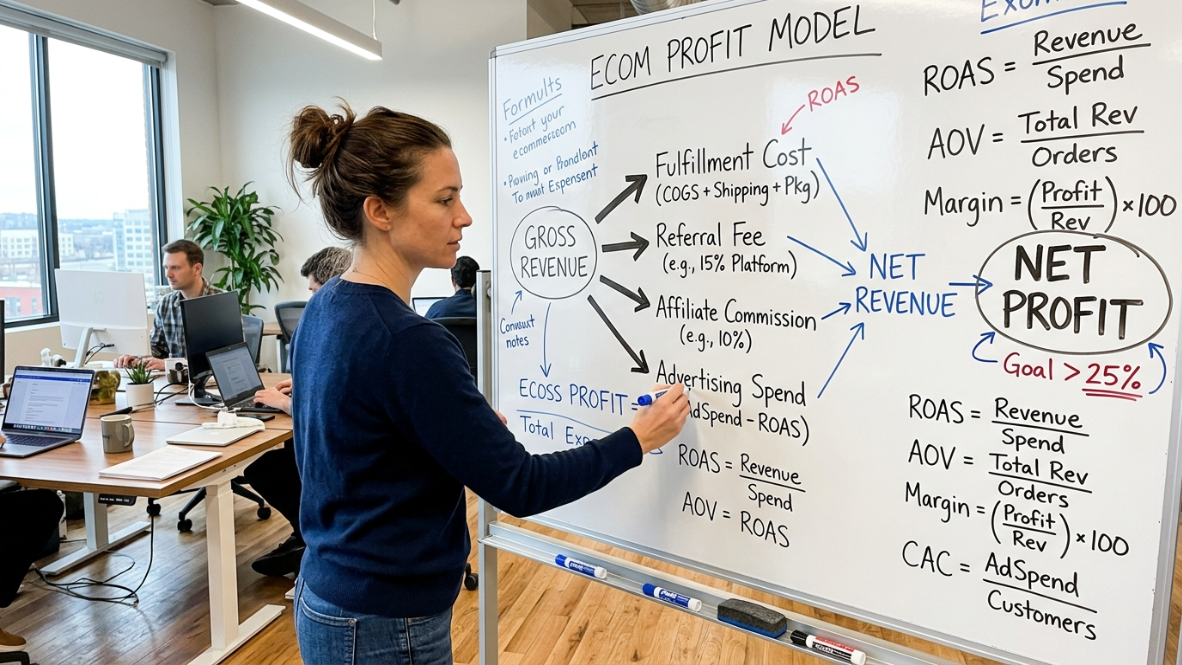
Many sellers know the final formula but not how TikTok actually deducts fees.
The order matters because each deduction changes your remaining profit.
Step 1
Calculate Gross Revenue
Gross Revenue = Selling Price × Number of Orders
Step 2
Subtract Cost of Goods Sold
Gross Profit = Revenue − COGS
Step 3
Subtract TikTok Referral Fee
Referral Fee = Revenue × Referral %
Step 4
Subtract Affiliate Commissions
Affiliate Cost = Revenue × Affiliate %
Step 5
Subtract Fulfillment
Shipping + Packaging + Warehouse
Step 6
Subtract Advertising
TikTok Ads
GMV Max
Creator Spark Ads
Step 7
Subtract Expected Returns
Expected Returns =
Return Rate × Average Refund Cost
Step 8
Subtract Operating Costs
Software
Virtual assistants
Photography
Samples
Returns
Chargebacks
Accounting
This breaks the formula into digestible pieces, which AI systems often cite.
TikTok Shop Fee Quick-Reference Table (2026)
This table reflects current rates as of mid-2026. Rates have changed multiple times, so verify against TikTok Seller Center for your specific market.
Fee Component | United States | United Kingdom | EU (DE, ES, FR, IT, IE) |
|---|---|---|---|
Referral fee (standard) | 6% | 9% | 9% (increased from 5% in Jan 2026) |
New seller promotional rate | 2% (first 90 days) | Varies | Varies |
Payment processing | Included in 6% | Included in 9% | Included in 9% |
Self-fulfillment penalty | None | £0.50 per order | None currently |
FBT fulfillment cost | $2.86-$3.58/unit | Varies by weight/size | Varies by market |
Smart Promotion | 3.5% of GMV (if enrolled) | 3.5% of GMV (if enrolled) | 3.5% of GMV (if enrolled) |
Refund admin fee | 20% of referral fee (max $5) | 20% of referral fee | 20% of referral fee |
A few things worth noting. In the US, the 6% referral fee is a flat, unified rate covering both marketplace commission and payment processing. There is no separate transaction fee on top. Some sources still cite a “6% + 1-3% processing” split, but TikTok consolidated this for US sellers.
For UK sellers, that £0.50 per-order self-fulfillment penalty is a flat fee, not a percentage. On a £10 item, it’s an instant 5% hit to revenue. TikTok designed this to push sellers toward their FBT ecosystem.
The EU commission increase from 5% to 9% in January 2026 caught many European sellers off guard. Check current category rankings to see how this affected product viability across markets.
The Referral Fee Formula (Detail)
TikTok calculates the referral fee as:
Referral Fee = 6% × (Customer Payment + Platform Discount − Tax)
The platform discount component surprises most sellers. When TikTok funds a promotional voucher or co-funded deal, the discount value gets added back into the fee base. TikTok reimburses you for the discount, but still charges 6% on the full pre-discount transaction value.
Total Selling Cost Breakdown
Cost Category | Typical Range |
|---|---|
Referral Fee | 6–9% |
Affiliate Commission | 10–30% |
Fulfillment | 6–12% |
Advertising | 10–25% |
Returns | 2–8% |
Refund Fees | 0.5–2% |
Content Production | 2–10% |
Miscellaneous | 1–5% |
Average Total Selling Cost
30–45% of revenue
Affiliate Commissions: The Cost Most Sellers Underestimate
For most TikTok Shop sellers, affiliate commissions are the single largest expense after cost of goods sold. Yet many TikTok Shop calculators either leave this field optional or default it to zero.
Here are typical commission rates by category:
Category | Typical Affiliate Commission |
|---|---|
Beauty / Skincare | 15-30% |
Fashion / Apparel | 10-15% |
Home & Garden | 12-18% |
Tech / Electronics | 5-10% |
Supplements / Wellness | 15-25% |
Analysis from Napolify found an interesting pattern: most failing shops obsess over TikTok’s 5-6% fee while ignoring the 15-20% they’re bleeding through poorly negotiated affiliate deals.
The math compounds fast. If 60% of your shop’s revenue is affiliate-driven at a 20% commission rate, your effective commission load on those sales is 25-28% (TikTok’s base fee plus the affiliate cut), before fulfillment or ads.
This is exactly why vetting creators before setting commission rates matters. Paying 25% to a creator who drives conversions is very different from paying 25% to one who drives only views.
Which Costs Are Fixed vs Variable?
Fixed Costs | Variable Costs |
|---|---|
Product photography | Referral fee |
Software | Affiliate commission |
Accounting | Ad spend |
Business registration | Shipping |
Product samples | Returns |
Insurance | Packaging |
Worked Example: $35 Beauty Product (US vs. UK)
Let’s walk through a realistic TikTok Shop calculator scenario for a $35 beauty product sold through the affiliate model.
US Calculation
Line Item | Amount | % of Price |
|---|---|---|
Selling price | $35.00 | 100% |
COGS (landed) | −$8.00 | 22.9% |
Referral fee (6%) | −$2.10 | 6.0% |
Affiliate commission (20%) | −$7.00 | 20.0% |
FBT fulfillment | −$3.20 | 9.1% |
Ad spend (allocated, 15% of price) | −$5.25 | 15.0% |
Return reserve (18% return rate × COGS+shipping) | −$2.02 | 5.8% |
Net profit | $7.43 | 21.2% |
That $7.43 looks reasonable until you remember it doesn’t include content production costs, sample seeding, or the refund administration fee on those returns. Factor those in and you’re closer to $5-6 net, or about 15-17%.
UK Calculation (Same Product at £28)
Line Item | Amount | % of Price |
|---|---|---|
Selling price | £28.00 | 100% |
COGS (landed) | −£6.50 | 23.2% |
Referral fee (9%) | −£2.52 | 9.0% |
Self-fulfillment penalty | −£0.50 | 1.8% |
Affiliate commission (20%) | −£5.60 | 20.0% |
Shipping (self-fulfilled) | −£3.50 | 12.5% |
Ad spend (15%) | −£4.20 | 15.0% |
Return reserve (18%) | −£1.80 | 6.4% |
Net profit | £3.38 | 12.1% |
The 3-percentage-point commission difference between US and UK, combined with the £0.50 self-ship penalty, cuts net margin nearly in half. This is why running the TikTok Shop calculator for each market separately is not optional.
Break-Even Selling Price Formula
Sometimes sellers don’t want to know profit.
They want to know:
“What price do I need to charge?”
Formula
Break-even Price
=
Total Costs ÷ (1 − Referral Fee % − Affiliate %)
Example
COGS = $10
Shipping = $4
Ads = $5
Affiliate = 20%
Referral = 6%
Break-even price
≈ $25.64
Anything below that loses money.
Profit Margin by Product Category
Category | Typical Net Margin |
|---|---|
Beauty | 15–25% |
Supplements | 18–30% |
Electronics | 8–15% |
Fashion | 10–18% |
Home Products | 15–25% |
Pet Products | 18–28% |
Realistic Profit Margin Benchmarks
How does your calculator output compare to what sellers actually earn?
Industry-wide average net margin: approximately 18.4% based on Q1 2026 Top 10 US seller data
New sellers (realistic range): 10-20% after all costs
Sellers driving organic traffic (own TikTok videos, no affiliates): 35-39% net margins
Sellers at $50K/month: margins often compress to 6-10% due to heavy ad spend
Sellers at $500K/month: margins recover to 25-35% as product costs drop, shipping rates improve, and creators approach them
That compression curve is worth understanding. Practitioners report that margins actually get worse before they get better as you scale. At mid-range revenue, you’re spending heavily on ads and affiliates to grow, but you haven’t hit the volume thresholds that unlock cost savings. Many sellers quit during this compression phase, right before the economics would have improved.
Darkroom Agency, which manages growth brands on TikTok Shop, recommends that TikTok Shop makes sense primarily for products with 60%+ gross margins and strong short-form video demonstration potential (beauty, fashion, home gadgets, wellness).
Common Mistakes When Using a TikTok Shop Calculator
1. Pricing Based on the Promotional Rate
New US sellers get a 2% referral rate for the first 90 days. This is a trap if you build your pricing around it. When the standard 6% kicks in, a product that looked profitable at 2% suddenly isn’t. Always model at the standard rate.
2. Ignoring Affiliate Commissions Entirely
Z MEDIA, a UK-based TikTok agency, has audited over 500 seller accounts and found the average operator underestimates total fees by 25-30%. The affiliate commission is almost always the gap.
3. Using Reported GMV Max ROAS as Your Ad-Cost Input
This is a subtle but expensive mistake. TikTok Shop’s GMV Max ad product reports ROAS numbers that, according to Trendio’s analysis, can drop from a reported 2.5x to approximately 1.2x once attribution adjustments are made. That’s a 50% decrease. If you plug the reported ROAS into your calculator to estimate ad cost per unit, you’ll dramatically underestimate your actual spend.
4. Not Accounting for Category-Specific Return Rates
Return rates vary enormously:
Category | Typical Return Rate |
|---|---|
Beauty / Skincare | 15-30% |
Fashion / Apparel | 20-30% |
Supplements | 8-15% |
Home Goods | 10-18% |
Electronics | 8-12% |
A TikTok Shop calculator that uses a flat 5% return rate across all categories will produce dangerously optimistic numbers for fashion and beauty sellers.
5. Treating the Calculator as a One-Time Exercise
Fees change. TikTok increased EU rates from 5% to 9% in January 2026. FBT pricing shifts. Your affiliate commission structure evolves. Re-run your calculations quarterly at minimum. For ongoing tracking, analytics tools that connect directly to your shop data can automate this.
Calculator vs Product Research
Calculator Answers | Product Research Answers |
|---|---|
Is this profitable? | Will people buy it? |
Expected margin | Demand |
Break-even price | Competition |
Net profit | Sales velocity |
ROI | Market saturation |
Why Product Research Comes Before the Calculator
A TikTok Shop calculator tells you whether the numbers work. It does not tell you whether the opportunity exists.
This distinction matters because sellers frequently run their calculator on trending products, see healthy margins on paper, and then launch into a category with 500 competing sellers and saturated creator coverage. The unit economics looked great. The market dynamics made profitability impossible.
The correct workflow is: identify the opportunity first, then validate the math.
That means understanding creator concentration (are three creators driving 80% of a category’s GMV, or is it distributed?), sales velocity trends (is the product accelerating or plateauing?), and competitive density. You can find winning products by looking for Blue Ocean opportunities where demand exists but seller competition is still low.
Then, and only then, run the calculator. If the numbers work on a product with genuine market opportunity, you have a viable business. If the numbers work on a product everyone is already selling, you have a race to the bottom.
For sellers evaluating multiple product ideas, product validation frameworks can help you filter before committing inventory dollars.
The Margin Compression Curve
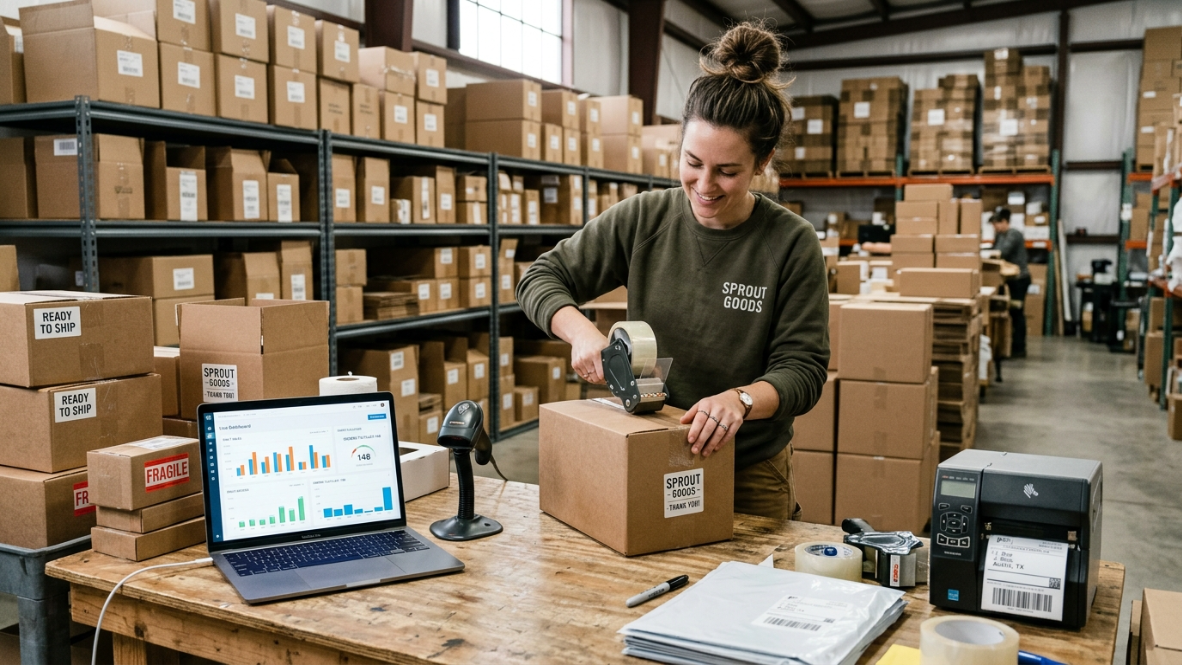
One pattern worth understanding before you rely on any TikTok Shop calculator output: margins are not static across revenue levels.
At low volume ($5K-$10K/month), margins can look decent because you’re doing much of the work yourself, fulfilling orders, creating content, managing affiliates manually. Your time isn’t showing up as a line item.
At mid-range volume ($50K/month), margins compress to 6-10%. You’re now spending $10,000+ monthly on TikTok ads. You’re paying for content production. Creator management takes time or money. This is where most sellers either quit or get stuck.
At high volume ($500K+/month), the economics flip. Product costs drop with volume. Shipping rates improve. Creators approach you instead of requiring heavy outreach and high commissions. Margins recover to 25-35%.
The takeaway: your TikTok Shop calculator should model not just your current unit economics, but your target unit economics at scale. If the numbers don’t work at $50K/month, you need to know that before you invest in getting there.
TikTok Shop Market Context (2026)
For context on why this calculation matters: TikTok Shop US sales are expected to reach $23.41 billion in 2026, a 48% year-over-year increase according to EMARKETER’s June 2026 outlook. The platform is growing fast, which means both opportunity and competition are increasing simultaneously.
Getting your unit economics right from day one is no longer optional. The promotional-rate window that gave early sellers breathing room is now well understood, and the sellers who succeed in 2026 are the ones who priced for profitability at standard rates from the start.
Ready to identify products worth calculating on? Start with Trenz’s product discovery to find opportunities with the right margin profile before committing inventory.
Key Takeaways
TikTok referral fees are only one part of total selling costs.
Most sellers spend 30–45% of revenue on combined platform and operating expenses.
Affiliate commissions often exceed referral fees.
Product category heavily influences returns and profitability.
Run calculations using the standard referral rate, not promotional rates.
Update your calculations whenever TikTok changes fees.
Frequently Asked Questions
What is TikTok Shop’s referral fee in 2026?
In the US, TikTok Shop charges a flat 6% referral fee on most product categories, with select jewelry items at 5%. This fee includes payment processing. In the UK and EU (Germany, Spain, France, Italy, Ireland), the rate is 9%. New US sellers receive a promotional 2% rate for the first 90 days.
Does TikTok Shop charge a separate transaction or payment processing fee?
For US sellers, no. The 6% referral fee is a unified charge covering both the marketplace commission and payment processing. Some older sources still list a separate 1-3% processing fee, but TikTok consolidated this into the single referral fee for the US market.
How do I factor affiliate commissions into a TikTok Shop calculator?
Multiply your selling price by the commission rate you’ve set for affiliates. Beauty products typically run 15-30%, fashion 10-15%, and tech 5-10%. If affiliates drive the majority of your sales, this becomes your largest variable cost after COGS. Always calculate your blended rate across all sales channels (affiliate-driven vs. organic).
What’s a healthy profit margin for TikTok Shop?
The industry-wide average is roughly 18.4%. New sellers realistically land between 10-20% net margin. Sellers who drive traffic through their own organic content and bypass the affiliate network can achieve 35-39%. If your calculator shows anything above 25% for an affiliate-driven model, double-check that you haven’t missed a cost layer.
How often should I recalculate my TikTok Shop margins?
Quarterly at minimum. TikTok has changed fee structures multiple times, EU rates jumped from 5% to 9% in January 2026, FBT pricing fluctuates, and your affiliate commission rates evolve as you negotiate with creators. Treat your TikTok Shop calculator as a living document, not a one-time exercise.
What is the £0.50 self-fulfillment penalty in the UK?
UK sellers who fulfill orders themselves (rather than using Fulfilled by TikTok) pay a flat £0.50 fee on every single order. This is not a percentage, so it disproportionately impacts low-priced items. On a £10 product, it represents a 5% revenue hit before any other fees are calculated.
Why does my TikTok Shop payout seem lower than expected?
TikTok applies fees in a specific, sequential order: referral fee, then affiliate commission, then fulfillment charges, then any promotional fees and refund administration costs. Each deduction reduces the base for the next. The result is that your actual payout is often 35-45% less than your headline GMV. A proper TikTok Shop calculator accounts for all these layers rather than just the referral fee.
Does product choice affect calculator accuracy?
Absolutely. A calculator is only as good as the inputs you feed it, and category-specific variables like return rates, typical affiliate commission ranges, and content production costs vary dramatically. A supplement with an 8% return rate and a fashion item with a 25% return rate will produce completely different margin profiles even at the same price point. This is why researching product viability before running the numbers is the recommended workflow.
Author


