
TL;DR
The best AI social media tools for agencies fall into two categories: AI-native platforms that generate content, analyze markets, and publish from one place, and AI-assisted schedulers that bolt lighter AI features onto traditional scheduling. For agencies managing TikTok Shop clients, Trenz stands alone with product-to-GMV attribution. For enterprise governance, Hootsuite leads. For budget-conscious multi-client shops, SocialPilot offers the best value. This guide covers 9 tools with real pricing modeled at agency scale, honest tradeoffs, and a decision framework to match the right tool to your workflow.
The social media management market hit $40.24 billion in 2026 and is growing at a 25.35% CAGR, on track to reach $160 billion by 2032. That growth is driven almost entirely by AI adoption: 96% of social media managers now use AI tools daily, according to recent industry surveys.
But here’s the problem most “best of” lists ignore. There’s a widening gap between two types of tools, and agencies picking the wrong category waste thousands of dollars annually.
AI-native platforms start from artificial intelligence and build scheduling around it. They generate video, images, and scripts. They analyze markets, discover products, and connect content performance to actual revenue. AI-assisted schedulers are traditional calendar tools that added GPT-powered caption suggestions. Same price range, completely different value. As one practitioner analysis from Apaya put it, “AI-first tools at $59 to $109 per month are replacing the work a $1,500 to $3,000/month freelancer does. Traditional scheduling tools at $99 to $199 per month are replacing a calendar and a spreadsheet.”
This distinction matters more than any feature comparison table. It should shape how agencies evaluate every tool on this list.
Explore Trenz’s agency solutions to see how an AI-native approach works for multi-client teams.
What are the best AI social media tools for agencies in 2026?
The best AI social media tools for agencies in 2026 fall into two categories: AI-native platforms and AI-assisted schedulers. AI-native tools like Trenz and ContentStudio generate content, analyze markets, and connect posts to business outcomes like revenue. AI-assisted tools like Hootsuite, Sprout Social, and Buffer focus on scheduling, analytics, and workflow automation with lighter AI features.
Best overall tools by use case:
– Best for TikTok Shop & social commerce: Trenz
– Best for enterprise governance: Hootsuite
– Best for analytics & reporting: Sprout Social
– Best budget agency tool: SocialPilot
– Best white-label solution: Sendible
Agencies should choose based on account volume, reporting needs, and whether they require content-to-revenue attribution.
Quick Decision Summary: Which AI Social Media Tool Should You Choose?
If you only have 30 seconds, use this breakdown:
Best tool by agency type:
TikTok Shop / social commerce agencies → Trenz
Enterprise / compliance-heavy clients → Hootsuite or Sprinklr
Data-driven reporting agencies → Sprout Social
White-label client service agencies → Sendible
Budget multi-client agencies → SocialPilot
Freelancers / micro-agencies → Buffer
Engagement-heavy community management → Agorapulse
Key decision rule:
If you can’t connect content to revenue, you’re only measuring engagement—not business impact.
At-a-Glance Comparison Table
Tool | Starting Price | AI Depth | Best For | Max Social Accounts | G2 Rating | Key Limitation |
|---|---|---|---|---|---|---|
Trenz | Free (50 credits) | Deep (video, image, script, market intel) | TikTok Shop / social commerce agencies | 50 (Scale) | N/A (new) | TikTok-first; credit model needs budgeting |
ContentStudio | $25/mo | Medium (AI writer, content curation) | Content-heavy agencies | 50 | 4.6/5 | AI credits run out fast |
Hootsuite | $199/mo | Medium (captions, social listening) | Enterprise governance + listening | Scales with plan | 4.2/5 | Per-channel pricing adds up |
Sprout Social | $79/seat/mo | Medium (sentiment, reporting) | Analytics-focused agencies | Varies | 4.4/5 | Per-seat model is expensive at scale |
SocialPilot | $30/mo | Light (AI captions) | Budget multi-client agencies | 50 (Ultimate) | 4.5/5 | $4/account overage charges |
Buffer | $5/channel/mo | Light (GPT-4 captions) | Freelancers, micro-agencies | Unlimited (Team) | 4.3/5 | No listening, limited analytics |
Sendible | $29/mo | Light | White-label agencies | Scales with plan | 4.2/5 | Slower support |
Agorapulse | $69/user/mo | Light-Medium | Engagement-first agencies | 10+ | 4.7/5 | Per-user pricing punishes larger teams |
Sprinklr | Custom | Deep (enterprise) | Global enterprise agencies | Unlimited | 4.3/5 | Overkill for most agencies |
What Makes an AI Social Media Tool “Agency-Ready”?
Not every social media tool is built for agencies, even if the marketing page says otherwise. Agency workflows have specific requirements that solo-user tools simply don’t address. Before evaluating individual platforms, here’s what to look for:
Multi-brand workspace separation. Every client needs its own walled-off environment. Content, analytics, and team permissions should never bleed across accounts.
White-label reporting. Clients expect reports with your agency’s branding, not a SaaS company’s logo. Some tools charge extra for this. Others don’t offer it at all.
Client approval workflows. The ability to send draft posts for client review without forcing them to create an account saves hours of back-and-forth emails.
Scalable seat and account pricing. This is where agencies get burned. A tool that costs $79/month for one user can cost $1,596/month for a four-person team. Always model the real number.
Content-to-revenue attribution. For agencies managing commerce brands (especially on TikTok Shop), connecting a piece of content to actual sales is the difference between proving ROI and guessing at it. Learn more about how cross-platform content intelligence works in practice.
API access. Agencies building custom client dashboards or integrating tools into existing tech stacks need open APIs, not locked-down platforms.
Pricing Reality Check: What Agencies Actually Pay
Most pricing pages understate real agency costs. The actual spend depends on seats, accounts, and overages.
Real monthly cost factors:
Per-seat pricing (Sprout Social, Agorapulse)
Per-channel pricing (Buffer, SocialPilot)
Account overages (SocialPilot, Hootsuite)
Enterprise add-ons (listening, reporting, API access)
Example: real vs advertised pricing
Tool | Advertised Price | Real Agency Cost (10 clients) |
|---|---|---|
Buffer | $5/channel | $200–$600+ |
SocialPilot | $30–$100 | $100–$250 |
Hootsuite | $99 | $249–$500+ |
Sprout Social | $79/seat | $600–$1,500+ |
Takeaway: Pricing scales non-linearly—always model based on accounts × users, not base plan.
Feature Gap Analysis: Why Most Tools Fail Agencies
Most AI social media tools fail agencies in three critical areas:
1. No revenue attribution
Most tools only measure:
Likes
Comments
Reach
They do NOT measure:
Sales generated
ROAS from content
TikTok Shop GMV impact
2. Weak multi-client architecture
Agencies need:
Isolated client workspaces
Role-based permissions
Cross-client reporting
Many tools only support single-brand workflows.
3. AI is not workflow-integrated
Most “AI features” are:
Caption generators
Post suggestions
They are NOT:
Content creation systems
Market intelligence engines
Autonomous publishing workflows
Result: Agencies still rely on manual workflows even with “AI tools.”
Best AI-Native Tools
These platforms were built with AI at the core. Content generation, market analysis, and publishing operate as parts of one integrated system.
1. Trenz
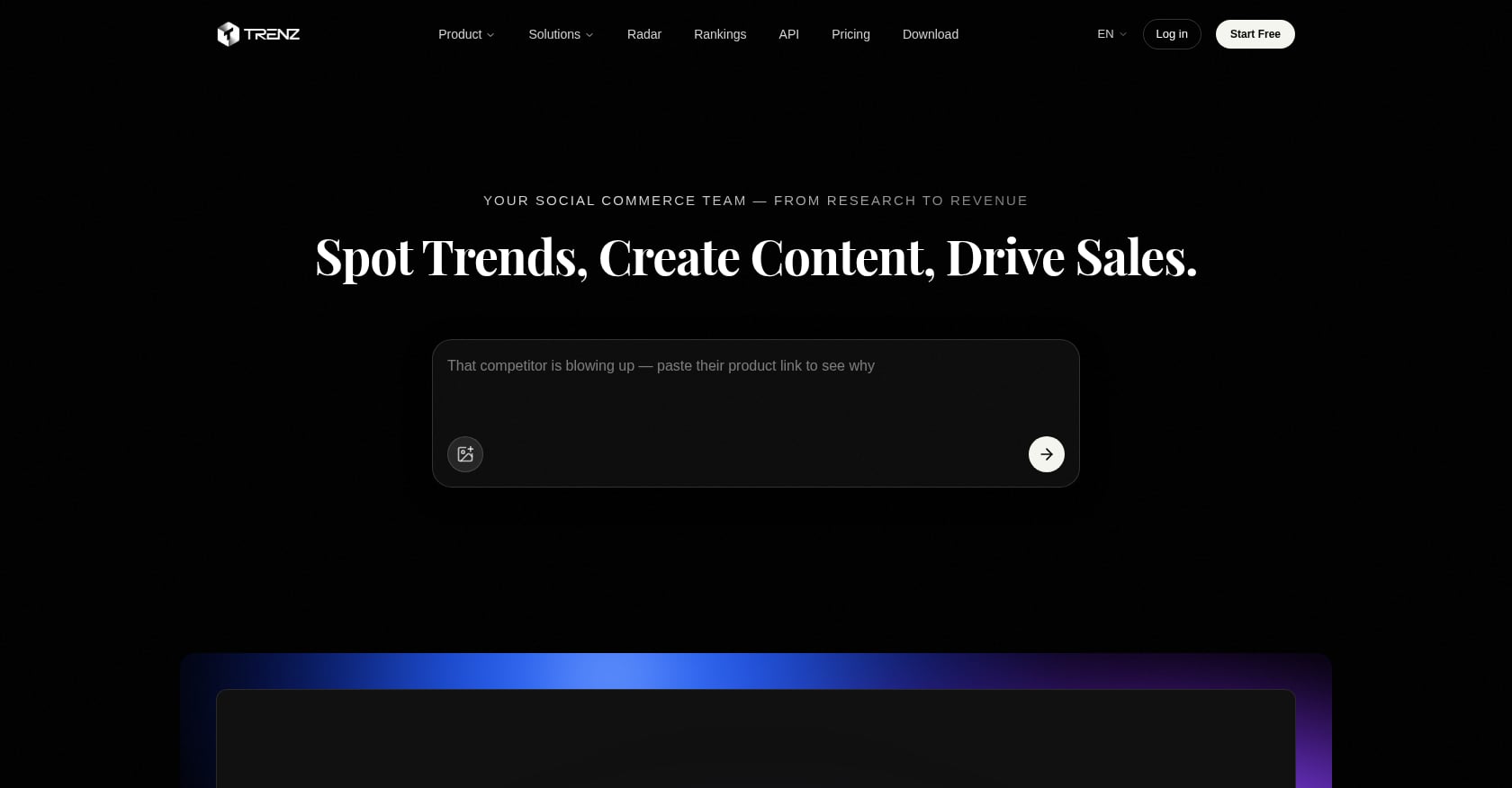
Best for: Agencies managing TikTok Shop and social commerce clients who need product intelligence, AI content creation, and cross-platform publishing in a single pipeline.
Pricing:
Free: 50 welcome credits, 1 social account, no credit card required
Growth: 250 credits/month, 3 social accounts
Pro: 650 credits/month, 10 social accounts, +20% bonus on top-ups
Scale: 1,800 credits/month (shared pool), 50 social accounts, team workspace, $19/seat/month
Credits: $10 = 100 credits; purchased credits never expire
See the full pricing breakdown for credit costs per task.
Key features:
Three AI agents working together: Market Analyst (product discovery across TikTok Shop, Amazon, and DTC), Creative Director (AI video, image, and script generation using Seedance 2.0, Veo 3.1, and Wan 2.6 models), and Social Manager (schedule and publish to TikTok, Instagram, YouTube, and Facebook)
Daily Radar delivering five data-backed product opportunities per day with GMV, growth rates, and creator concentration metrics
Monthly TikTok Shop Rankings by category and region, with approximately $408.7M in GMV tracked. You can browse current category rankings to see what’s actually selling.
Open API indexing 50M+ TikTok products and 2M+ creators, with average video generation time around 60 seconds
Credit-based billing with transparent per-output costs (1 credit per image, 3 credits/second for video, approximately 10 credits for product discovery)
Why agencies choose it:
The Scale plan’s 50 social accounts and team workspace handle most mid-size agency rosters without per-channel surcharges. The Open API lets agencies build custom client dashboards. Most importantly, the content-to-GMV attribution is something no other tool in this category provides. If you’re managing brands that sell on TikTok Shop, this connection between content and commerce is the whole game.
Tradeoffs:
Deepest value is concentrated in TikTok Shop workflows. Other platforms are supported for publishing and analytics but don’t get the same commerce data depth.
The credit model requires upfront budgeting. Video generation at 3 credits per second adds up for longer content. A 30-second video costs roughly 90 credits.
AI video quality depends on third-party models, and availability can vary by region.
Base plan prices for Growth, Pro, and Scale aren’t prominently displayed on the website; you see credit allocations and features instead.
Who should skip it: Agencies with zero social commerce clients who only need basic scheduling and reporting.
2. ContentStudio
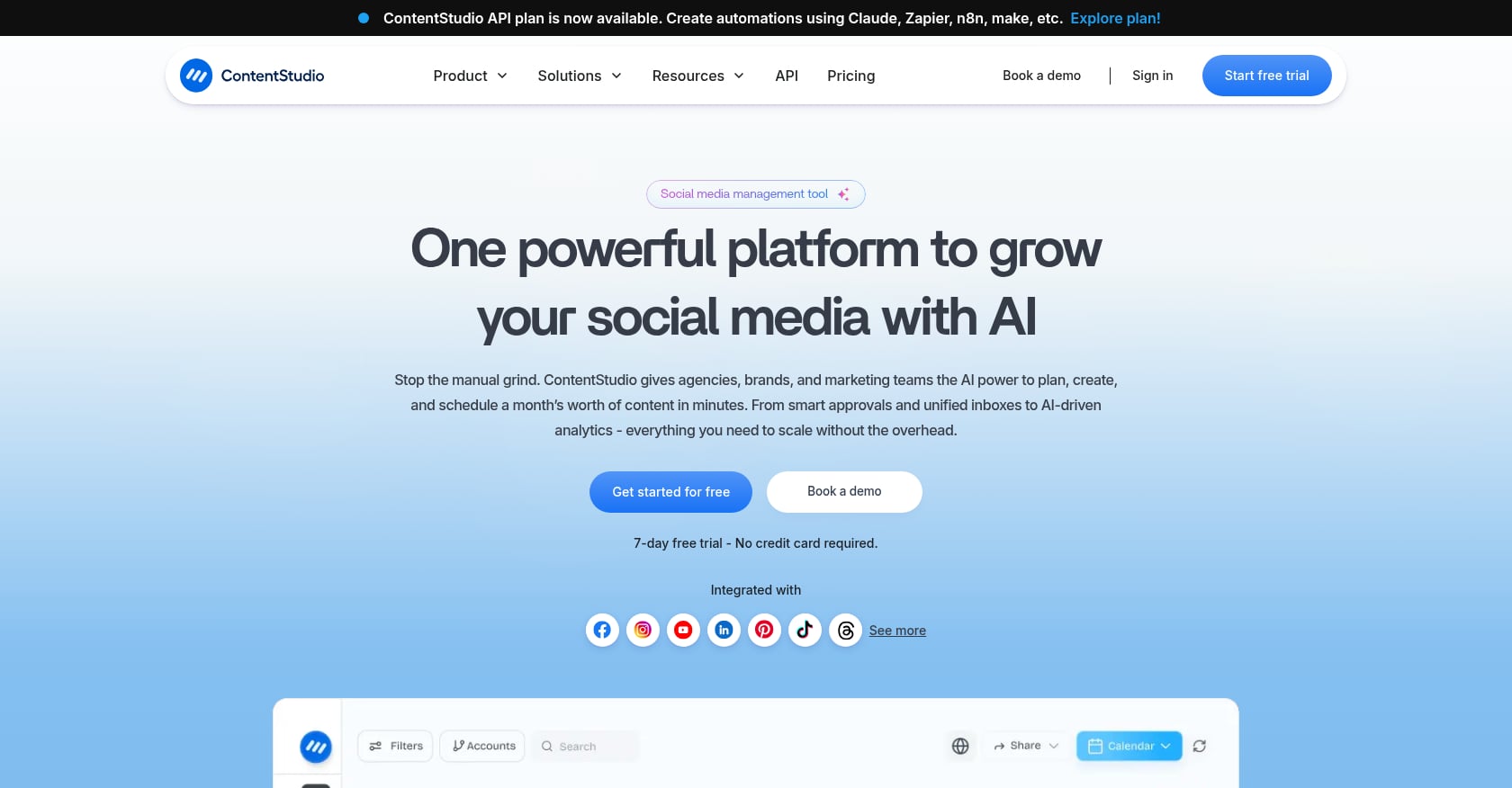
Best for: Content-heavy agencies that need content discovery and curation bundled with scheduling and automation.
Pricing:
Entry-level: $25/month
Agency plan: $99/month (5 users, 25 accounts, white-label reports)
Key features:
Content discovery engine that surfaces trending topics and articles for curation, a feature most competitors charge extra for or don’t include
Automation Recipes that automatically recycle top-performing evergreen content on a schedule
AI writer for captions, blog intros, and social copy
White-label reporting included on Agency plan
Why agencies choose it:
ContentStudio bundles discovery with scheduling in a way that reduces the need for separate tools like BuzzSumo or Feedly. The Automation Recipes feature is genuinely useful for agencies managing content calendars across many clients. Multiple G2 reviewers note the platform “offers several features for the money I pay,” with some specifically mentioning they switched from Buffer.
Tradeoffs:
“AI credits run out fast. Wish there was an unlimited option” is a common complaint on Capterra reviews
25 social accounts on the Agency plan may be tight for larger agencies
No social commerce or TikTok Shop integration
Content discovery is strong, but the AI writing quality is average compared to dedicated AI writing tools
Best AI-Assisted Schedulers
These tools started as scheduling platforms and added AI features over time. They tend to have more mature calendaring, approval workflows, and integrations, but their AI capabilities are narrower.
1. Hootsuite
Best for: Mid-market and enterprise agencies needing mature governance, social listening, and ad management in one platform.
Pricing:
Professional: $99/month (1 user, 10 social accounts)
Team: $249/month (3 users, 20 accounts)
Per-seat pricing on higher tiers
Both Hootsuite and Sprout Social start at $199/month on annual billing for comparable tiers
Key features:
OwlyWriter AI for caption generation and Blue Silk AI for sentiment analysis and posting-time optimization
Full Talkwalker social listening integrated into the dashboard following Hootsuite’s 2024 acquisition
Paid social ad management alongside organic publishing
Governed environment with role-based permissions suitable for compliance-heavy industries
Why agencies choose it:
The social listening bundled into paid tiers is the headline differentiator. Sprout Social charges approximately $999/month extra for comparable listening capabilities. For agencies selling listening and sentiment analysis as a service, this pricing gap is significant. The Team plan at $249/month for 3 users and 20 accounts is genuinely competitive for small agencies.
Tradeoffs:
Per-channel pricing means agencies managing dozens of client profiles need to model costs carefully before committing
No native social commerce or TikTok Shop integration
The platform has repositioned toward enterprise, and the interface reflects that complexity
Smaller agencies may find the learning curve steeper than necessary for basic scheduling needs
Real-world perspective: Practitioners on forums note that Hootsuite has essentially become an enterprise platform with pricing to match. The $99/month entry point gets you in the door, but most agencies will land at $249/month or higher once they add the users and accounts they actually need.
2. Sprout Social
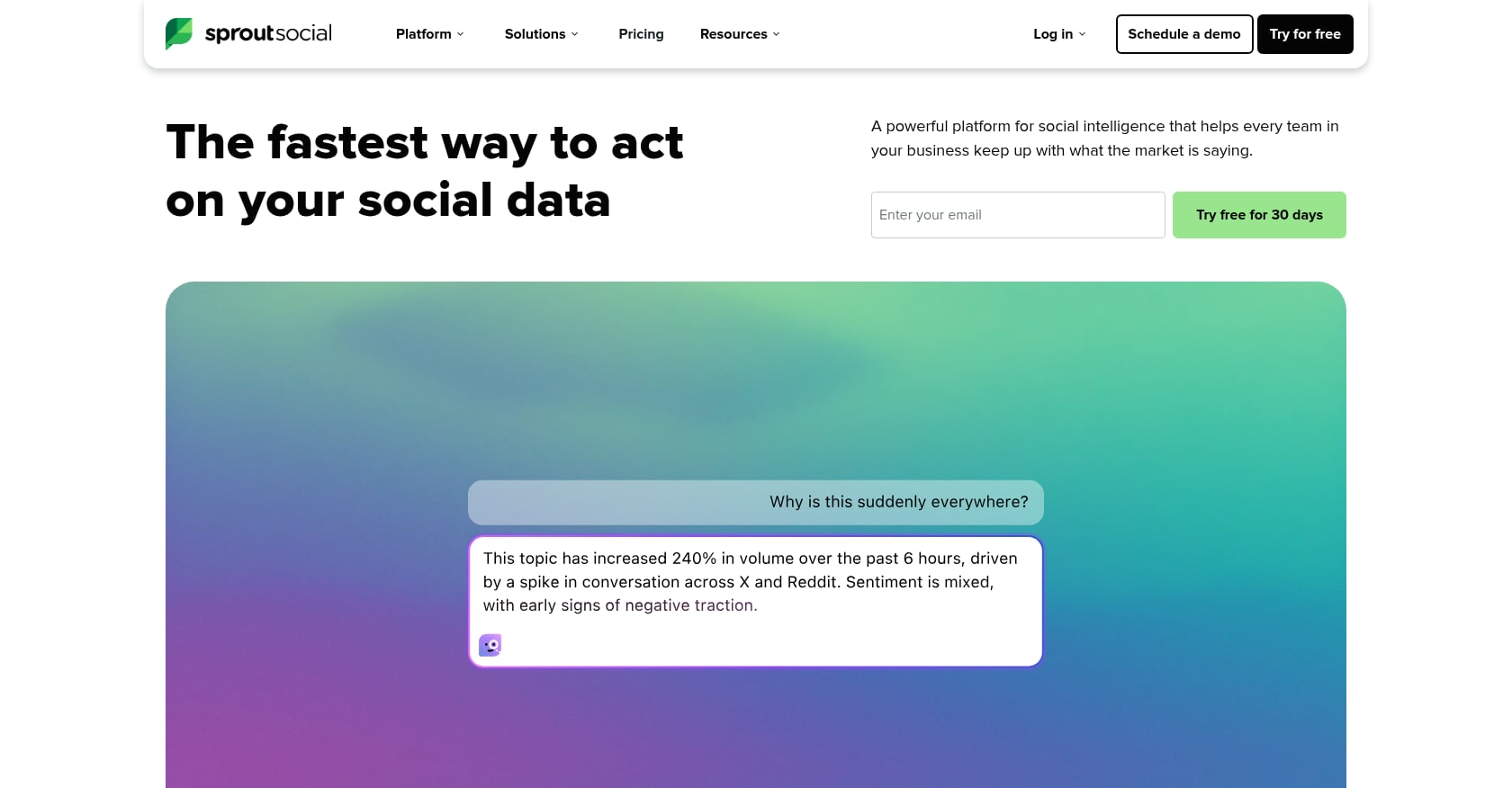
Best for: Agencies that sell premium analytics and need client-ready reporting out of the box.
Pricing:
Standard: $79/seat/month (on G2 data, plans range up to $399/seat)
Every team member needs their own seat
A four-person team on Professional: $1,596/month, not the $399 listed on the pricing page
Key features:
AI Assist providing real-time sentiment analysis across mentions and messages
Automated response suggestions for customer service workflows
Reporting automation that turns engagement data into executive-ready insights without manual formatting
Smart Inbox that unifies messages across all connected platforms
Why agencies choose it:
The reporting is best in class. If your agency’s value proposition includes delivering polished analytics decks to clients, Sprout’s output requires the least manual cleanup. The Smart Inbox is also strong for agencies handling community management.
Tradeoffs:
The per-seat pricing model is the most frequently cited concern in G2 reviews. Small businesses, nonprofits, and solo marketers regularly describe it as steep.
Social listening and premium analytics are add-ons with significant additional costs
No TikTok Shop commerce data or content-to-revenue attribution
Several G2 users note they switched to or considered Hootsuite or Buffer specifically for cost savings
3. SocialPilot
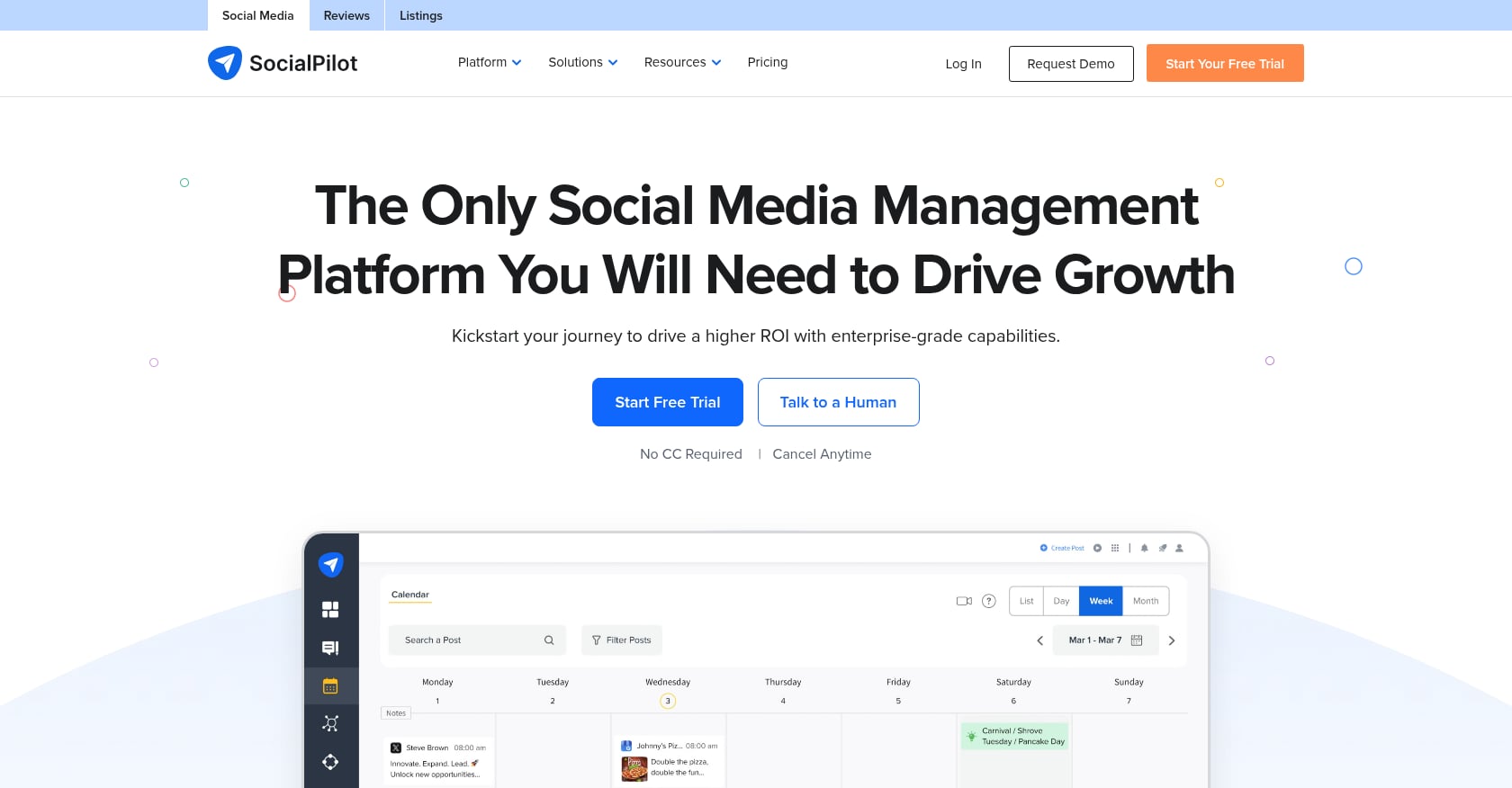
Best for: Budget-conscious agencies that need white-label reports and client approval workflows without enterprise pricing.
Pricing:
Essentials: $30/month
Standard: $50/month
Premium: $100/month (best for growing agencies)
Ultimate: $200/month (50 accounts)
Key features:
Client approval process using personalized shareable links, no sign-ups required from the client side
White-label reports on Premium and above
Bulk scheduling for high-volume content calendars
AI-powered caption suggestions
Why agencies choose it:
SocialPilot is clearly designed with agencies as the primary customer. The approval workflow compiles everything a client needs to review on a single screen, accessible through a direct link. One TrustRadius reviewer summarized the appeal: “Some are simply too expensive nowadays but SocialPilot is still one of the best competitors when it comes to price.”
Tradeoffs:
The Premium plan at $100/month includes only 25 social accounts. Additional accounts cost $4 each per month. For agencies managing multiple clients with several profiles each, these overages accumulate quickly.
AI capabilities are limited to caption generation, nothing for video, images, or market analysis
No social listening
Reporting depth falls short of Sprout Social or Hootsuite
4. Buffer
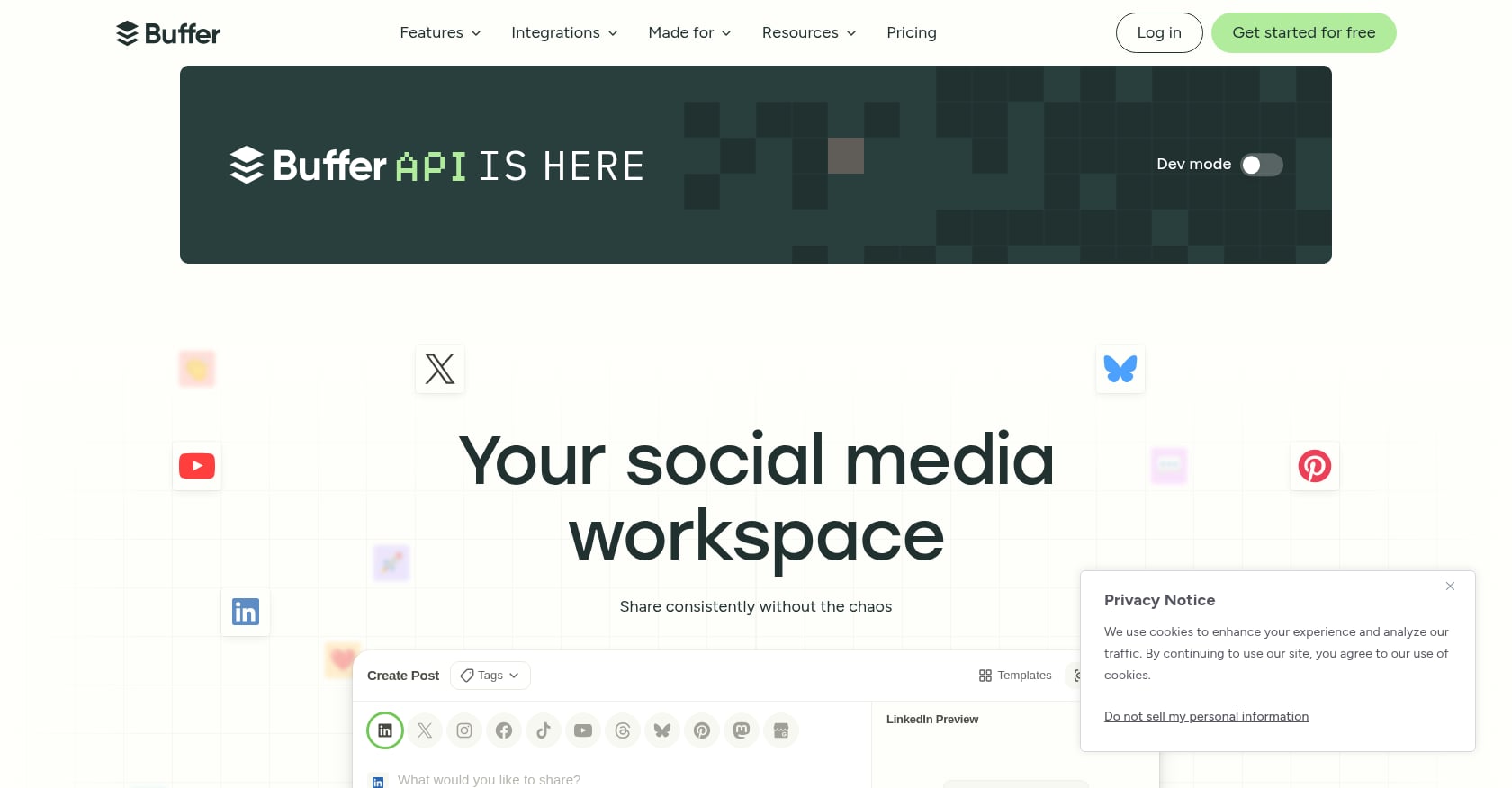
Best for: Solo freelancers and micro-agencies managing fewer than 10 channels who prioritize simplicity.
Pricing:
Free: 3 channels, 10 scheduled posts each
Essentials: $5/month per channel (unlimited scheduling, advanced analytics)
Team: $10/month per channel (unlimited users, approval workflows, custom permissions)
Volume discounts kick in above 10 channels (up to 63% reduction per channel)
Key features:
GPT-4 powered caption suggestions
Clean, minimal interface with near-zero learning curve
Unlimited users on Team plan (rare at this price point)
Per-channel pricing model that rewards small and punishes large
Why some agencies use it:
Buffer works for small agencies managing a limited number of client accounts. The December 2025 restructure consolidated agency features into the Team plan, and volume discounts help at moderate scale. A 30-client agency pays roughly $4,550/year.
Tradeoffs:
No separate Agency tier exists anymore
Per-channel pricing becomes expensive with multiple clients; there’s a crossover point where flat-rate tools cost less
No social listening, no advanced analytics, no client management features
No social commerce capabilities
Agencies outgrow Buffer quickly, and migration is always painful
5. Sendible
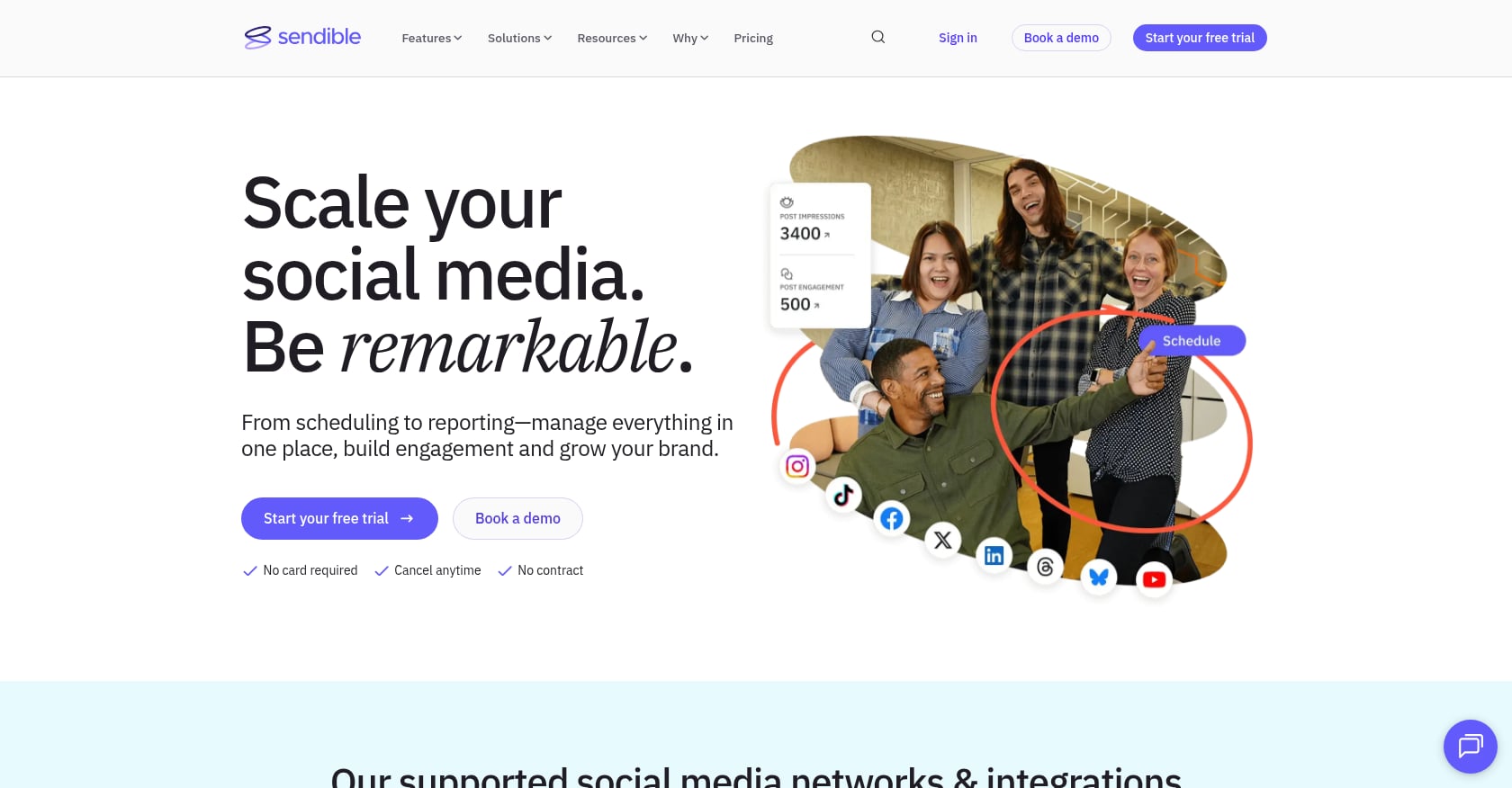
Best for: White-label-focused agencies that need branded client dashboards and reports at a reasonable price.
Pricing:
Starter: $29/month
Scale: $199/month (7 users)
Key features:
Strongest white-label feature set in this category, including branded dashboards, reports, and client portals
Content calendar with drag-and-drop simplicity
Integration with Canva for in-platform design
Decent range of social platform connections
Why agencies choose it:
If white-labeling is a core requirement and budget matters, Sendible is the clear winner. Agorapulse, its closest competitor on features, has no white-label options at all. For a team of 2 to 4 people, Sendible’s Traction plan at $89/month is significantly cheaper than Agorapulse’s per-user model ($196/month for 4 Standard users).
Tradeoffs:
Customer support relies heavily on email, with slower response times compared to competitors like Agorapulse
AI features are minimal, basically caption assistance
Analytics depth doesn’t compete with Sprout Social or Hootsuite
No social commerce integration
6. Agorapulse
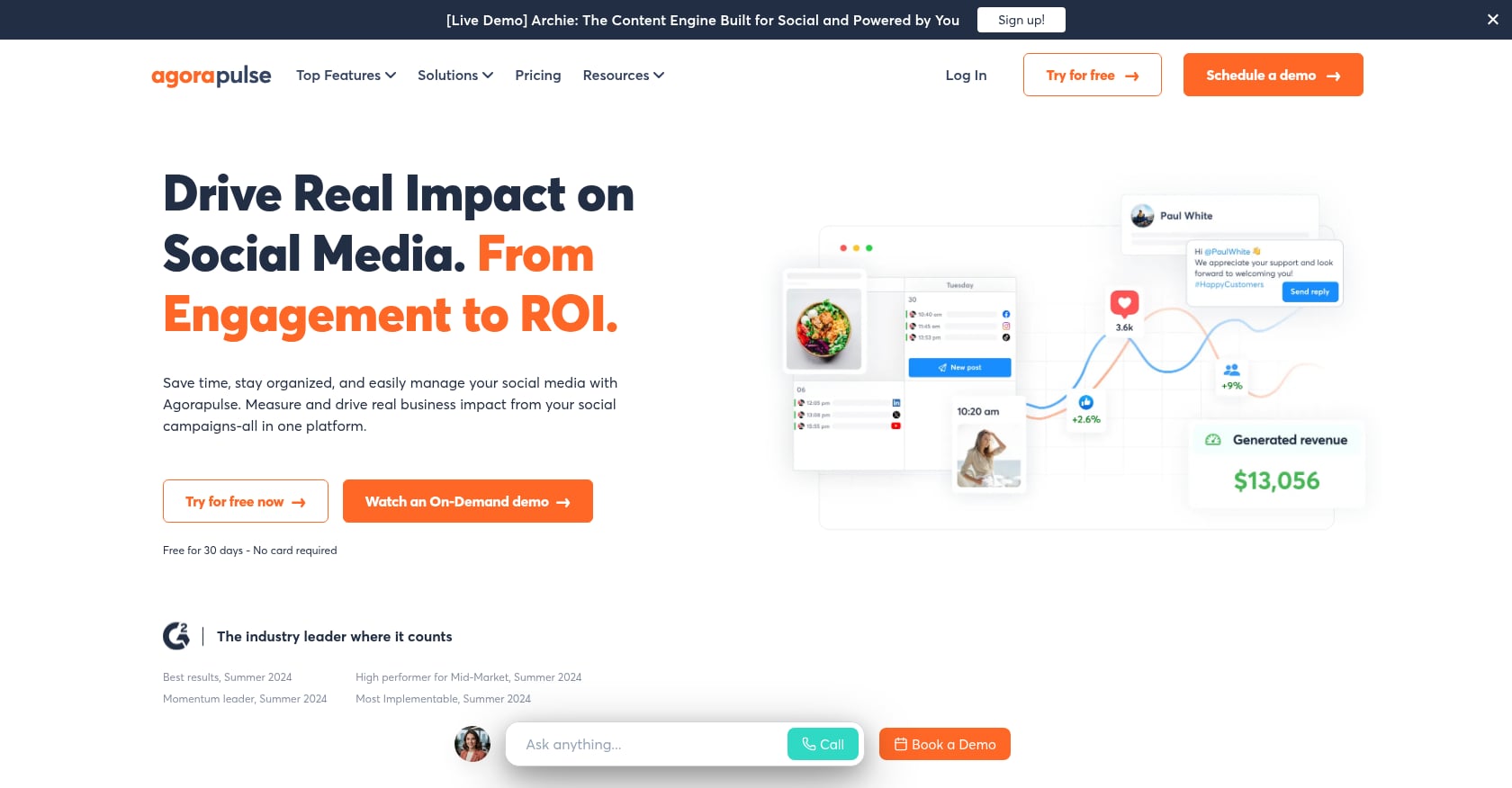
Best for: Community managers and engagement-first agencies where inbox management is the top priority.
Pricing:
Standard: $69/month per user
Plans range up to $149/month per user
Per-user pricing on all tiers
Key features:
Industry-leading zero-inbox workflow for managing comments, messages, and mentions across all platforms
Automated inbox rules and saved replies for common interactions
ROI reporting connecting social activity to website conversions
Highest G2 ratings in 29 out of 41 social media management categories
Why agencies choose it:
The inbox is genuinely the best in the market. For agencies whose clients generate high volumes of comments and DMs (restaurants, retail, entertainment), the time savings from Agorapulse’s inbox workflow justify the premium. At $69/month per user, it’s not cheap, but multiple reviewers on G2 say it justifies the cost through pure efficiency gains.
Tradeoffs:
Per-user pricing makes it 2 to 3 times more expensive than Sendible for teams of 4+
No white-label options
No social commerce or TikTok Shop integration
Overkill if your agency’s clients don’t generate heavy engagement volume
7. Sprinklr
Best for: Enterprise agencies with governance, compliance, and global-scale requirements.
Key features:
Full customer experience management suite with social as one module
Social listening, competitive benchmarking, social advertising, and conversational commerce
Enterprise-grade governance and role-based access controls
Global-scale deployment across hundreds of brands and regions
Pricing: Custom only. Expect enterprise contract minimums.
Tradeoffs:
Out of budget and scope for small-to-mid agencies
Implementation timelines measured in months, not days
The breadth of the platform means most agencies use only a fraction of it
This is an honorable mention, not a recommendation for most readers of this guide
Recommended Agency Tool Stacks (By Scenario)
Stack 1: TikTok Shop Growth Agency
Trenz (content + GMV attribution)
Canva (design support)
Google Sheets (reporting backup)
Stack 2: Full-Service Social Media Agency
Hootsuite (publishing + listening)
Sprout Social (reporting)
Buffer (light scheduling overflow)
Stack 3: Budget Multi-Client Agency
SocialPilot (core scheduler)
ContentStudio (content discovery)
Canva (creative)
Stack 4: White-Label Agency
Sendible (client dashboards)
Google Looker Studio (reporting)
Buffer (backup scheduling)
The Social Commerce Gap No Other Guide Covers
Here’s something missing from every other list of the best AI social media tools for agencies: social commerce.
TikTok Shop’s US quarterly GMV exceeded $4.5 billion recently, a 125% increase over the prior quarter. Social commerce-driven Cyber Monday purchases rose 56% year over year. Agencies managing brands that sell through TikTok Shop, Instagram Shopping, or similar channels need tools that connect content performance to actual revenue.
None of the legacy schedulers, not Hootsuite, Sprout Social, Buffer, or SocialPilot, provide this. They measure likes, comments, shares, and reach. They don’t tell you which video generated $14,000 in GMV last Tuesday.
This is where AI-native platforms built for commerce diverge from general-purpose schedulers. For agencies with TikTok Shop clients, the workflow needs to start with product discovery (what should we sell?), move through content creation (what video will convert?), include publishing, and end with revenue attribution (did it work?).
Trenz’s AI social commerce platform is purpose-built for this end-to-end flow. The Market Analyst agent scans products across TikTok Shop, Amazon, and DTC to find opportunities. The Creative Director generates video, images, and scripts. The Social Manager publishes and measures GMV impact. It’s a single pipeline where most agencies currently stitch together four or five separate tools.
For agencies curious about what’s actually trending on TikTok Shop right now, the Daily Radar insights offer a good starting point.
How to Choose: Agency Decision Framework
Forget feature checklists for a moment. The right tool depends on three questions.
Question 1: How many total social accounts do you manage?
Multiply clients by profiles per client. A 10-client agency with 3 profiles each (TikTok, Instagram, Facebook) manages 30 accounts. Now model the real cost:
Tool | Cost for 30 Accounts (approximate) |
|---|---|
SocialPilot (Ultimate) | $200/mo |
Sendible (Scale) | $199/mo |
ContentStudio (Agency) | $99/mo (25 accounts, then overage) |
Hootsuite (Team) | $249/mo (20 accounts, need to upgrade) |
Buffer (Team) | ~$300/mo at volume discount |
Sprout Social (3 users) | $747/mo minimum |
Trenz (Scale, 2 seats) | Scale plan + $38/mo for seats |
The per-seat and per-channel models that look cheap on a pricing page rarely stay cheap at agency scale.
Question 2: Do your clients sell through social commerce?
If yes, you need content-to-revenue attribution. The only tool on this list with native TikTok Shop GMV tracking is Trenz. If your clients sell through social channels and you can’t prove ROI in revenue terms, you’re vulnerable to budget cuts. Read more about TikTok Shop analytics and how attribution works in practice.
Question 3: What does your agency actually deliver?
Content creation at volume? Trenz or ContentStudio
Community management and engagement? Agorapulse
Premium reporting and analytics? Sprout Social
Social listening and brand monitoring? Hootsuite
White-label everything? Sendible
Just scheduling on a budget? SocialPilot or Buffer
Agency practitioners on forums and LinkedIn consistently make this point: the biggest mistake is buying the tool with the most features instead of the tool that fits your delivery model. An engagement-focused agency using Sprout Social is paying for analytics it doesn’t monetize. A commerce agency using Buffer is missing the entire revenue attribution layer.
The Rise of Agentic AI in Agency Workflows
One more trend worth understanding as you evaluate the best AI social media tools for agencies in 2026: agentic AI.
An agentic tool doesn’t just suggest captions when you click a button. It creates content, posts it at optimal times, engages with comments, monitors performance, and adapts the strategy, all without a human clicking buttons for each step. As one agency-focused analysis from Conbersa described it, “Agencies can manage 50 or more client accounts across TikTok, Instagram Reels, YouTube Shorts, and Reddit without proportionally growing their team. Each AI agent operates a client account like a dedicated social media manager would.”
The economics shift fundamentally. The average social media manager spends over 6 hours per week just switching between platforms, according to Guideflow research. Multiply that by each client account, and the time cost for agencies is staggering. Agentic AI doesn’t just save a few minutes on caption writing. It compresses entire workflows.
Trenz’s three-agent architecture (Market Analyst, Creative Director, Social Manager coordinated by an orchestrator called “Trenzer”) represents this agentic approach. Most of the AI-assisted schedulers on this list are still in the “click a button, get a caption” phase.
Agency Buyer Checklist for AI Social Media Tools
Before choosing a tool, verify:
Does it support multi-client workspaces?
Can it scale beyond 20+ accounts without major cost jumps?
Does it include AI content generation beyond captions?
Can it automate scheduling and approvals?
Does it offer white-label reporting?
Does it track ROI or revenue impact (not just engagement)?
Does pricing scale per seat, per channel, or flat?
If more than 2 answers are “no,” the tool is likely not agency-ready.
FAQ
What is the best free AI social media tool for agencies?
Trenz offers a free plan with 50 welcome credits, 1 social account, and access to its full AI agent stack (no credit card required). Buffer’s free plan supports 3 channels with 10 scheduled posts each but includes minimal AI. For agencies specifically, the Trenz free tier is more useful for testing AI-native workflows, while Buffer’s free plan works for basic scheduling tests.
How much should an agency spend on social media tools per client?
Most agencies budget between $15 and $50 per client per month on tools, depending on scope. A 10-client agency on SocialPilot’s Ultimate plan pays $20/client/month. On Sprout Social with 3 seats, that jumps to $75/client/month. Model the total cost at your actual account and seat count, not the starting price on the website.
Can AI tools replace a social media manager at an agency?
Not entirely, but they’re compressing the work. AI-first tools at $59 to $109/month are handling tasks that previously required a $1,500 to $3,000/month freelancer, according to practitioner analyses. The strategic thinking, client relationships, and crisis management still need humans. The repetitive content production, scheduling, and basic reporting increasingly don’t.
What’s the difference between AI-native and AI-assisted social media tools?
AI-native tools (Trenz, ContentStudio with automation) generate content, analyze markets, and optimize publishing from the ground up using AI. AI-assisted schedulers (Hootsuite, Buffer, SocialPilot) are traditional calendar-based tools that added AI caption suggestions as a feature. The distinction matters because AI-native tools can replace multiple point solutions, while AI-assisted schedulers mainly replace a spreadsheet and a timer.
Do any social media tools track TikTok Shop GMV?
Among the tools covered in this guide, only Trenz provides native TikTok Shop GMV tracking and content-to-commerce attribution. The legacy schedulers track engagement metrics (likes, shares, comments) but don’t connect content performance to actual sales revenue. For agencies managing commerce brands, this is a critical gap.
What AI features actually matter for agency social media management?
Focus on three capabilities: AI content generation (not just captions, but video, images, and scripts), AI-powered analytics (sentiment analysis, performance prediction, optimal timing), and workflow automation (approval flows, publishing sequences, content recycling). Caption generation alone doesn’t justify an AI premium over basic scheduling tools.
Is white-label reporting available on all social media tools?
No. Sendible and SocialPilot offer white-label reporting on mid-tier plans. ContentStudio includes it on the Agency plan. Agorapulse has no white-label options. Sprout Social and Hootsuite offer limited branding customization on enterprise tiers. If white-labeling is non-negotiable, narrow your shortlist to Sendible, SocialPilot, or ContentStudio before evaluating anything else.
How do I evaluate AI social media tools for an agency managing TikTok Shop clients?
Start with whether the tool provides TikTok Shop product research, creator analytics, and GMV attribution. Then check if it supports AI video generation (critical for short-form commerce content). Finally, verify it can publish to TikTok alongside other platforms. Most tools fail on the first requirement.
Choosing among the best AI social media tools for agencies comes down to matching your delivery model to the right platform category. If you manage commerce brands selling on TikTok Shop, explore Trenz’s agency solutions to see how product intelligence, AI content creation, and GMV attribution work in a single workflow. The free plan requires no credit card and gives you 50 credits to test the full agent stack.
Author


