
TL;DR
A TikTok Shop agency SOP is a documented, repeatable process that agencies use to manage every aspect of a brand’s TikTok Shop, from creator recruitment and sample seeding to daily Seller Center operations and compliance. Agencies need SOPs across at least seven categories to scale without chaos. The brands that win on TikTok Shop aren’t the most creative; they’re the most operationally disciplined. This guide maps every SOP type, the metrics each should track, and how automation is reshaping the playbook.
A TikTok Shop agency SOP is a documented system that standardizes how an agency manages creator recruitment, sample logistics, Seller Center operations, reporting, compliance, and campaign optimization. Most successful agencies organize their SOPs into seven core workflows that reduce operational errors, improve creator activation, and scale TikTok Shop management without increasing headcount.
The seven essential TikTok Shop agency SOPs are:
– Creator discovery and vetting
– Creator onboarding and briefing
– Sample seeding and logistics
– Content production and quality control
– Seller Center operations
– Performance reporting
– Compliance monitoring
Agencies should review these SOPs quarterly as TikTok Shop policies, automation tools, and platform features continue evolving.
What Is a TikTok Shop Agency SOP?
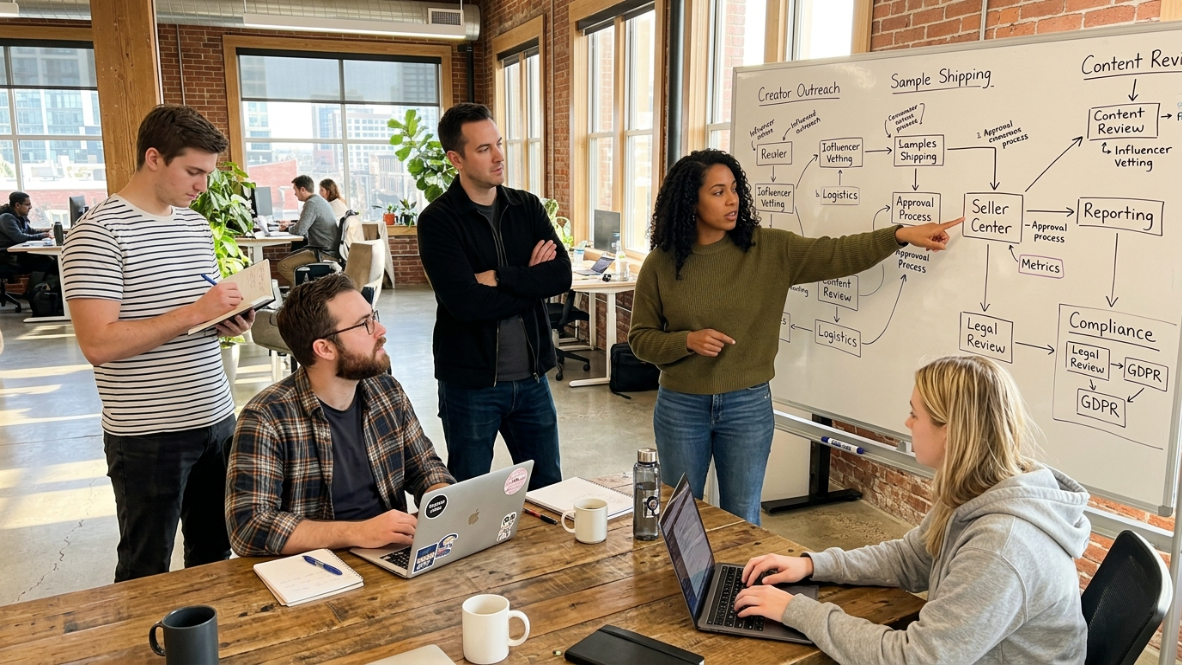
A standard operating procedure (SOP) is a set of step-by-step instructions that helps a team carry out routine operations consistently. In the context of a TikTok Shop agency, SOPs are the documented workflows that govern how the agency manages a brand’s entire TikTok Shop presence: product listings, creator partnerships, content production, advertising, fulfillment oversight, and financial reporting.
A TikTok Shop agency (also called a TikTok Shop Partner, or TSP) is a managed-service partner that operates your brand’s TikTok Shop end-to-end. That includes Seller Center setup, catalog optimization, affiliate recruitment, UGC content production, TikTok Ads management, LIVE selling, and performance reporting.
What makes a TikTok Shop agency SOP different from a generic social media agency SOP? Volume, velocity, and commerce integration. A TikTok Shop is not a passive sales channel. It’s a living ecosystem that demands constant attention across content creation, creator management, live commerce, fulfillment, and paid amplification, all running simultaneously. Generic social media SOPs don’t account for order management, commission structures, Shop Performance Scores, or the reality that the platform rewards 30+ creator videos per week.
With TikTok Shop’s US ecommerce sales forecast to reach $23.41 billion in 2026 (a 48% increase year over year) and 475,000 TikTok shops in the US alone, operational discipline is what separates agencies that scale from agencies that stall.
If you’re an agency building these systems, Trenz’s agency solutions can automate many of the manual steps described below.
The Three Partner Types That Shape Your SOPs
Before mapping specific SOPs, you need to understand the three official TikTok Shop partner designations. Each requires a different operational focus, which means different SOPs.
TSP (TikTok Shop Partner): Provides broad operational support including shop management, product listing optimization, advertising setup, and general platform operations. TSPs need the widest range of SOPs because they touch everything.
CAP (Creator Agency Partner): Focuses on managing longer-term relationships between brands and creators. CAPs typically represent or manage a network of creators, helping brands identify individuals whose audiences align with their products. They also provide guidance on content direction and campaign structure. To apply as a CAP, agencies need US company registration, proof of experience working with creators, and livestreaming or short video content capabilities.
TAP (TikTok Affiliate Partner): A certified agency that helps brands run and scale creator affiliate campaigns. TAP partners recruit creators, coordinate campaigns, negotiate commissions, and track sales performance. Think of TAP as transaction-focused and CAP as relationship-focused, though in practice there’s overlap.
The SOPs below apply most directly to TSPs (who do everything) but CAPs and TAPs will recognize the creator and content sections as their core playbooks.
Which SOPs Does Each TikTok Shop Partner Need?
SOP | TSP | CAP | TAP |
|---|---|---|---|
Seller Center | ✓ | ||
Creator Recruitment | ✓ | ✓ | ✓ |
Creator Briefing | ✓ | ✓ | ✓ |
Sample Logistics | ✓ | ✓ | |
LIVE Commerce | ✓ | ||
Ads Management | ✓ | ||
Reporting | ✓ | ✓ | ✓ |
Compliance | ✓ | ✓ | ✓ |
This comparison helps agencies prioritize documentation based on their official TikTok Shop Partner designation.
TikTok Shop Agency SOP Workflow
Most agencies follow the same operational flow regardless of niche or product category.
Stage | Primary Goal | Owner |
|---|---|---|
Creator Research | Find qualified creators | Creator Manager |
Outreach | Secure creator participation | Affiliate Manager |
Sample Seeding | Deliver products | Logistics Coordinator |
Content Production | Publish creator content | Content Manager |
Performance Review | Analyze sales and ROI | Ecommerce Manager |
Optimization | Improve campaigns | Growth Manager |
Reporting | Client reporting | Account Manager |
This workflow prevents operational bottlenecks by assigning ownership to every recurring process.
The 7 Core SOP Categories Every TikTok Shop Agency Needs
1. Creator Discovery and Vetting SOP
This SOP defines how the agency finds and qualifies creators before any outreach begins. Without it, teams waste time pitching creators who will never convert.
Key steps:
Define a Creator ICP (Ideal Creator Profile) before outreach. Most agencies target creators with 10K to 250K followers and 3% to 7% engagement rates for stronger TikTok Shop conversions.
Build sourcing lists across TikTok’s affiliate marketplace, competitor creator rosters, and third-party creator analytics tools.
Score each creator against the ICP using follower count, engagement rate, content quality, niche fit, and prior affiliate performance.
Separate outreach, vetting, briefing, shipping, and performance tracking into distinct workflow stages to eliminate bottlenecks.
Benchmark: Affiliate creator content drives roughly 42% of TikTok Shop GMV in the US. Getting this SOP right has an outsized impact on revenue.
2. Creator Onboarding and Briefing SOP
Once a creator passes vetting, the onboarding SOP takes over. The goal is to move from “yes” to “published content” as fast as possible with minimal back-and-forth.
Key steps:
Send a standardized welcome package that includes commission terms, content expectations, shipping timeline, and a one-page creative brief.
The brief should include positioning, talking points, format guidance, hooks, CTA, do’s and don’ts, and a deadline. Keep it to one page. Brands that use structured briefs see 2 to 4x higher conversion rates on creator content compared to unbriefed creators.
Give creators direction but leave room for their own style. Overly scripted content performs poorly on TikTok because the audience detects inauthenticity immediately.
Scaling benchmark: In a systematized operation, one manager typically handles 50 to 100 creators. With fully built workflows, one manager can oversee 300 to 400 creators. That gap is entirely about SOP quality.
3. Sample Seeding and Logistics SOP
Product seeding at scale is a logistics problem disguised as a marketing activity. Without a TikTok Shop agency SOP for sample management, agencies bleed inventory and get nothing in return.
Key steps:
Maintain a separate seeding inventory to avoid fulfillment conflicts with customer orders.
Set up a tracking number system so you know exactly which creator received product and when.
Build a follow-up cadence: Day 0 is delivery confirmation plus a brief reminder, Day 2 is a check-in with content examples, Day 4 to 5 is a deadline reminder with a bonus mention.
Over-recruit to hit activation targets. Expect 30% to 50% creator ghosting after sample shipment.
Volume benchmark: For new products with zero traction, plan to distribute 50 to 100 samples within the first 30 days. Expect only 5% to 10% of creators to produce content worth promoting. From 100 samples sent, you’ll realistically get 5 to 10 quality videos.
The dual-track approach emerging in 2026: Smart agencies now run two parallel systems. The automation track puts stable SKUs with proven conversion fundamentals into TikTok’s Auto-optimized Samples system, letting the platform’s matching and approval logic expand content coverage efficiently. The strategy track keeps new products, critical campaigns, and high-judgment creator fits inside manual management where brand control matters more than pure volume. Since June 2026, TikTok Shop has been pushing samples, creator screening, content output, and amplification into one automated chain adjustable by ROI. Agencies that build SOPs assuming full manual control for everything will need to adapt.
4. Content Production and Quality Control SOP
This SOP governs how content gets reviewed, approved, and sometimes amplified with paid spend. It sits between the creative brief and the performance report.
Key steps:
Define quality thresholds: minimum video length, required product visibility, proper TikTok Shop link placement, disclosure compliance.
Run a weekly compliance pass. Read through 10 random creator posts. Anything making a claim the brand cannot substantiate? Flag and remove.
Identify top-performing content within the first 24 to 72 hours of posting using sales velocity, not views.
Queue winning content for Spark Ads or Video Shopping Ads amplification.
For agencies managing content across TikTok and other platforms simultaneously, a cross-platform scheduling system reduces the coordination overhead significantly.
5. Daily, Weekly, and Monthly Seller Center Operations SOP

This is the operational heartbeat of a TikTok Shop agency SOP. It’s the checklist that keeps orders flowing, listings optimized, and finances reconciled.
Daily cadence:
Review cancellations, held orders, refund requests, and abnormal order patterns.
Check listing health and suppressed products.
Monitor affiliate activity and new creator applications.
Weekly cadence:
Match payouts to orders, returns, discounts, and fulfillment events.
Review ad spend efficiency across GMV Max and Spark campaigns.
Audit affiliate commission tiers and creator performance rankings.
Monthly cadence:
Full P&L review: revenue, COGS, commission, ad spend, FBT fees, returns, overhead.
Calculate net contribution per order and net contribution per SKU. Kill anything that hasn’t paid for itself in 60 days.
Roster review: net active creator count, adds versus removes, cohort performance.
Category analysis using TikTok Shop rankings data to spot emerging competitors and shifting demand.
One critical point practitioners on Reddit and LinkedIn stress repeatedly: Seller Center is the command center for execution, but it is not the full operating system. Brands that scale cleanly use it for order control, then fill the reporting gaps with better inventory, finance, and creator management tools.
6. Performance Reporting and GMV Tracking SOP
This SOP defines what gets measured, how often, and who sees the report. It’s where agencies prove their value to clients.
Metrics that matter:
Orders, AOV, conversion rate, return rate, settlement amounts, and target ROI hit rate.
Creator activation rate (what percentage of onboarded creators actually post).
Sample-to-content conversion rate (should be 5% to 10% at minimum).
Net contribution per creator (not just GMV attributed, but profit after commission and seeding costs).
What to ignore: Views and engagement as standalone metrics. A creator video with 1M views and zero sales is not a winner. Use sales velocity in the first 24 to 72 hours instead. Practitioners on LinkedIn consistently warn that agencies should be judged by profitable GMV, not creator count, views, or how busy the Slack channel feels.
Shop Performance Score (SPS): This is TikTok’s composite score (0 to 5) based on six metrics across product quality, logistics, and customer service. It activates after 30 delivered orders in 90 days. To be eligible for an accelerated settlement period of 5 days after delivery, sellers need a minimum SPS of 3.5. Every agency SOP for operations should include SPS monitoring as a standing item.
For deeper analytics beyond what Seller Center provides, a dedicated TikTok Shop analytics tool can surface the SKU-level and creator-level data these SOPs require.
Monthly Agency KPI Dashboard
Every monthly client report should include these metrics.
KPI | Target |
|---|---|
GMV | Growing Month-over-Month |
Orders | Increasing |
AOV | Stable or Rising |
SPS | 3.5+ |
Creator Activation | 50–70% |
Sample Conversion | 5–10% |
Refund Rate | Declining |
Net Contribution | Positive |
Top Performing Creators | Top 10 |
Top Performing SKUs | Top 20% |
This creates a standardized reporting format across all clients.
7. Compliance and Policy Monitoring SOP
TikTok Shop’s policies change frequently, and violations can result in listing suppression or shop suspension. This SOP is less exciting than creator management but arguably more important for long-term survival.
Key steps:
Monthly policy review: check TikTok’s Seller University for updated restricted product lists, content guidelines, and disclosure requirements.
Weekly compliance pass on creator content (mentioned above in the content QC section).
Maintain a log of flagged content and corrective actions taken.
Ensure all creator agreements include disclosure standards and responsibility clauses.
The agency should follow platform policies and disclosure standards, with responsibility for process management clearly documented in the contract.
How TikTok Shop Agency SOPs Differ From Generic Agency SOPs
Four things make the TikTok Shop agency SOP landscape fundamentally different from what a typical social media or ecommerce agency deals with:
Commerce is embedded in the content loop. Every piece of content is directly tied to a product listing, a commission structure, and an order. Generic social SOPs don’t account for fulfillment, returns, or settlement timelines.
Creator economics are complex. Commission rates vary by product, creator tier, and campaign type. Agencies manage open collaboration rates, targeted collaboration rates, and sometimes hybrid structures. The SOP must standardize how these get set, reviewed, and adjusted.
Content velocity is extreme. The platform rewards high-frequency posting. Sustaining 30+ creator videos per week requires a pipeline, not a project. Most social media agencies are used to producing 3 to 5 posts per week per client.
Platform-specific compliance creates unique risk. TikTok Shop’s restricted categories, health claim rules, and disclosure requirements are distinct from Meta or Google’s advertising policies. A generic compliance SOP won’t cover them.
TikTok Shop Agency vs Traditional Ecommerce Agency
Feature | TikTok Shop Agency | Traditional Ecommerce Agency |
|---|---|---|
Creator Management | Heavy | Minimal |
LIVE Selling | Yes | Rare |
Affiliate Programs | Core Service | Optional |
Seller Center | Daily | No |
Short Video Production | Constant | Occasional |
Marketplace Operations | Native | Usually External |
Commerce Content | Integrated | Separate |
Key Metrics That TikTok Shop Agency SOPs Should Track
Metric | Why It Matters | Benchmark |
|---|---|---|
Shop Performance Score (SPS) | Determines settlement speed and affiliate eligibility | 3.5+ minimum for 5-day settlement |
Creator Activation Rate | Measures SOP effectiveness from onboarding to content | 50-70% of accepted creators should post |
Ghosting Rate | Reveals sample waste and follow-up SOP gaps | Expect 30-50%, optimize to reduce |
Sample-to-Content Rate | True seeding ROI | 5-10% from cold outreach |
Net Contribution Per SKU | Profitability after all costs | Kill SKUs that haven’t paid for themselves in 60 days |
Net Contribution Per Creator | Identifies which creators drive profit, not just views | Use a creator ROI calculator for this |
Sales Velocity (first 72 hours) | Predicts content winner potential | More predictive than lifetime views |
Content-to-GMV Conversion Rate | Connects content quality to revenue | Track at the individual video level |
How AI Tools Are Changing TikTok Shop Agency SOPs
The biggest shift happening in 2026 is the automation of SOP steps that were previously manual. This is changing what agencies need to document and what they can delegate to software.
Discovery is automated. Instead of manually scanning bestseller lists, agencies can use AI-powered product research tools to identify Blue Ocean opportunities, sales spikes, and seasonal trends across millions of products.
Content production is accelerating. AI video generation, script writing, and image creation can now produce converting short-form content in minutes. Trenz’s Creative Director agent, for example, generates videos, scripts, and images using multiple AI models, reducing the reliance on freelance production cycles that used to take days and cost $100+ per video.
Scheduling is consolidated. Rather than manually posting across TikTok, Instagram, YouTube, and Facebook, agencies can use the Social Manager agent within Trenz’s AI social commerce platform to schedule, publish, and analyze content from one workspace.
The platform itself is becoming the SOP. TikTok’s push toward Auto-optimized Samples, Creator Matchmaking, and automated affiliate commission logic means the platform is absorbing steps that agencies used to manage manually. The agencies that thrive will be the ones that update their SOPs to work with these automated systems rather than fighting against them.
Who Should Build the SOP?
Different team members own different SOPs.
Role | Responsible SOPs |
|---|---|
Agency Owner | Strategy |
Ecommerce Manager | Seller Center |
Creator Manager | Recruitment |
Logistics Coordinator | Sample Shipping |
Creative Lead | Content Review |
Media Buyer | Ads |
Finance Manager | Reporting |
Compliance Officer | Policy Reviews |
Clearly assigning ownership prevents duplicated work and accountability gaps.
Common Mistakes in TikTok Shop Agency SOPs
Building SOPs around vanity metrics. If your reporting SOP centers on views and engagement rather than profitable GMV, you’re measuring theater. Practitioners consistently report that brands lose 20% to 40% of upside to coordination costs and misdirected effort.
Not separating seeding inventory from fulfillment inventory. This causes stockouts for paying customers when a seeding campaign ramps up. It’s a simple fix but a common oversight.
No follow-up sequence after sample delivery. Without a structured cadence (Day 0, Day 2, Day 4-5), you lose 30% to 40% of your samples to creator inaction. The SOP literally pays for itself by recovering content from products already shipped.
No monthly compliance audit. One creator making an unsubstantiated health claim can trigger a listing suppression or worse. The compliance SOP should be boring and mandatory.
Treating Seller Center as the full operating system. Seller Center handles order execution well. It does not handle SKU-level contribution margin analysis, creator performance cohorts, or competitive intelligence. Agencies need external tools to fill those gaps. The SOP should specify which decisions get made in Seller Center and which require other systems.
Skipping the monthly SKU kill decision. Every month, the SOP should force a review of SKUs that haven’t earned back their costs in 60 days. Keeping underperformers alive drains creator effort, ad spend, and sample inventory from products that could actually grow.
Signs Your TikTok Shop SOP Needs Updating
Review your SOPs immediately if you notice:
Creator response rates dropping
Increasing refund rates
SPS falling below 4.0
More policy violations
Higher creator ghosting
Slower campaign launches
Duplicate manual work
Inventory mismatches
Reporting inconsistencies
Automation tools replacing manual workflows
Most agencies review SOPs every quarter, while high-volume agencies update them monthly.
Key Takeaways
Successful TikTok Shop agencies rely on standardized SOPs rather than ad hoc processes.
Seven core SOP categories cover creator management, operations, reporting, and compliance.
Seller Center should be combined with external analytics and finance tools for complete visibility.
AI is automating repetitive workflows, but human oversight remains essential for strategy and compliance.
Agencies should review SOPs regularly to keep pace with TikTok Shop feature updates and policy changes.
FAQ
What does SOP stand for in the context of TikTok Shop?
SOP stands for Standard Operating Procedure. In TikTok Shop, it refers to the documented workflows an agency or brand follows for every recurring operation: creator outreach, sample shipping, content review, order management, financial reporting, and compliance checks.
What is the difference between a TSP, CAP, and TAP?
A TSP (TikTok Shop Partner) provides broad shop management services. A CAP (Creator Agency Partner) focuses on managing long-term brand-creator relationships. A TAP (TikTok Affiliate Partner) specializes in running and scaling affiliate campaigns. TSPs need the widest range of SOPs; CAPs and TAPs focus primarily on creator and content workflows.
How many creators can one agency manager handle?
With basic systems in place, one manager typically handles 50 to 100 creators. With fully built SOPs and automation tools, that number scales to 300 to 400 creators per manager. The gap is entirely about process quality.
What’s a good sample-to-content conversion rate?
From cold outreach seeding, expect 5% to 10% of creators to produce content worth promoting. That means sending 100 samples should yield roughly 5 to 10 quality videos. Building a follow-up sequence into the SOP improves this rate significantly.
What Shop Performance Score do agencies need to maintain?
SPS ranges from 0 to 5 and is calculated based on six metrics across product quality, logistics, and service. A minimum score of 3.5 is required for accelerated settlement (5 days after delivery) and affiliate program eligibility. Agency SOPs should include SPS monitoring as a daily or weekly check.
How much do TikTok Shop agencies typically charge?
Most TikTok agencies charge between $1,000 and $10,000 per month depending on scope, with many using hybrid models that combine a base retainer with a percentage of GMV. The complexity of the SOP requirements described in this guide is a major reason why agency fees scale with scope.
Why are TikTok Shop SOPs different from regular social media SOPs?
TikTok Shop SOPs must account for commerce operations (orders, fulfillment, returns, settlement), creator economics (commissions, affiliate tracking), extreme content velocity (30+ videos per week), and platform-specific compliance rules. Generic social media SOPs don’t cover any of these dimensions.
How are AI tools changing TikTok Shop agency SOPs?
AI tools are automating product discovery, content creation, scheduling, and analytics, replacing manual steps that agencies used to document in their SOPs. Meanwhile, TikTok itself is automating parts of the sample seeding and creator matching process. Agencies should build SOPs that specify which steps remain manual and which are delegated to automation.
Ready to automate the manual steps in your TikTok Shop agency SOPs? Explore Trenz’s pricing and see how the platform handles product intelligence, content creation, and publishing from a single workspace.
Author


