
TL;DR
Kalodata, FastMoss, and PiPiAds solve three different problems. Kalodata is best for product discovery and trend research. FastMoss excels at creator intelligence and multi-market analytics for agencies. PiPiAds is an ad spy tool for dropshippers, though it carries a poor trust score on Trustpilot. None of the three handle content creation, social publishing, or end-to-end workflow, which means most sellers end up stacking multiple tools. If you want product research, AI video creation, and publishing in one place, Trenz offers a free plan worth testing before committing to any subscription.
If you’re deciding between Kalodata, FastMoss, and PiPiAds, choose based on your primary workflow rather than the number of features.
– Choose Kalodata if your priority is finding winning TikTok Shop products using historical sales data.
– Choose FastMoss if you need creator analytics, influencer outreach, and multi-country market intelligence.
– Choose PiPiAds if you primarily research winning TikTok and Facebook advertisements.
– Choose Trenz if you want product research, AI content creation, publishing, and analytics inside one platform.
No single platform is objectively “best.” The right choice depends on whether your biggest challenge is product discovery, creator partnerships, ad research, or managing your entire TikTok Shop workflow.
Why This Comparison Matters Right Now
TikTok Shop crossed $64.3 billion in global GMV in 2025. U.S. social commerce is projected to surpass $100 billion in 2026. With that kind of money flowing through the platform, sellers need data tools that actually match their workflow, not just the one with the flashiest marketing page.
Here’s the problem: most comparison articles treat Kalodata, FastMoss, and PiPiAds as interchangeable alternatives. They aren’t. Each tool was built for a distinct job. Kalodata answers “what should I sell?” FastMoss answers “which creators should I partner with?” PiPiAds answers “what ads are working right now?” Picking the wrong one wastes both money and time.
This guide breaks down the real differences in pricing, features, and user feedback for all three, then addresses the bigger question nobody else is asking: do you actually need multiple subscriptions, or can one platform cover the full workflow? For a deeper head-to-head breakdown, we’ve also published a dedicated comparison page.
Quick Decision Matrix
If You Want To… | Best Tool |
|---|---|
Find winning TikTok Shop products | Kalodata |
Research creators and affiliates | FastMoss |
Spy on competitor ads | PiPiAds |
Create AI videos | Trenz |
Schedule TikTok content | Trenz |
Analyze GMV trends | Kalodata / Trenz |
Export influencer contacts | FastMoss |
Lowest starting cost | Trenz Free |
Mobile app | Kalodata, Trenz |
API access | Trenz |
At-a-Glance Comparison Table
Dimension | Kalodata | FastMoss | PiPiAds | Trenz |
|---|---|---|---|---|
Starting price | $45.90/mo | $59/mo | $49/mo | Free (50 credits) |
Free trial | 7-day, no CC | 7-day, auto-renew | 500 credits | Free plan, no CC |
Primary strength | Product discovery, historical trends | Creator analytics, multi-market data | Ad spy, creative research | Discover, create, publish, measure |
Best for | Solo sellers, affiliates | Agencies, brands, MCNs | Dropshippers, ad buyers | Sellers wanting one platform |
Content creation | No | Basic AI scripts | Separate AI tools ($12+/mo) | Built-in AI video, image, scripts |
Social publishing | No | No | No | TikTok, IG, YouTube, Facebook |
API access | Enterprise only | No | Enterprise only | Open Platform (PAYG $0.15/credit) |
Mobile app | Yes | No | No | Yes (iOS) |
Trust score | 7.0/10 (WinningHunter) | SourceForge Top Performer | 2.3/5 Trustpilot | Official TikTok Shop Partner (claimed) |
Pros and Cons at a Glance
Tool | Biggest Advantage | Biggest Drawback |
|---|---|---|
Kalodata | Excellent historical product data | No publishing tools |
FastMoss | Best creator intelligence | Expensive |
PiPiAds | Massive ad library | Poor customer reviews |
Trenz | Complete workflow | Credit system |
Now let’s go deeper on each tool.
1. Trenz
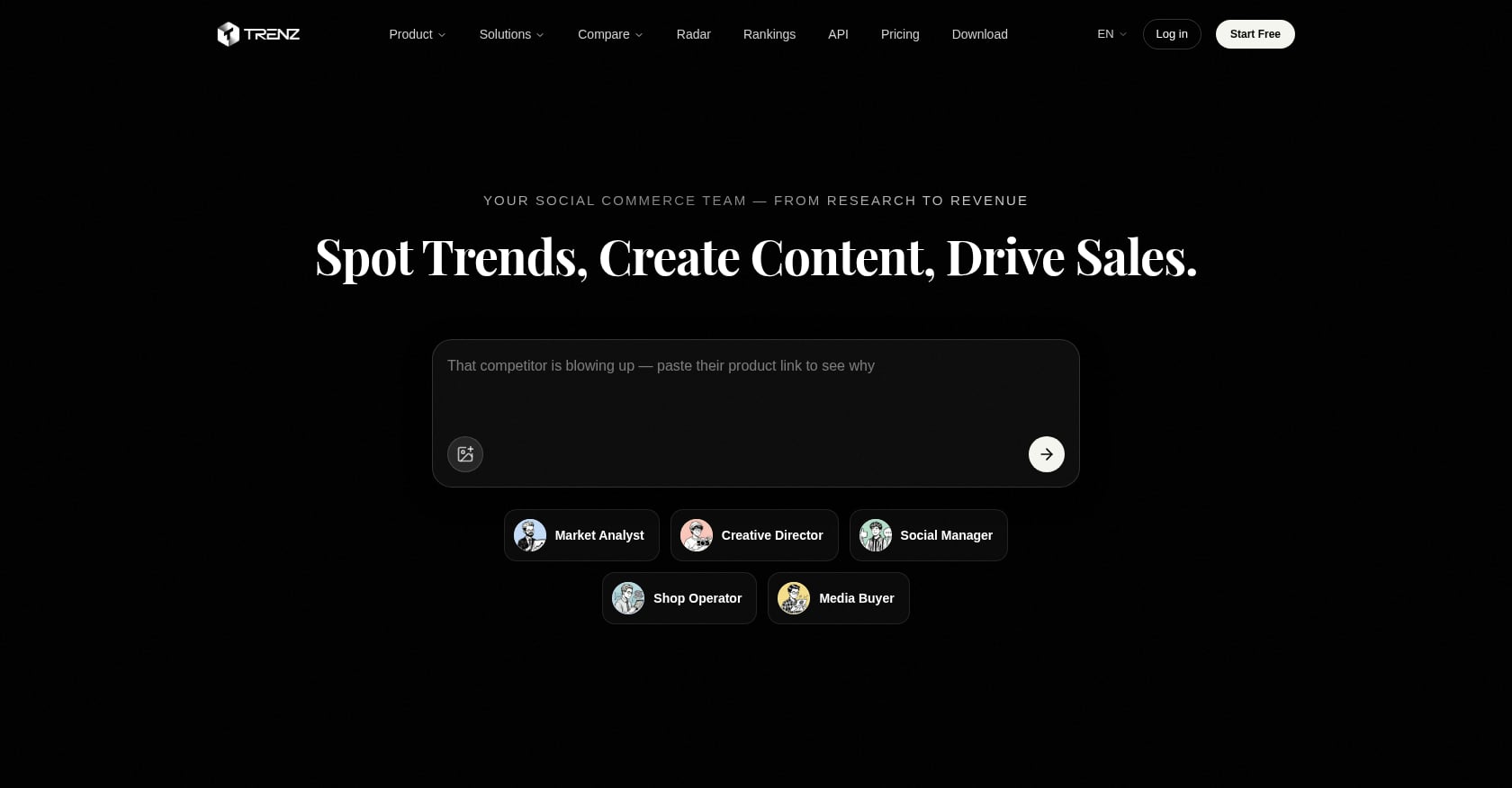
Best for: Sellers and agencies who want product research, AI content creation, multi-platform publishing, and GMV tracking in a single platform.
Pricing:
Free plan: 50 welcome credits, no credit card required
Growth, Pro, and Scale tiers with increasing credits and data depth
Credits work across all features (research, video generation, publishing)
Top-up credits at $10 for 100 credits, and they never expire
Team members on the Scale plan at $19/seat/month
Key features:
Market Analyst agent: scans products across TikTok Shop, Amazon, and DTC; identifies blue-ocean opportunities, sales spikes, and seasonal bestsellers
Creative Director agent: generates videos (via Seedance 2.0, Veo 3.1, Wan 2.6), images, scripts with hooks, angles, and money-shot templates, averaging about 60 seconds per video
Social Manager: schedule and publish to TikTok, Instagram, YouTube, and Facebook from one calendar; best-time-to-post insights; comments and messages inbox
Daily Radar: five fresh, data-backed product and market opportunities per day with GMV, growth, and creator-concentration analysis
Monthly Rankings: category-level TikTok Shop rankings with $408.7M in tracked GMV
Open Platform API: unified access to 50M+ TikTok products and 2M+ creators, plus AI content generation and social publishing endpoints
iOS mobile app for trend insights and content creation on the go
You can explore TikTok Shop rankings directly to see how this data looks in practice.
Limitations:
Deepest value is TikTok Shop focused; other platforms are supported mainly for publishing and analytics, not full commerce data
Credits are metered, so video-heavy workflows (3 credits per second of video) require careful budgeting
Base plan pricing for Growth, Pro, and Scale isn’t displayed publicly, meaning you need to sign up to see exact costs
The “Official TikTok Shop Partner” claim appears on the site but hasn’t been independently verified through TikTok’s public partner directory
Why it matters in this comparison: Every other tool in this article is analytics-only. Trenz is the only option that closes the loop from data to content to publishing to revenue measurement. For sellers tired of paying for three or four disconnected dashboards, the credit-based model covering all functions is the structural advantage.
2. Kalodata
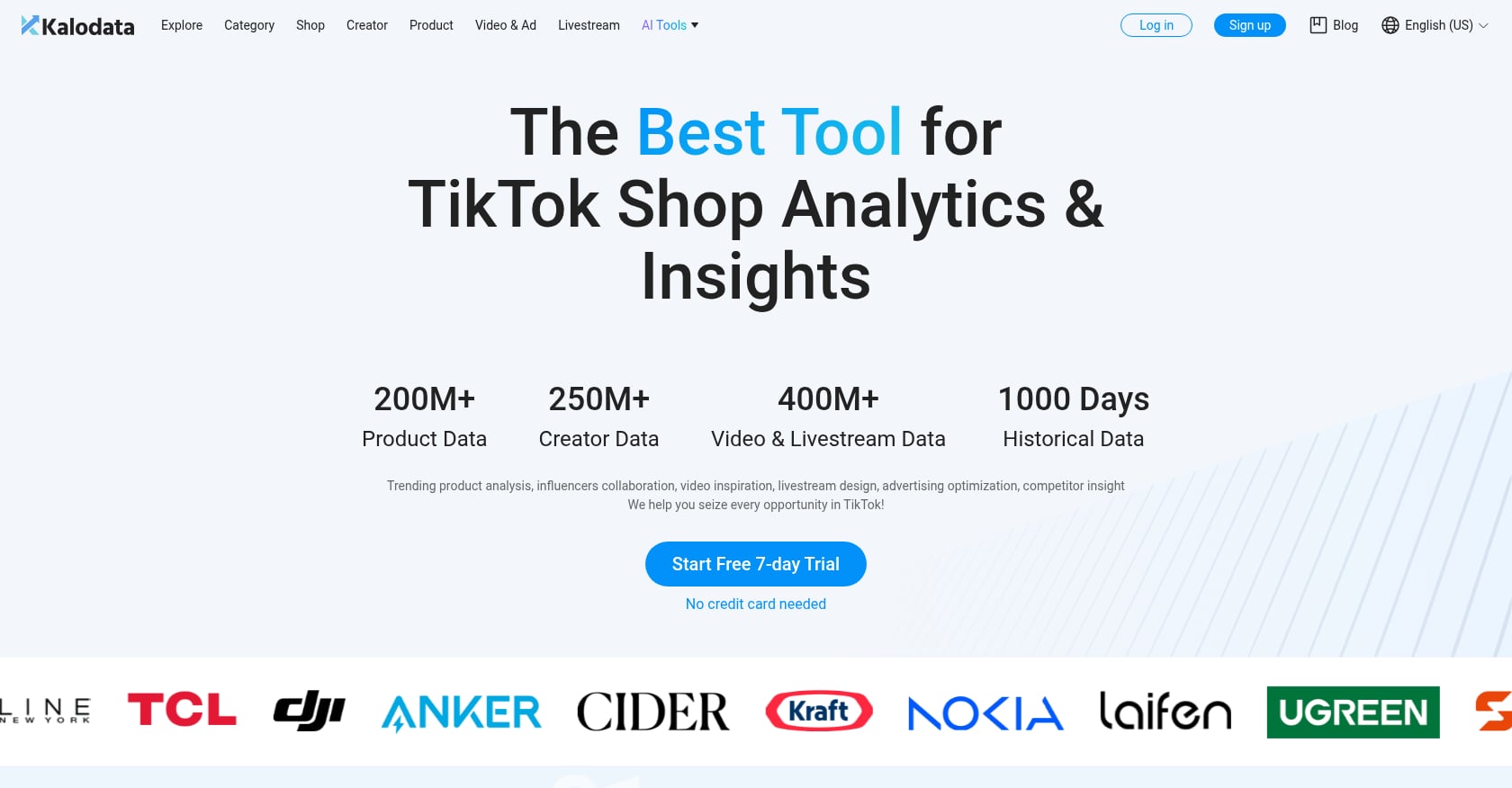
Best for: Individual sellers and affiliates who prioritize product discovery, historical trend analysis, and want an affordable entry point.
Pricing:
Starter: $45.90/month ($38.30/month on annual billing)
Professional: $99.90/month ($83.20/month annual)
Enterprise: custom pricing with API access
7-day free trial, no credit card required
The Starter plan includes 50 searches per day, 100 detail page views per day, and a 90-day data viewing range. Professional expands that to 250 daily searches, 500 detail page views, and a 180-day data window.
Key features:
500 days of historical data with transparent methodology
15-minute data refresh rate throughout the day
“Blue-ocean” product scoring that highlights high-demand, low-competition opportunities
Mobile app available (one of the few TikTok analytics tools with one)
Built by a team of former TikTok Shop developers
Limitations:
Creator analytics are basic: follower count, engagement rate, and recent video performance, but no sales-driven data attached to creator profiles
No content creation tools whatsoever
No social publishing
The Starter plan’s daily limits (50 searches, 100 detail pages) can feel restrictive for power users
A Capterra reviewer noted the tool “keeps a lot behind paywall for free trial unlike competitors”
Real user feedback:
One Capterra reviewer described the interface as “kind of bland compared to competitors,” though they acknowledged the depth of product data. WinningHunter scored Kalodata 7.0/10, calling out its clear strength in trend tracking and creator discovery as positives.
Practitioners on Reddit and forums frequently mention Kalodata as the go-to starting point for product research, particularly when sellers need to validate whether a product category has room to grow before committing ad spend. The 500-day historical window is a feature that comes up repeatedly in these discussions.
If Kalodata’s creator analytics gap or lack of content tools is a concern, a more detailed Kalodata alternative comparison covers what other platforms offer in those areas.
3. FastMoss
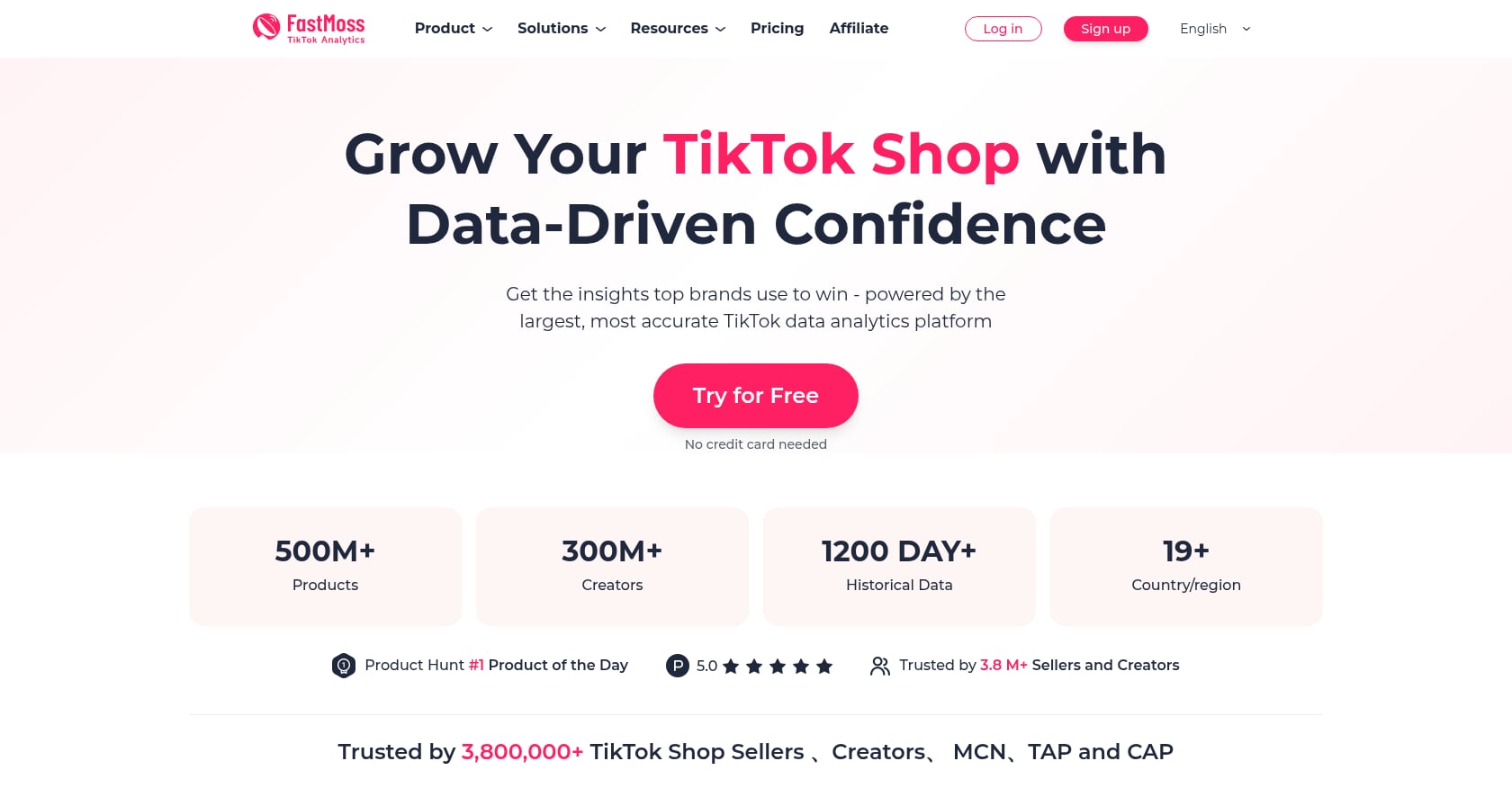
Best for: Agencies, brands, and MCNs that need comprehensive creator analytics, LIVE data tracking, and multi-market intelligence.
Pricing:
Basic: $59/month (some sources note a $29 first-month promotional rate)
Cloud Pro: $109/month
Team: $399/month
7-day free trial with auto-renewing subscription (cancel before it ends or you’re charged)
FastMoss is the most expensive option at every tier. The Team plan at $399/month reflects its positioning toward larger operations, not solo sellers.
Key features:
Covers 17+ countries with data from 250M+ creators and 200M+ shops and products
Creator Discovery Engine that exports up to 6,000 influencer contacts daily, filtered by region and engagement
Tracks individual creators’ product-level performance, meaning how many units a specific creator has actually sold
Video analytics to study high-performing ads, a video downloader, and an AI script generator
LIVE stream analytics for real-time performance monitoring
Trusted by over 3.2 million users as of 2026
Limitations:
No mobile app
No API access
Multiple users describe the interface as overwhelming. One review noted “much of the information is overkill at times,” which suggests the data depth that makes FastMoss powerful for agencies can be paralyzing for solo sellers
The most expensive entry point of the three main tools compared here
Auto-renewing trial is a friction point; a G2 reviewer flagged a serious issue: “FastMoss has yet to solve anything for me, I paid for a subscription that does not want to work,” with no customer service response
Real user feedback:
A SourceForge reviewer acknowledged it’s “a little pricey but I guess it’s worth it.” The consensus among practitioners is that FastMoss runs circles around competitors when it comes to influencer research, particularly the ability to see which creators actually drive sales versus just views.
For agencies evaluating whether FastMoss is the right investment, the FastMoss alternative page compares it with platforms that offer overlapping creator analytics plus content creation.
If your primary workflow is finding TikTok Shop creators and managing affiliate partnerships, FastMoss has the deepest database. But if you also need to produce content for those creators or publish across platforms, you’ll need additional tools.
4. PiPiAds
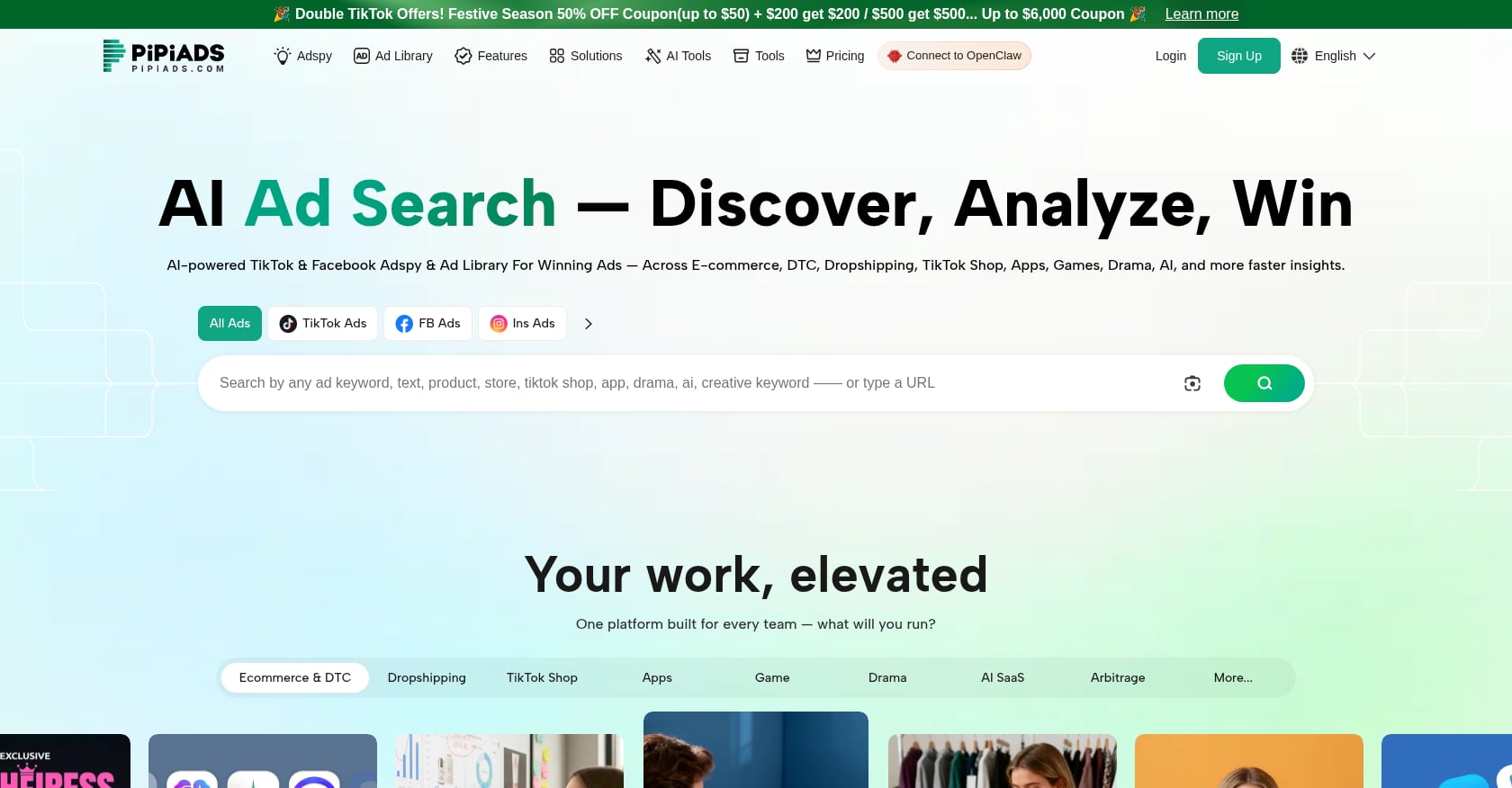
Best for: Dropshippers and paid-ads teams who need to spy on TikTok and Facebook ad creatives before launching campaigns.
Pricing (v2.0 credit-based system):
Basic: $49/month (10,000 credits)
Advanced: $99/month
Enterprise: $900/month
Flexible plan starting at $180/month
30% annual discount available
Free trial: 500 credits
Here’s the catch with PiPiAds’ credit system that trips people up: viewing basic data costs 1 credit, but accessing detailed ad information costs 20 credits. That means the Basic plan’s 10,000 credits translates to only 500 detailed ad views per month. Many users don’t realize this until after subscribing.
Key features:
TikTok and Facebook ad library access
Three product lists: best-selling TikTok Shop products, new arrivals, and hot products
Ad tracking to spot top-performing campaigns
Separate AI tools for video transcription, image translation, and text removal (starting at $11.99/month, billed separately)
Limitations, and there are significant ones:
PiPiAds is fundamentally an ad spy tool, not a TikTok Shop analytics tool. This distinction matters. It doesn’t provide GMV data, creator sales attribution, or the depth of product intelligence that Kalodata or FastMoss offer.
Facebook data is widely described as “outdated and unreliable” by users across review platforms
No content creation or social publishing
The credit burn rate for detailed views makes the tool far more expensive than the sticker price suggests
No mobile app
Real user feedback (this is where it gets rough):
PiPiAds carries a 2.3 out of 5 rating on Trustpilot. Multiple reviewers describe slow responses, unresolved tickets, and confusion around billing. One user wrote: “After I got charged $155, they won’t give me my money back, take 5 days to respond to emails.” WinningHunter scored PiPiAds 6.8/10, noting it was “held back by credit limits, repetitive results, and major issues with ongoing support and billing.”
This isn’t an isolated complaint. The pattern of billing disputes and poor support response times appears across Trustpilot, G2, and independent review sites. Any seller considering PiPiAds should start with the 500-credit free trial and test support responsiveness before committing money.
On the positive side, a G2 reviewer praised the platform for TikTok and Facebook coverage, though they wished for Instagram and YouTube support. For dropshippers specifically focused on ad creative research, PiPiAds does deliver on its core promise, but you need to go in knowing exactly what you’re getting and what you’re not.
If PiPiAds’ trust issues or credit limitations are dealbreakers, the PiPiAds alternative breakdown covers tools with better support track records.
The Real Problem Nobody Talks About: Tool Stacking
Here’s what most comparison articles skip entirely. The kalodata vs fastmoss vs pipiads question assumes you only need one tool. In practice, most serious TikTok Shop sellers end up needing several.
A typical stack looks like this:
Product research tool (Kalodata): ~$46/month
Ad spy tool (PiPiAds): ~$49/month
Video editing or AI video tool: ~$30/month
Social scheduling tool: ~$15/month
That’s $140+ per month across four disconnected dashboards. None of them talk to each other. You can’t trace a product discovery insight through to a piece of content through to a sale. The data lives in silos, and you’re the manual integration layer.
This is the structural gap in the entire kalodata vs fastmoss vs pipiads conversation. All three are analytics-only tools. They tell you what’s happening on TikTok Shop. None of them help you act on it.
Both Kalodata and FastMoss are scraped-data discovery tools with roughly 80% data overlap. Neither connects to official TikTok APIs for verified data. Certain details like transaction amounts and ad spending inevitably have small variations from real-world numbers. This isn’t a knock on either tool specifically; it’s a limitation of the entire category.
The question worth asking isn’t “which analytics tool is best?” It’s “can I find a platform that covers the full workflow so I stop paying for and switching between four different products?”
Trenz’s AI social commerce platform was built specifically to address this gap, combining product discovery, AI content creation, multi-platform publishing, and GMV measurement in one credit-based system.
Which Tool Should You Pick? A Decision Framework
The right choice depends on your primary job-to-be-done, not on which tool has the most features on a spec sheet.
If your main job is product research: Start with Kalodata’s Starter plan ($45.90/month) or Trenz’s free plan. Kalodata gives you 500 days of historical data and solid blue-ocean scoring. Trenz’s Market Analyst agent covers similar ground while also offering content creation if you want to act on what you find. For a deeper look at product research options, the best TikTok Shop product research tools guide covers more alternatives.
If your main job is creator outreach at scale: FastMoss is the strongest option. Its creator-level sales attribution and 6,000 daily contact exports are unmatched. Agencies running multi-market operations across 17+ countries will get the most value here. Pair it with a content tool if you also need to produce assets for those creators.
If your main job is ad creative spying: PiPiAds serves this purpose, but proceed with caution given the Trustpilot reviews and credit burn rate. Make sure to test the 500-credit free trial thoroughly, and contact support with a test question before subscribing. If the 4-5 day response times reported by users are still the norm, factor that into your decision.
If you want to discover, create, publish, and track in one place: Trenz is the only platform in this comparison that covers the full workflow. The free plan with 50 credits lets you test every feature (product research, video generation, social publishing) without a credit card.
Budget-conscious solo sellers: Start with Trenz Free or Kalodata Starter. Both offer low-risk entry points. Avoid committing to FastMoss’s $59/month or PiPiAds’ credit-based system until you’re sure you need their specific capabilities.
Agencies managing multiple clients: FastMoss for global creator intelligence, combined with Trenz’s Scale plan for content production and multi-platform publishing across up to 50 social accounts. The agency solutions overview details how this works in practice.
Ready to Stop Switching Between Tools?
Start free with Trenz, no credit card required, and test how product discovery, AI video creation, and social publishing work in a single platform.
Frequently Asked Questions
Is Kalodata or FastMoss more accurate?
Neither tool uses official TikTok APIs, so both rely on scraped data. They overlap roughly 80% in product-level intelligence. Kalodata offers deeper historical data (500 days), while FastMoss is stronger on creator-level sales attribution. For most sellers, accuracy differences are marginal. The real difference is what each tool is optimized for: product research (Kalodata) versus creator analytics (FastMoss). For a more detailed breakdown, the Kalodata vs FastMoss comparison guide covers the nuances.
Does PiPiAds work for TikTok Shop analytics?
Not really. PiPiAds is designed for ad creative spying, not TikTok Shop product analytics. It can show you which ads are running and which products appear in those ads, but it doesn’t provide GMV data, creator sales attribution, or the historical trend depth that Kalodata and FastMoss offer. If you need TikTok Shop analytics, PiPiAds is the wrong tool. It’s best used alongside a dedicated TikTok Shop analytics tool, not as a replacement for one.
Can I use one tool instead of all three?
Yes, if you pick a platform that covers multiple workflow stages. Kalodata, FastMoss, and PiPiAds each handle one piece of the puzzle. Trenz is the only option in this comparison that combines product discovery, content creation, social publishing, and performance tracking in a single credit-based system. Whether that’s enough depends on your specific needs. Agencies with deep creator outreach requirements might still want FastMoss alongside Trenz.
What’s the cheapest way to start with TikTok Shop analytics?
Trenz offers a free plan with 50 credits and no credit card required. Kalodata offers a 7-day free trial, also with no credit card. PiPiAds gives 500 free credits to explore. FastMoss has a 7-day trial but auto-renews to a paid subscription, so set a reminder to cancel if you’re just testing. For pure cost comparison: Trenz Free ($0) and Kalodata Starter ($45.90/month) are the most accessible starting points.
Why do Kalodata vs FastMoss vs PiPiAds comparisons usually miss the bigger picture?
Most comparison articles treat these three as direct substitutes, ranking them on the same criteria. In reality, they solve different problems for different user types. Kalodata is a product research tool. FastMoss is a creator intelligence platform. PiPiAds is an ad spy tool. Comparing them on the same axis is like comparing a hammer, a screwdriver, and a wrench, then asking which is “best.” The better question is what job you need done, and whether you can find a single platform that eliminates the need to stack three tools plus a video editor plus a scheduler.
Is PiPiAds safe to subscribe to given the Trustpilot reviews?
The 2.3/5 Trustpilot rating is a genuine concern, with recurring complaints about billing disputes, slow support response times (4-5 days for email replies), and difficulty getting refunds. This doesn’t mean every user has a bad experience, but the pattern is consistent enough to warrant caution. Use the 500-credit free trial first, test customer support with a real question, and avoid annual commitments until you’ve verified the tool meets your needs and that support is responsive when you need it.
Do any of these tools offer API access for custom integrations?
Kalodata offers API access only at the Enterprise tier (custom pricing). FastMoss does not provide API access at any level. PiPiAds offers API at the Enterprise tier ($900/month). Trenz provides an Open Platform API on a pay-as-you-go basis at $0.15 per credit, with Enterprise rates at $0.10 per credit, making it the most accessible option for developers and agencies wanting to build custom workflows on top of TikTok commerce data.
Author


