
TL;DR
TikTok Shop product research is a race against the clock: 72% of trending products get copied by competitors within 48 hours. The best research tools help you spot opportunities before saturation, not after. This guide ranks 10 tools by their ability to actually move revenue, includes real pricing, and walks through a five-step research framework you can start using today. For sellers who want a single platform covering discovery through content creation and publishing, Trenz is our top pick. Budget-conscious beginners can start free with TikTok Creative Center and scale up from there.
Quick Answer: Best TikTok Shop Product Research Tools (2026)
If you only want a fast recommendation:
– Best overall all-in-one tool: Trenz — combines product discovery, AI content creation, and publishing in one workflow
– Best for historical data: Kalodata — strongest for 500+ days of product performance tracking
– Best for creator intelligence: FastMoss — ideal for influencer and affiliate research
– Best free tool: TikTok Creative Center — official TikTok trend and product insights
– Best for ad spying: PiPiADS — best for analyzing winning TikTok and Meta ads
Bottom line: Most sellers don’t fail from lack of tools—they fail from slow execution. The best tool is the one that lets you go from product discovery → content testing in under 24 hours.
Ranking Criteria (2026 Evaluation Framework)
Data Depth: Historical coverage, accuracy, and update frequency
Speed to Action: How quickly a user can go from insight → content → test
TikTok Shop Focus: Whether the tool is built specifically for TikTok commerce
Revenue Impact: Ability to identify products that actually convert
Workflow Completeness: Research only vs end-to-end execution tools
We weighted execution speed and revenue impact highest, because TikTok Shop success depends more on timing than data volume.
Why TikTok Shop Product Research Matters More Than Ever
U.S. social commerce is projected to surpass $100 billion in 2026, and TikTok Shop is leading that acceleration. Globally, TikTok Shop sellers generated over $33 billion in GMV in 2024 alone. The opportunity is enormous, but so is the competition.
Here’s the uncomfortable truth most sellers learn too late: picking the right product is 80% of the battle. Choose well, and everything downstream (content, affiliates, ads) becomes easier. Choose poorly, and you waste months creating videos for a product nobody wants. Most sellers lose not because their content is bad, but because their product research was lazy.
The challenge is speed. According to TikTok’s own reports, 72% of trending products are copied by rivals within 48 hours. That means the gap between discovering an opportunity and acting on it keeps shrinking. A tool that shows you what was trending yesterday is already too late. You need systems that surface emerging products, help you validate them quickly, and let you create content fast enough to capture the window.
That’s exactly what this guide covers: the tools, the framework, and the budget to make TikTok Shop product research a competitive advantage rather than a bottleneck.
Explore Trenz’s AI platform to see how discovery, content, and publishing work in a single workflow.
Quick Comparison Table
Tool | Starting Price | Best For | Key Strength | Free Option? | Content Creation? |
|---|---|---|---|---|---|
Trenz | Free (50 credits) | End-to-end research + content pipeline | Blue Ocean discovery + AI video generation | Yes | Yes |
Kalodata | ~$38/mo | Deep historical product analysis | 500 days of historical data | 7-day trial | No |
FastMoss | ~$29 first month, then $59/mo | Creator discovery + competitive intel | Exports 6,000 influencer contacts daily | Limited | No |
PiPiADS | $49/mo | Ad creative intelligence | Millions of indexed TikTok and Meta ads | 500 trial credits | No |
EchoTik | $9–$19/mo | Budget-friendly beginners | Chrome extension + free-forever plan | Yes | Limited |
Shoplus | Varies | Affiliate creator partnerships | Influencer marketing analytics | Limited | No |
TikTok Creative Center | Free | Official trend starting point | First-party TikTok data | Yes (fully free) | No |
Sell The Trend | $39.97/mo | Cross-platform dropshippers | Multi-marketplace product scanning | 7-day trial | No |
FindNiche | $9/mo | AliExpress + TikTok cross-reference | Supplier-level analytics | Free tier | No |
Niche Scraper | $49.95/mo | Daily curated product picks | Hand-picked product lists | Free tier | No |
TikTok Shop Product Research Tools Comparison (2026)
Tool | Best For | Strength | Weakness | Price |
|---|---|---|---|---|
Trenz | End-to-end workflow | Research + AI content + publishing | Credit-based system | Free–$ |
Kalodata | Historical analysis | 500-day product data | No content tools | ~$38+ |
FastMoss | Creator intelligence | Influencer exports | Complex UI | ~$29+ |
PiPiADS | Ad spy research | Massive ad database | Not product-focused | $49+ |
EchoTik | Beginners | Cheap + Chrome extension | Limited depth | $9–$19 |
TikTok Creative Center | Free research | Official TikTok data | No revenue data | Free |
How TikTok Shop Product Research Actually Works: A 5-Step Framework
Before jumping into tool reviews, here’s the methodology that separates profitable sellers from those chasing trends into brick walls. Each step maps to specific tool capabilities, so you’ll know exactly what to look for.
Step 1: Identify Category Momentum
Start broad. You want to find categories where overall GMV is rising, not just individual viral products. Monthly category rankings (sorted by revenue, growth rate, and new entrant count) reveal where money is flowing.
For example, Trenz publishes monthly TikTok Shop rankings by category and region, tracking approximately $408.7 million in GMV. You can drill into specific verticals like US skincare or US makeup to see which subcategories are accelerating.
Step 2: Find Blue Ocean Opportunities
This is where most sellers go wrong. They look at what’s already trending and jump in. But “trending” and “opportunity” are not the same thing.
A blue ocean product has rising demand but low creator concentration. If three creators drive 80% of a product’s GMV, that’s not a category opportunity. It’s a creator opportunity, and you probably aren’t one of those three creators.
Look for products where GMV is growing but the number of active affiliates remains small. That’s your signal. Tools like Trenz’s Market Analyst agent specifically flag these blue ocean products alongside sales spikes and seasonal bestsellers.
Step 3: Validate with Cross-Platform Signals
Here’s a validation technique practitioners on FastMoss’s research blog highlight: if a product is trending on TikTok but shows no corresponding lift in Google search volume, it’s likely a flash trend rather than a real category. Flash trends burn out in days. Categories build sustainable businesses.
Cross-reference your TikTok discoveries against Google Trends, Amazon bestseller movement, and broader search interest. Products that show multi-platform signal convergence are worth investing content time into.
Step 4: Analyze Winning Content Angles
Once you’ve identified a product, study the content that’s actually driving sales. Not just views, but purchases. What hooks are working? What video formats convert? Is it a demo-style walkthrough, a before-and-after, or a problem-solution narrative?
This step requires access to video-level performance data tied to GMV, not just engagement metrics. A video with 2 million views and zero sales teaches you nothing useful.
Step 5: Test Fast with AI-Generated Content
The 48-hour clone window means traditional content production timelines are too slow. By the time you’ve hired a UGC creator, briefed them, received footage, and edited it, the opportunity may be gone.
AI video generation changes the math. Trenz, for instance, generates short-form videos in roughly 60 seconds using models like Seedance 2.0, Veo 3.1, and Wan 2.6, then lets you publish directly to TikTok, Instagram, YouTube, and Facebook from the same platform. The entire loop from discovery to published content can happen in under an hour.
For a look at how daily opportunities surface, browse today’s Radar picks, which include GMV data, growth metrics, and creator concentration analysis for five fresh product opportunities each day.
The 10 Best TikTok Shop Product Research Tools
1. Trenz
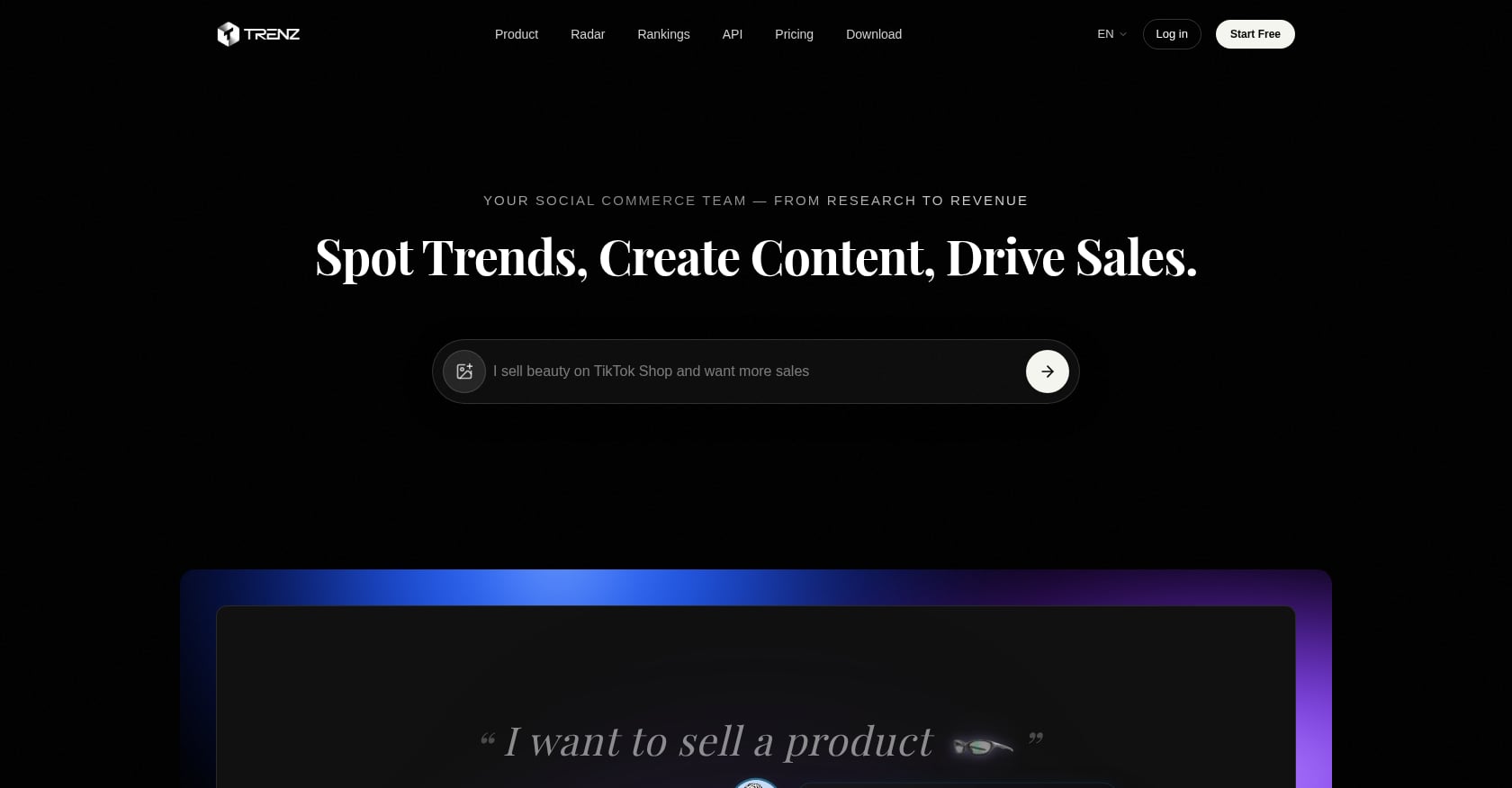
Best for: Sellers who want one platform covering discovery, AI content creation, and multi-platform publishing.
Trenz is an AI-native social commerce platform and Official TikTok Shop Partner that approaches product research differently from pure analytics tools. Instead of stopping at “here’s what’s trending,” it connects discovery to content creation to publishing to GMV measurement in a single workflow. That end-to-end pipeline is what sets it apart.
Pricing:
Free: 50 welcome credits, no credit card required
Growth: 250 credits/month, 3 social accounts
Pro: 650 credits/month, 10 social accounts
Scale: 1,800 credits/month, team workspace, additional seats at $19/seat/month
Credit top-ups: $10 for 100 credits (never expire). A product discovery task costs roughly 10 credits.
See full pricing details to estimate monthly costs for your volume.
Key features:
Market Analyst AI agent scans products across TikTok Shop, Amazon, and DTC brands. Identifies blue ocean products, sales spikes, and seasonal bestsellers.
Daily Radar delivers five data-backed product opportunities per day with GMV, growth, and creator concentration analysis.
Monthly TikTok Shop rankings by category and region, tracking approximately $408.7 million in GMV.
AI video, image, and script generation using multiple models (roughly 60-second average video generation time).
Social Manager for scheduling and publishing to TikTok, Instagram, YouTube, and Facebook.
Open API indexing 50 million+ TikTok products and 2 million+ creators.
iOS mobile app for on-the-go research.
Tradeoffs:
Deepest value is TikTok-first. Other platforms are supported mainly for publishing, not full commerce data.
Credit-based model requires budget planning, especially for video generation (3 credits per second adds up for longer videos).
AI video quality depends on third-party models, which can vary in consistency.
Base plan pricing is structured around credits and features rather than flat monthly amounts, so new users should run a test cycle to estimate total spend.
Why it ranks first: Every other tool on this list covers one or two stages of the research-to-revenue pipeline. Trenz is the only platform that bridges all of them: discovering products, generating content, publishing across channels, and measuring which content actually drives GMV. For sellers tired of stitching together four or five separate subscriptions, that consolidation is the real value.
Start free with 50 credits and run your first product discovery task.
2. Kalodata
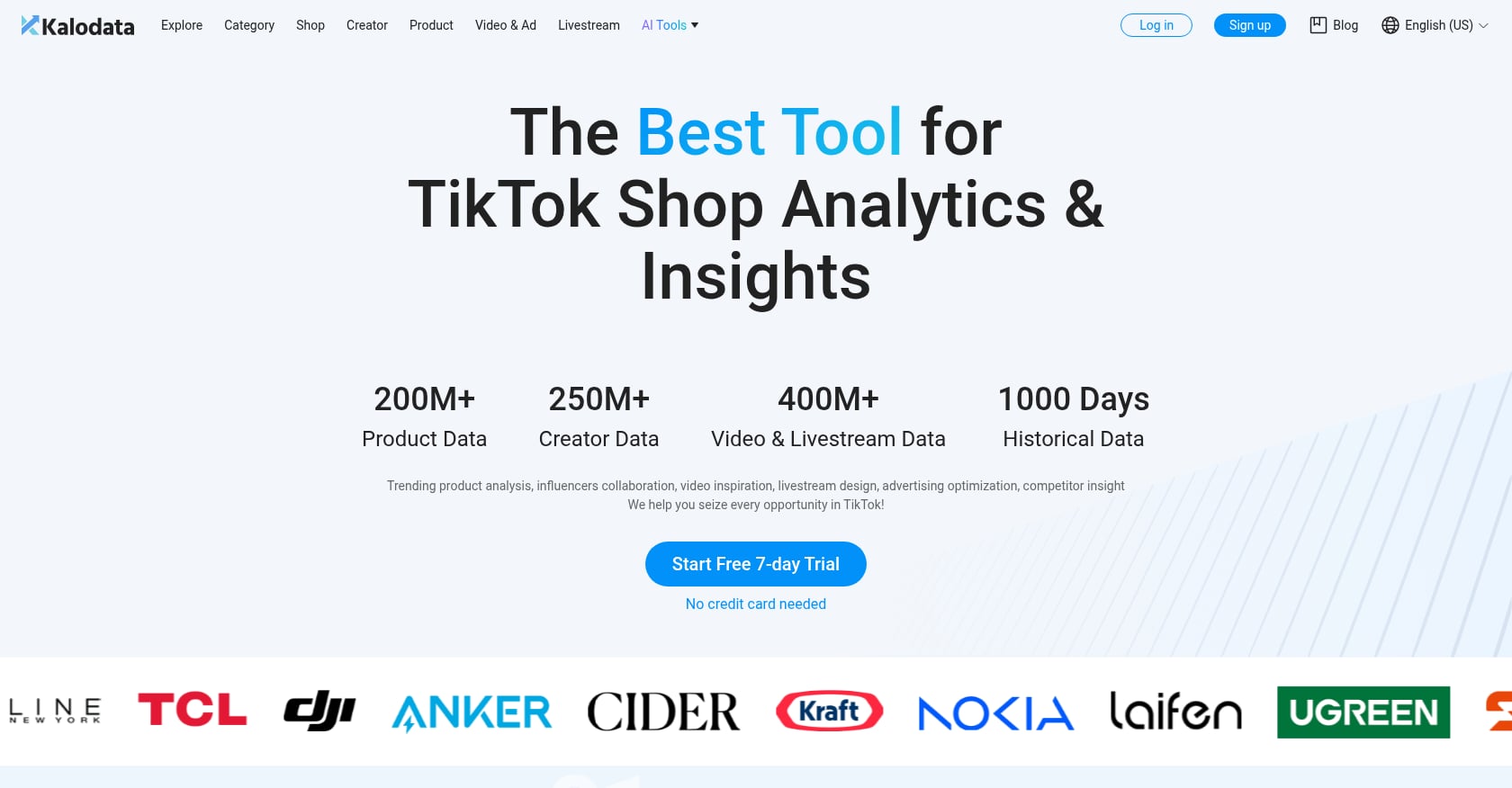
Best for: Sellers who want deep historical product analysis before committing to a niche.
Kalodata is a pure analytics and research tool focused on TikTok Shop product data, trending items, creator performance, and shop-level metrics. Its standout feature is historical depth.
Pricing:
Starter: approximately $38–$45/month
Professional: approximately $83–$99/month
7-day free trial available
Key features:
500 days of historical data, making it strong for identifying seasonal patterns and long-term trends rather than just current spikes.
Product, creator, video, and shop-level analytics.
Trending product rankings updated frequently.
Video hover preview feature for quickly scanning content performance.
Tradeoffs:
Analytics only. No content creation, no publishing, no store integration.
Revenue estimates are based on scraped and modeled data, not official API connections. Practitioners on Reddit’s r/TikTokshop describe the tool as useful but question whether revenue estimates accurately reflect real numbers. This limitation applies to all third-party analytics tools, not just Kalodata.
Can feel expensive for sellers still testing their first product or operating with limited capital.
User perspective: In Reddit discussions, users frequently note that Kalodata’s combination of pricing, interface, and the video hover preview feature makes it the stronger choice for roughly 70% of TikTok Shop users who primarily need research capabilities. However, the same threads consistently warn that GMV estimates from any tool should be treated as directional, not definitive.
For a detailed comparison, read our Kalodata alternative analysis to understand where each tool excels.
3. FastMoss
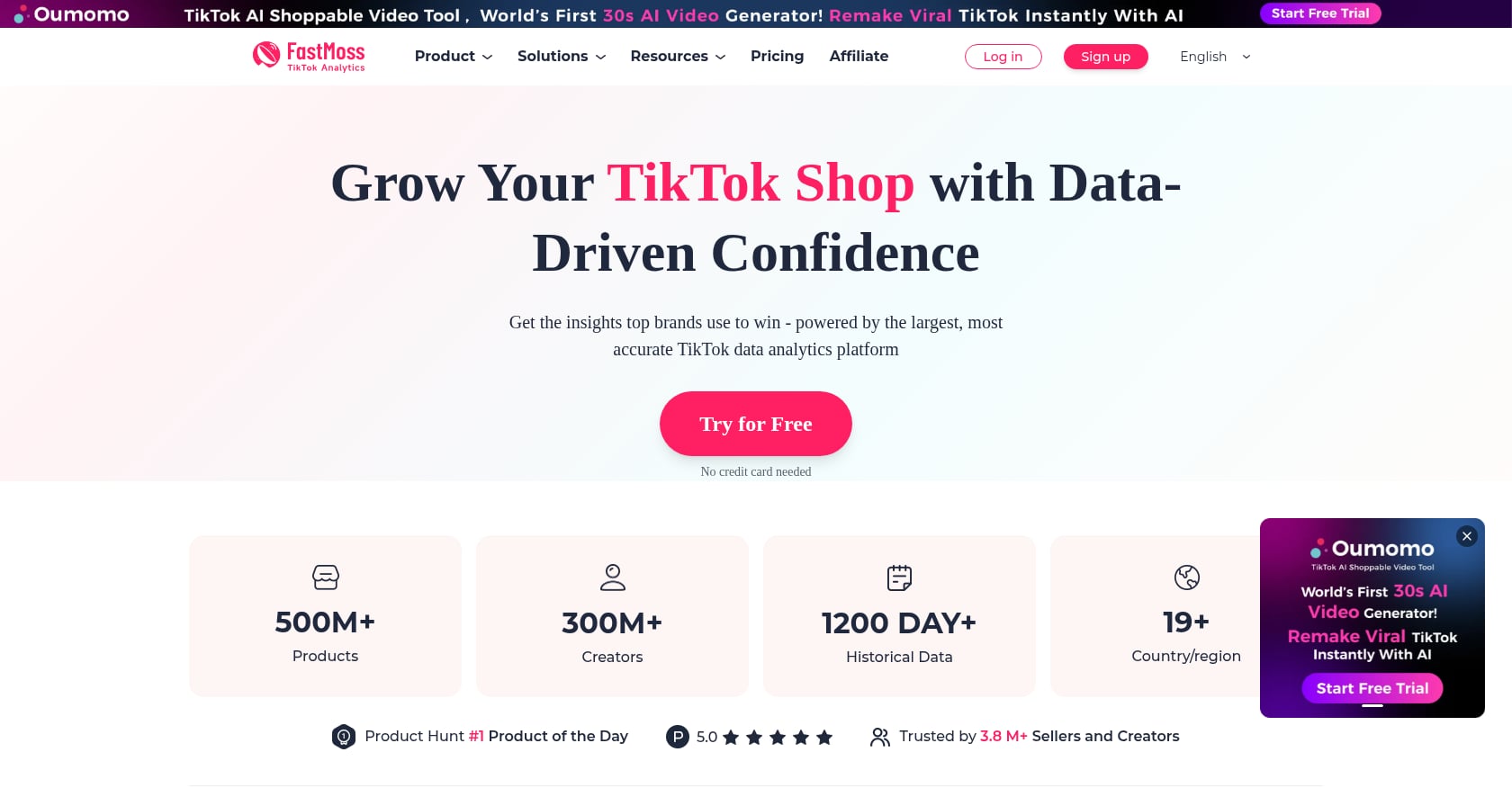
Best for: Agencies and operators focused on creator discovery and competitive intelligence across multiple markets.
FastMoss positions itself as the enterprise-grade analytics solution for TikTok Shop, with particular strength in global market coverage and influencer contact workflows.
Pricing:
Introductory: $29 for the first month, then $59/month on the Basic Plan
Higher tiers available for enterprise needs
Key features:
Global coverage across the US, UK, Indonesia, and Vietnam.
Macro-trend visualization with category-level graphs showing 30 to 90-day market growth.
Creator Discovery Engine capable of exporting up to 6,000 influencer contacts daily.
Ad monitoring and competitive intelligence features.
Tradeoffs:
Steeper learning curve than most competitors. Teams that love deep analysis will find patterns, but casual users may feel overwhelmed.
No content creation tools. No mobile app.
If you’re a creator doing product research (rather than a shop operator), much of FastMoss’s data will be irrelevant to your workflow.
User perspective: Experienced sellers note that FastMoss and Kalodata overlap roughly 80%, so picking one of the two makes more sense than subscribing to both. One creator shared in a review that FastMoss is “a really awesome tool for creators who generated millions of sales,” but acknowledged it’s overkill for smaller operations.
For a deeper look at how FastMoss compares, check out our FastMoss alternative breakdown.
4. PiPiADS
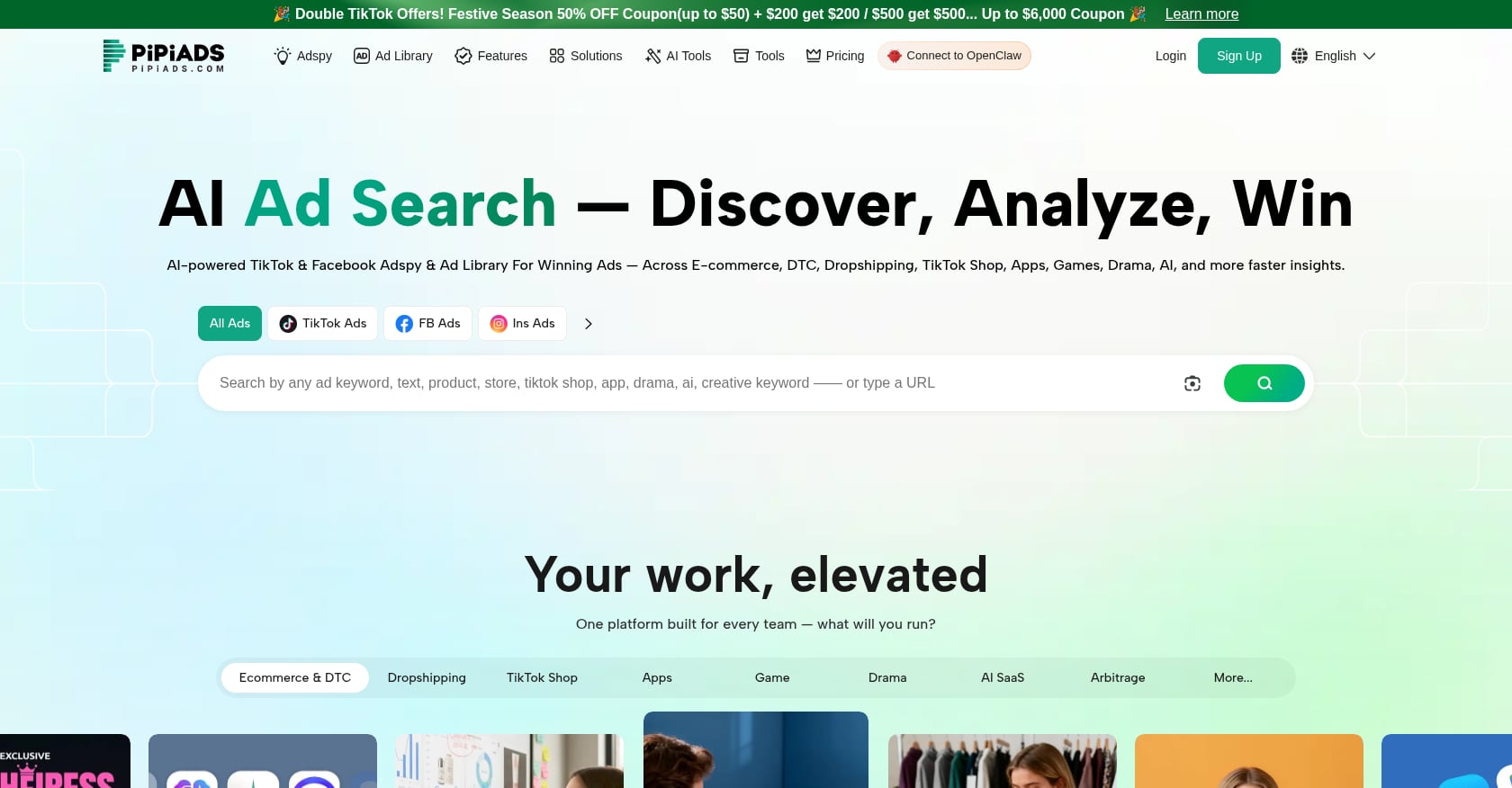
Best for: Intermediate and advanced sellers running consistent paid ad campaigns on TikTok and Meta.
PiPiADS is an ad spy tool first and a product research tool second. Its core strength is indexing millions of active ads across TikTok, Facebook, Instagram, and Audience Network, letting you see exactly what competitors are running and which creatives are performing.
Pricing:
Basic: $49/month
Advanced: $99/month
Enterprise: $900/month
Flexible: starting at $180/month (customizable)
500 free trial credits for new users
Key features:
Largest dedicated TikTok and Meta ad intelligence database.
Ad-level performance signals combined with product discovery.
Creative inspiration library for ad formats and hooks.
Filtering by engagement, duration, and ad spend indicators.
Tradeoffs:
Ad-centric, not a full shop analytics solution. Won’t help with organic product research or creator analytics.
Typically starts delivering strong ROI only when operators reach monthly ad spend exceeding $3,000 to $5,000. Below that threshold, the subscription cost is hard to justify.
Price sensitivity is a common theme. A G2 reviewer noted, “If the price could be a little lower, I believe it would be the most cost-effective ad tool.”
User perspective: Another G2 reviewer shared: “PiPiADS saves me so much time when doing ad research. I can quickly find trending TikTok ads, see what competitors are running, and get ideas for creatives.” The consensus is that it’s genuinely useful for ad-heavy operations but unnecessary for organic-first sellers.
Our PiPiADS alternative guide digs into when ad spy tools make sense versus pure product research platforms.
5. EchoTik

Best for: Budget-conscious beginners who want quick product checks while browsing TikTok.
EchoTik is a Singapore-based SaaS offering an affordable entry point into TikTok analytics. Its Chrome extension is particularly handy for casual research, letting you pull up product data without leaving the TikTok browser interface.
Pricing:
Free-forever plan available
Paid plans: $9 to $19/month
Key features:
Product selection tools, influencer discovery, and live streaming analysis.
Chrome browser extension for inline data while browsing TikTok.
Basic AI creative tools.
Web dashboard for deeper (though still surface-level) analysis.
Tradeoffs:
Data stays surface-level. Useful for quick checks but not deep enough for serious category analysis.
Limited historical data compared to Kalodata or FastMoss.
Won’t replace a dedicated research tool once you scale past beginner stage.
User perspective: In a YouTube walkthrough demonstrating EchoTik’s features, the presenter praised its accessibility but acknowledged that sellers outgrow it quickly once they need granular GMV data or creator concentration metrics. It’s a solid starting tool, not a long-term solution.
6. Shoplus
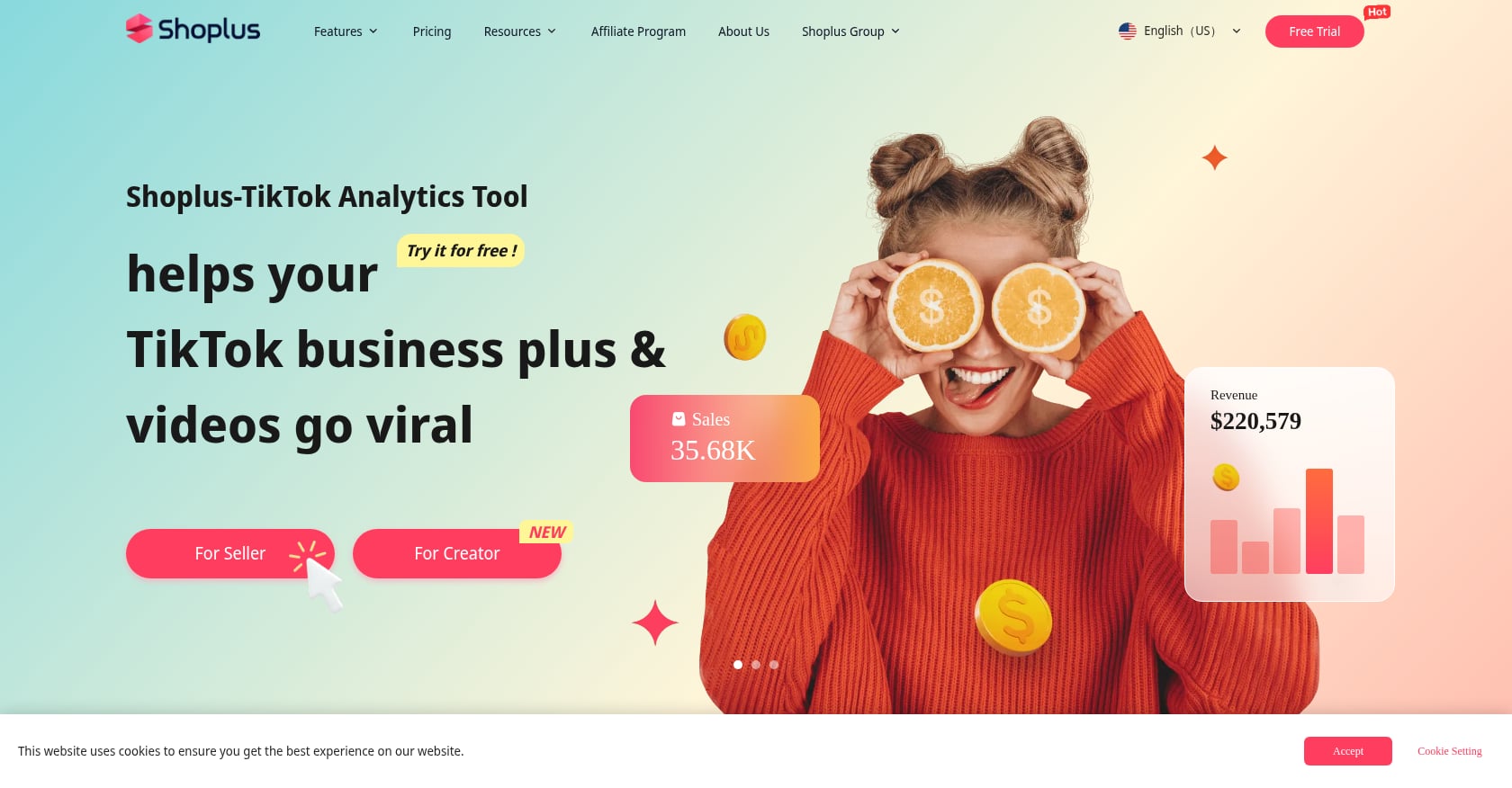
Best for: Sellers prioritizing affiliate creator partnerships and influencer marketing analytics.
Shoplus focuses on the intersection of product analytics and creator outreach, making it particularly useful for sellers whose growth strategy depends on recruiting TikTok affiliates.
Pricing: Varies by plan; check their site for current rates.
Key features:
Influencer marketing analytics tied to product performance.
Creator discovery and outreach tools.
Product opportunity scoring based on affiliate potential.
Tradeoffs:
Narrower feature set than Kalodata or FastMoss for pure product research.
Less useful for sellers who rely primarily on their own content rather than affiliate networks.
Smaller user community means fewer peer discussions and troubleshooting resources.
For sellers building affiliate strategies, our guide on finding TikTok Shop creators covers the full recruitment workflow.
7. TikTok Creative Center
Best for: Anyone starting product research with zero budget.
TikTok’s own Creative Center is the most overlooked free resource for product research. Its Top Products section displays trending items by region and category, with performance metrics pulled directly from the platform. Since this is first-party data, it reflects actual platform activity rather than third-party estimates.
Pricing: Completely free.
Key features:
Trending products by region and category.
Trending hashtags, songs, and creative formats.
Ad inspiration library with top-performing examples.
First-party data accuracy (no scraping or estimation).
Tradeoffs:
Desktop only.
No GMV or revenue data. You can see which products generate the most video content and engagement, but not actual sales figures.
No historical depth. Shows current trends only.
No export functionality or API access.
This is the right starting point for anyone doing TikTok Shop product research for the first time. It costs nothing and the data is as accurate as it gets. But the ceiling is low, and you’ll hit it quickly once you need sales estimates, competitive intelligence, or historical trend analysis.
8. Sell The Trend
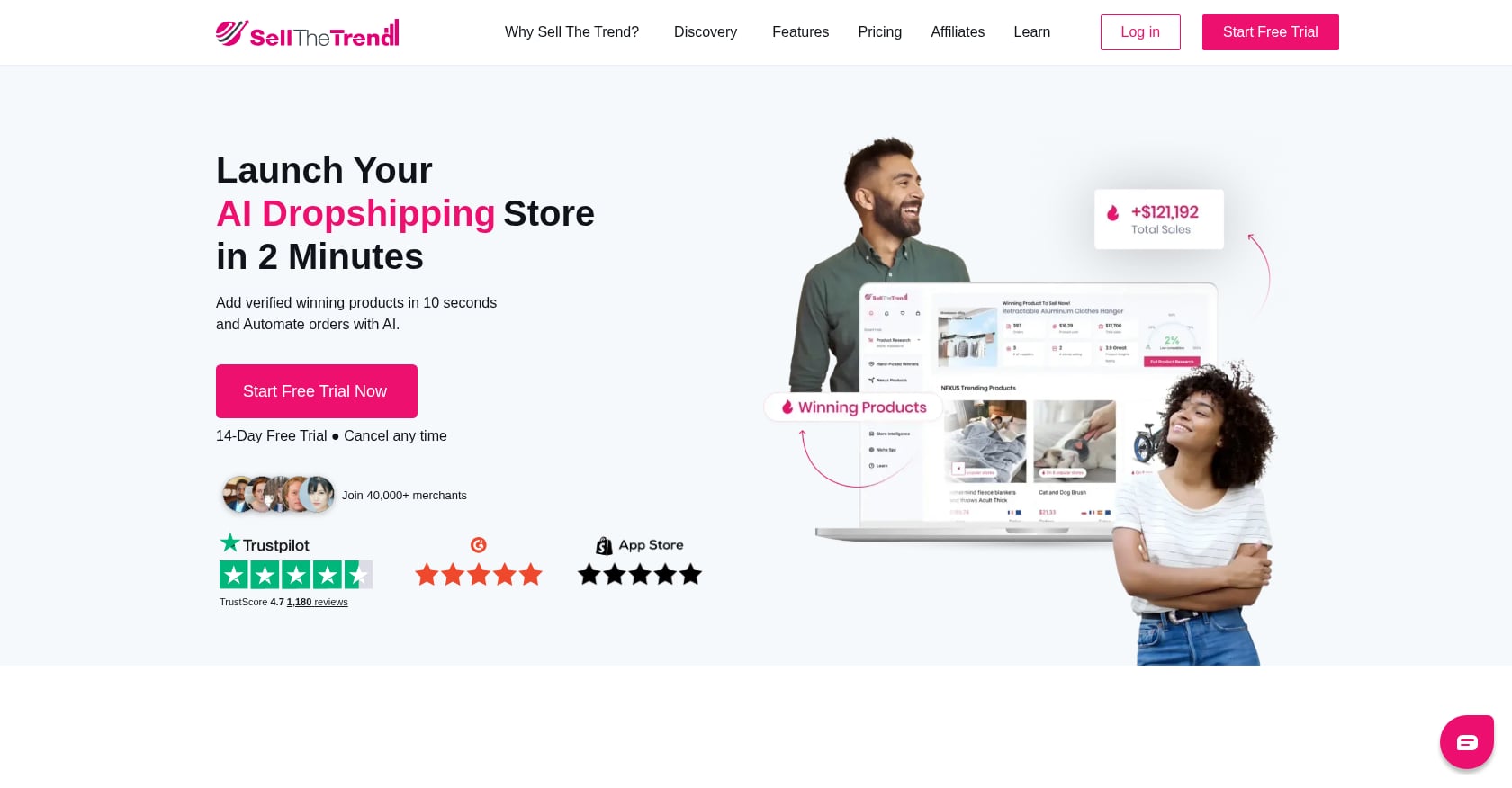
Best for: Dropshippers doing cross-platform product research across TikTok, AliExpress, Amazon, and Shopify.
Sell The Trend casts a wider net than TikTok-specific tools, scanning multiple marketplaces to find products with momentum across platforms.
Pricing:
Essential: $39.97/month
7-day free trial available
Key features:
Multi-platform product scanning (TikTok, AliExpress, Amazon, CJ Dropshipping).
“Nexus” AI product recommendation engine.
Store integration for one-click imports to Shopify.
Supplier connection tools.
Tradeoffs:
TikTok-specific data is shallower than dedicated tools like Kalodata or Trenz.
More suited for traditional dropshipping than TikTok Shop native selling.
Interface can feel cluttered with features irrelevant to TikTok-only sellers.
9. FindNiche
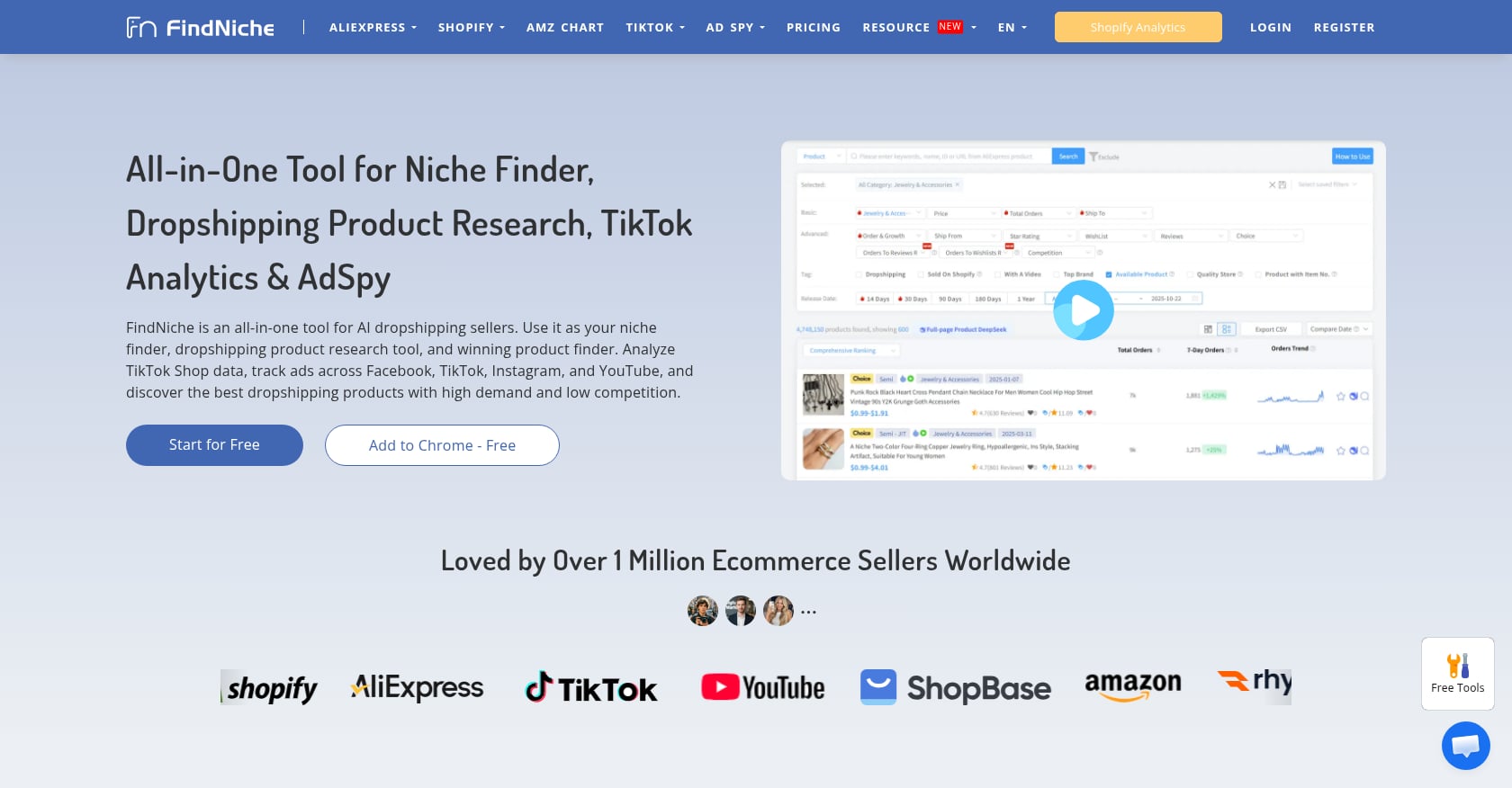
Best for: Sellers who want to cross-reference AliExpress supplier data with TikTok product trends.
FindNiche bridges the gap between product discovery and supplier sourcing, which is particularly useful for sellers who source from AliExpress or similar platforms and sell through TikTok Shop.
Pricing:
Free tier available with limited features
Paid plans starting at approximately $9/month
Key features:
AliExpress product database with supplier-level analytics.
TikTok trending product data for cross-referencing.
Niche market analysis with competition scores.
Shopify store analytics.
Tradeoffs:
AliExpress-centric design means TikTok data is supplementary, not primary.
Lighter on TikTok-specific insights than any of the dedicated tools above.
Best used as a supplement alongside a TikTok-native research tool, not as a standalone.
10. Niche Scraper
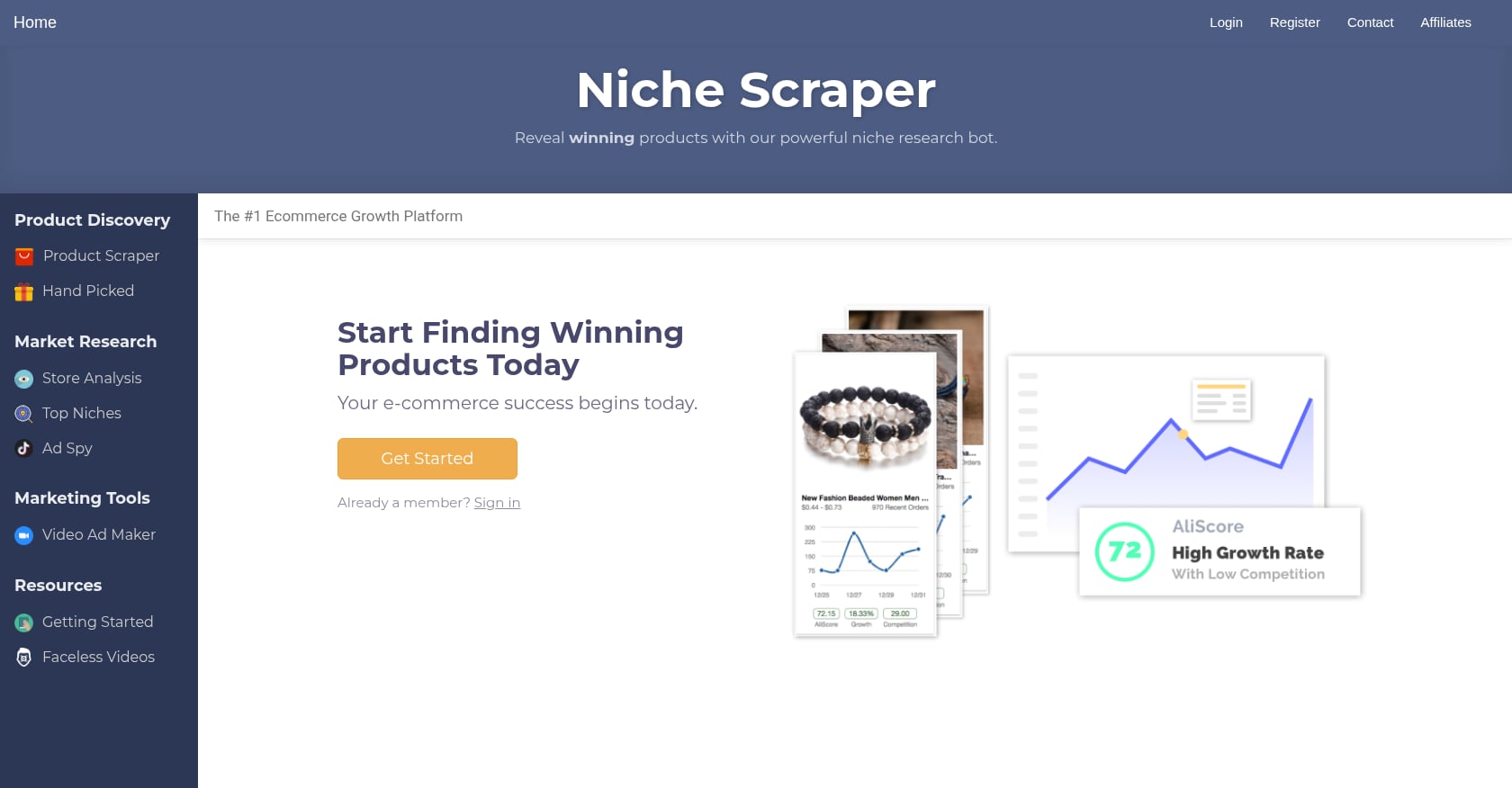
Best for: Sellers who prefer curated, daily product picks over doing their own deep research.
Niche Scraper takes a different approach from the analytics platforms on this list. Instead of giving you dashboards to explore, it serves up hand-picked product recommendations daily, essentially doing the research for you.
Pricing:
Free tier with limited daily picks
Pro: $49.95/month
Key features:
Daily curated product picks with performance data.
Product scraper for Shopify and AliExpress.
Video ad maker (basic).
Store analysis tools.
Tradeoffs:
You’re trusting someone else’s judgment on what constitutes a winning product.
Curated picks are seen by every subscriber simultaneously, creating instant competition.
TikTok Shop-specific coverage is secondary to their broader e-commerce focus.
How Much Should You Spend on TikTok Shop Product Research Tools?
The answer depends entirely on where you are in your selling journey. Experienced practitioners have settled on rough budget tiers that make practical sense:
Under $1,000/month in revenue: Spend $0 to $50 per month on tools. Start with TikTok Creative Center (free) and one analytics tool’s free trial. Your goal at this stage is learning the research process, not maximizing data coverage.
$1,000 to $10,000/month in revenue: Budget $80 to $150 per month. This typically covers one dedicated analytics tool plus basic AI content capabilities. At this level, paid tools start meaningfully improving decision quality.
Over $10,000/month in revenue: Expect to spend $400 to $1,000 per month across analytics, content intelligence, and operational tools. At scale, the cost of bad product decisions (wasted content, dead inventory, missed windows) far exceeds subscription fees.
The most practical advice, echoed repeatedly in seller communities: pick one research tool, not three. FastMoss and Kalodata overlap about 80% in functionality. Subscribing to both wastes money. Choose one based on whether you prioritize historical depth (Kalodata) or creator discovery (FastMoss), or choose a platform like Trenz that combines research with content creation to eliminate the multi-tool problem entirely.
For a broader look at the analytics tool category, our TikTok Shop analytics tools guide covers additional options beyond product research.
Common Mistakes in TikTok Shop Product Research
Chasing “trending” instead of “opportunity.” Products at the top of any trending list are already saturated. By the time a tool labels something as trending, dozens of sellers have already launched. The real value is in rising products with low creator concentration, the blue ocean signals that indicate demand is growing faster than supply.
Ignoring creator concentration. If three creators drive 80% of a product’s revenue, that’s their audience converting, not the product itself. New sellers entering that product will face a completely different conversion reality. Always check how distributed sales are across creators before committing.
Treating GMV estimates as facts. Every third-party analytics tool (Kalodata, FastMoss, EchoTik, all of them) relies on scraped or modeled data. None connect to TikTok’s actual transaction API. Practitioners on Reddit consistently warn that revenue estimates should be treated as directional indicators, not profit projections. Any “profit” number you derive from these tools is a guess until verified with your own sales data.
Not connecting research to content speed. One stat tells the whole story: 45% of TikTok sellers admit they can’t track which videos drive sales. And only 12% effectively use analytics to convert viral attention into actual revenue. Research without a content execution pipeline is just entertainment. The sellers who win are the ones who go from insight to published video within hours, not days.
Researching forever instead of testing. Product research should inform fast, low-cost tests, not replace them. Spending two weeks analyzing data for a product that takes $50 of AI-generated content to test is backwards. Get the signal, create the content, publish, and let real sales data tell you whether the research was right.
FAQ
What is the best free TikTok Shop product research tool?
TikTok Creative Center is the best free option. It provides first-party trending product data by region and category, pulled directly from the platform. It won’t show you revenue numbers or historical trends, but it’s the most accurate starting point for identifying what products are generating attention right now.
How do I find trending products on TikTok Shop?
Start with TikTok Creative Center’s Top Products section for free trend data. For deeper research, use paid tools like Trenz (which surfaces blue ocean opportunities and daily Radar picks) or Kalodata (which offers 500 days of historical data). The key is looking beyond what’s currently trending to find products with rising demand and low creator concentration.
Is Kalodata or FastMoss better for product research?
They overlap roughly 80% in functionality. Kalodata is stronger for historical product analysis and deep research before committing to a niche. FastMoss is better for creator discovery, contact workflows, and global market coverage. Most experienced sellers recommend picking one, not both.
How much do TikTok Shop analytics tools cost?
Free options exist (TikTok Creative Center, EchoTik’s free plan, Trenz’s 50 free credits). Paid tools range from $9/month (EchoTik) to $99/month or more (Kalodata Professional, PiPiADS Advanced). The right budget depends on your revenue: under $1,000/month, keep tool spend under $50. Above $10,000/month, $400 to $1,000 across your full tool stack is typical.
Can I do TikTok Shop product research without a paid tool?
Yes, but with significant limitations. TikTok Creative Center, TikTok Seller Center analytics, and manual browsing of the For You page can surface opportunities. The official free tools are enough to launch and get your first sales. Past $1,000 per month in revenue, paid analytics and AI content tools start meaningfully improving the quality of your decisions.
What makes a good product for TikTok Shop?
Strong TikTok Shop products share several traits: they solve a visible problem (demonstrable in video), have a “wow” factor that stops the scroll, fall in a price range that triggers impulse purchases ($15 to $60 typically), and exist in categories with rising GMV but relatively few active creators. Cross-platform validation (showing Google Trends lift alongside TikTok virality) is a strong signal of sustainable demand versus flash trends.
How quickly do trending products get saturated on TikTok Shop?
Fast. TikTok reports indicate 72% of trending products are copied by competitors within 48 hours. This makes speed of execution, from research to published content, the real competitive edge. Tools that combine product discovery with content creation (rather than requiring separate platforms for each) have a structural advantage in this environment.
What is the difference between product research tools and ad spy tools?
Product research tools (Trenz, Kalodata, FastMoss) analyze organic TikTok Shop data: which products are selling, which creators are driving revenue, and which categories are growing. Ad spy tools (PiPiADS) focus specifically on paid advertising: which ads are running, what creative formats are performing, and how much competitors appear to be spending. Most sellers benefit more from product research tools first and add ad spy tools once they’re spending $3,000 or more per month on paid campaigns.
The gap between finding a winning product and profiting from it has never been smaller, or faster to close. Whether you start with free tools or go straight to an end-to-end platform, the framework matters more than the tool. Identify momentum, find the blue ocean, validate across platforms, study winning content, and test fast. The sellers who execute that loop quickest are the ones who win.
Author


