
TL;DR
TikTok Shop competitor analysis means systematically tracking what rival sellers, creators, and ads are doing so you can move faster than the market. With 82% of TikTok Shop sellers losing money and top product listings lasting only about 60 days before copycats flood in, this is survival work, not optional homework. This guide covers nine tools (from free to enterprise), introduces a 4-layer competitor analysis framework no other guide offers, and walks through a practical workflow you can start today.
Explore Trenz’s AI platform to see how product discovery, content creation, and publishing connect in one place.
Quick Answer: What Is the Best TikTok Shop Competitor Analysis Tool?
The strongest competitor analysis workflow combines four areas:
1. Market analysis (category trends and demand)
2. Shop analysis (competitor stores and products)
3. Creator analysis (affiliate partnerships)
Creative analysis (videos and ads)
4. Tools that cover multiple areas generally provide better decision-making than single-purpose analytics platforms.
For most TikTok Shop sellers in 2026, the best competitor analysis tool depends on your goal:
Goal | Recommended Tool |
|---|---|
All-in-one competitor research, content creation, and publishing | Trenz |
Deep historical product and GMV analysis | Kalodata |
Creator discovery and shop tracking | FastMoss |
TikTok ad spy and creative intelligence | PiPiAds |
Budget-friendly analytics | Shoplus |
Free trend research | SimpTok |
Native first-party shop data | TikTok Seller Center |
Why TikTok Shop Competitor Analysis Is No Longer Optional
TikTok Shop generated $66 billion in global GMV in 2025, with US sales alone growing 108% year-over-year to $15.82 billion. Projections for 2026 put global GMV above $112 billion, with the US expected to contribute roughly $23.4 billion.
The numbers sound like opportunity. They are. But the supply side tells a different story.
Over 15 million active sellers now operate on TikTok Shop globally, and the US alone has around 475,000 shops, a 5,000% increase from just 4,450 in mid-2023. The supply side is growing faster than the demand side, which is the opposite of how most marketplaces develop. That imbalance makes competition for attention brutal.
Industry data cited by Short Form Nation puts the failure rate starkly: 82% of sellers on TikTok Shop are losing money. Meanwhile, research from MomentIQ shows that top-performing product listings have roughly a 60-day lifecycle before competitors replicate the formula. In most categories, 3 to 5 dominant shops capture the majority of GMV, leaving everyone else to fight over scraps.
This is why TikTok Shop competitor analysis has become survival infrastructure. Without it, you’re guessing which products to launch, which creators to partner with, which content angles to test, and which price points to hit. With it, you compress the learning curve and make decisions based on what’s actually working right now.
To see what that looks like in practice, browse live TikTok Shop rankings to understand how GMV concentrates within specific categories.
TikTok Shop Competitor Analysis Statistics (2026)
Statistic | Value |
|---|---|
Global TikTok Shop GMV (2025) | $66 Billion |
Projected Global GMV (2026) | $112+ Billion |
US TikTok Shop Sales (2025) | $15.82 Billion |
Projected US Sales (2026) | $23.4 Billion |
Active Global Sellers | 15+ Million |
US TikTok Shops | ~475,000 |
Seller Growth Since 2023 | 5,000% |
Sellers Losing Money | 82% |
Average Winning Product Lifecycle | ~60 Days |
These figures highlight why competitive intelligence has become a core requirement rather than an optional growth tactic.
The 4-Layer Competitor Analysis Framework
Most guides list tools without explaining what you’re supposed to do with them. That’s a problem. A tool is only as useful as the framework behind it.
TikTok Shop competitor analysis works best when you think of it as four distinct layers. Each layer answers a different question, and each requires different data.
Layer 1: Market-Level Analysis
Question: Which categories are growing, which are saturated, and where are the gaps?
At this level, you’re tracking category-wide GMV trends, market concentration (how many shops control a category), and emerging subcategories. You want to spot blue-ocean opportunities before they get crowded. For example, tracking US Skincare rankings month over month reveals which brands are gaining share and which subcategories are growing fastest.
Layer 2: Shop-Level Analysis
Question: What are specific competitors doing day to day?
Here you zoom in. Track individual shops’ sales velocity, product launches, price changes, review sentiment, and promotional timing. If a competitor drops prices on their hero SKU, you want to know within hours, not weeks.
Layer 3: Creator-Level Analysis
Question: Which creators are driving competitors’ revenue, and are any of them available to work with you?
TikTok Shop runs on creator partnerships. Understanding which affiliates generate actual conversions (not just views) for your competitors tells you where to recruit and what kind of creator content converts in your niche. For a deeper breakdown of creator metrics, the guide on TikTok Shop creator analytics covers ROI measurement in detail.
Layer 4: Creative-Level Analysis
Question: What ad formats, hooks, scripts, and content angles convert for competitors?
This is the most actionable layer. Reverse-engineering a competitor’s top-performing video tells you what thumbnail style, opening hook, product demonstration angle, and call-to-action format works in your category right now.
The tools below are organized by how well they cover these four layers.
What Data Should You Track During TikTok Shop Competitor Analysis?
Many sellers monitor competitors without knowing which metrics actually matter.
The most valuable competitor metrics are:
Metric | Why It Matters |
|---|---|
Estimated GMV | Reveals revenue leaders |
Sales Velocity | Shows product momentum |
Product Launch Frequency | Indicates innovation speed |
Average Selling Price | Helps position pricing |
Affiliate Count | Reveals creator strategy |
Video Engagement Rate | Measures content quality |
Review Growth | Signals customer satisfaction |
Creator Concentration | Shows dependency risk |
Ad Creative Volume | Indicates advertising aggression |
Category Share | Reveals market leaders |
Instead of tracking dozens of metrics, focus on these ten indicators consistently over time.
A smaller set of reliable signals produces better decisions than monitoring everything.
At-a-Glance Comparison Table
Tool | Starting Price | Competitor Analysis Depth | Content Creation | Publishing | Best For | Free Trial |
|---|---|---|---|---|---|---|
Trenz | Free (50 credits) | Deep (product, shop, rankings, GMV, Blue Ocean, Radar) | Yes (AI video, image, scripts) | Yes (TikTok, IG, YouTube, FB) | Full-workflow sellers and agencies | Yes, no card |
Kalodata | ~$38/mo (annual) | Deep (product, creator ROI, pricing, 500-day history) | No | No | Research-first sellers and affiliates | Yes, 7-day, no card |
FastMoss | $29 intro, then $59/mo | Very deep (200M+ products, shop watchlists, ad monitoring) | No | No | Agencies, multi-brand operators | Yes |
PiPiAds | $49/mo | Ad creative intelligence only | No | No | Paid-ads-first sellers | Yes, 500 credits |
Shoplus | $49/mo | Moderate (trends, competitor insights) | No | No | Budget-conscious sellers | Yes |
Sprout Social | $99/mo | Content benchmarking only (not commerce) | No | Yes | Brand social teams | Yes, 30-day |
EchoTik | ~$9/mo | Surface-level (Chrome extension) | No | No | Beginners on a tight budget | Yes |
SimpTok | Free | Basic trend data | No | No | Zero-budget sellers | Free |
TikTok Seller Center | Free | First-party only (no competitor data) | No | No | Operational reporting | N/A |
Quick guidance: If you need the full pipeline from research through content creation and publishing, start with Trenz. If you want pure data depth and don’t need content tools, pick either Kalodata or FastMoss (they overlap about 80%, according to practitioner consensus across comparison reviews). If your main question is “what ads are working,” PiPiAds is the specialist.
How We Evaluated TikTok Shop Competitor Analysis Tools
To compare platforms fairly, we evaluated each tool across six categories:
Data Coverage
How much TikTok Shop data is available, including products, creators, shops, and categories.
Historical Data Depth
How far back users can analyze performance trends.
Competitor Monitoring
Whether the platform supports watchlists, alerts, pricing changes, and shop tracking.
Creator Intelligence
Availability of creator discovery and affiliate performance metrics.
Content & Ad Analysis
Ability to analyze winning creatives, hooks, ads, and content formats.
Workflow Features
Support for content creation, publishing, reporting, and automation.
Tools scoring highly across multiple categories generally provide greater long-term value than platforms focused on a single analysis layer.
The 9 Best Tools for TikTok Shop Competitor Analysis
1. Trenz
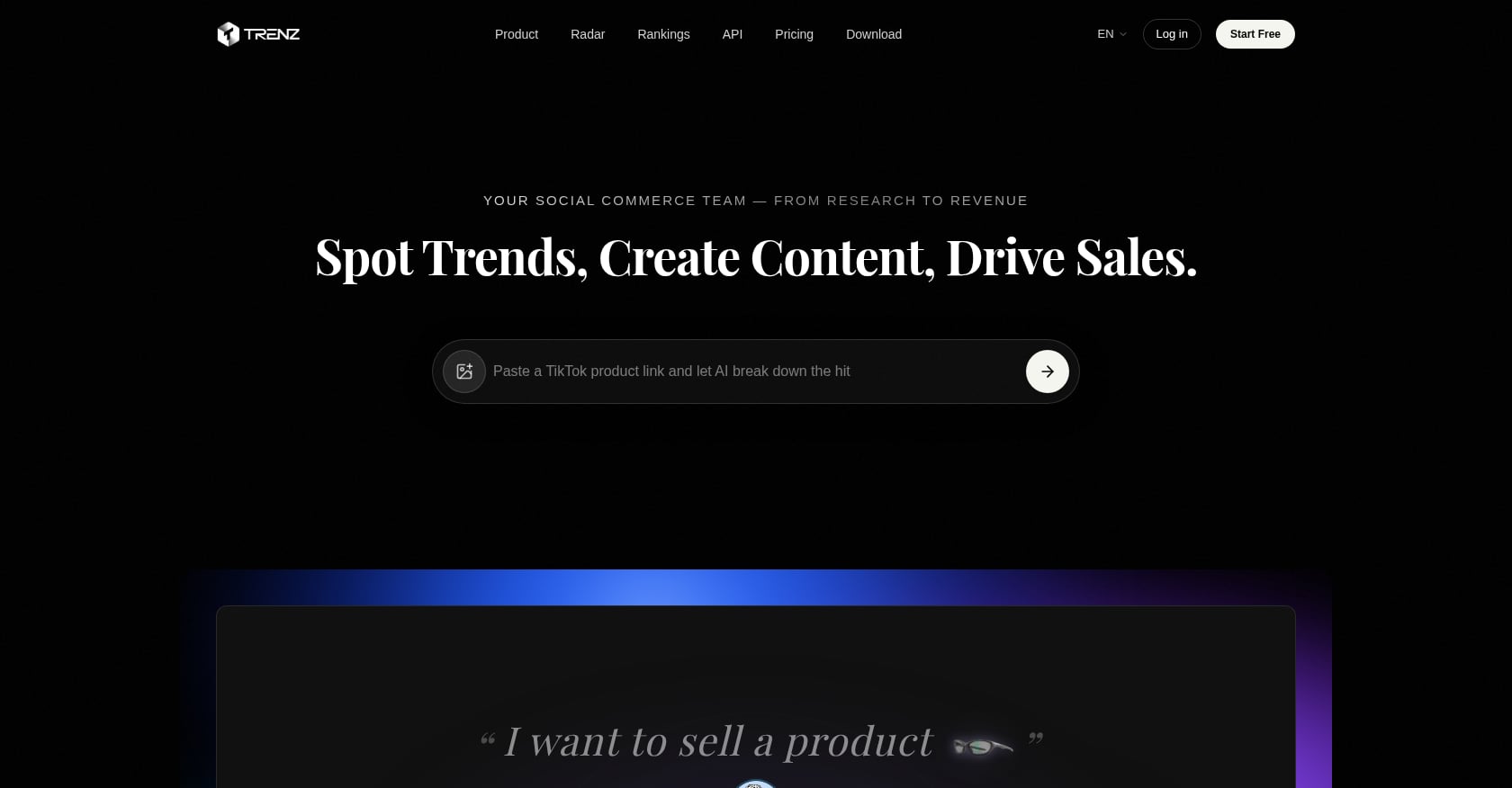
Best for: Full-workflow competitor analysis, from product discovery through content creation, publishing, and GMV measurement.
Trenz is an AI-native social commerce platform and Official TikTok Shop Partner that covers all four layers of competitor analysis in a single workspace. Most tools in this space handle research or analytics. Trenz connects research directly to content production and publishing, which eliminates the gap between “I found an insight” and “I acted on it.”
Key competitor analysis features:
Product Discovery (Market Analyst agent): Scans billions of products across TikTok Shop, Amazon, and DTC. Identifies Blue Ocean opportunities, Sales Spikes, and Seasonal Bestsellers. Includes competitor tracking and watchlists.
Daily Radar: Delivers 5 fresh, data-backed product and market opportunities per day with GMV, growth rate, and creator-concentration analysis for US and UK markets. Check today’s Radar for a sample.
Monthly Rankings: Category-by-category TikTok Shop rankings with GMV tracked (approximately $408.7M indexed) and top movers highlighted.
AI Content Creation (Creative Director agent): Generate videos (~60 seconds average) using Seedance 2.0, Veo 3.1, or Wan 2.6 models. Also produces scripts, hooks, content angles, and product images.
Social Manager: Schedule and publish to TikTok, Instagram, YouTube, and Facebook. Includes best-time-to-post insights and content-to-GMV measurement.
Open API: 50M+ TikTok products and 2M+ creators indexed under a single API key covering commerce data, AI generation, social ops, and ads.
Pricing:
Free: 50 welcome credits, no credit card required
Growth: 250 credits/month, 3 social accounts, 90-day data history
Pro: 650 credits/month, 10 social accounts, 180-day data history
Scale: 1,800 credits/month, 50 social accounts, 365-day history, team workspace ($19/seat/month)
Top-ups: $10 = 100 credits, never expire. Example costs: Product Discovery ~10 credits, Competitor Report ~8 credits, Video ~12 credits.
See full pricing and credit details for plan-by-plan breakdowns.
Honest tradeoffs:
Deepest value is for TikTok Shop workflows. Other platforms are supported primarily for publishing and analytics, not full commerce data.
The credit model is transparent but requires budget planning. Video generation at 3 credits per second adds up for longer videos.
Base plan dollar amounts beyond credits and features aren’t prominently displayed, so teams may need a test cycle to estimate total spend.
As a newer platform, it lacks the volume of third-party reviews that more established analytics-only tools have accumulated.
Who should pick this: Sellers and agencies who are tired of stitching together 4 to 5 separate tools for research, content, scheduling, and analytics. The ability to go from “spotted a competitor trend” to “published a response video” in one platform is genuinely unique in this category.
2. Kalodata
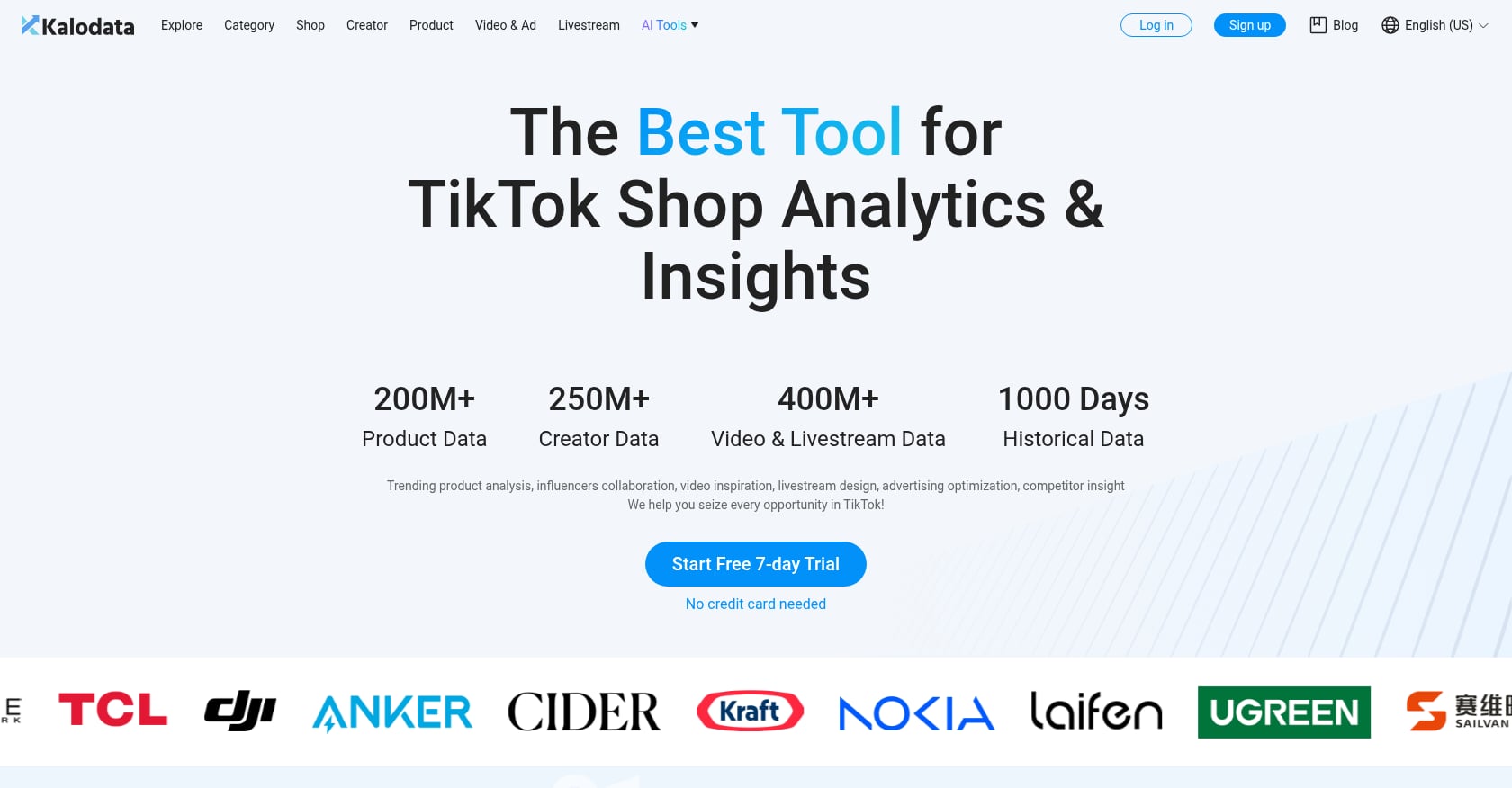
Best for: Deep product research and historical trend analysis for TikTok Shop.
Kalodata is a data analytics platform built specifically for TikTok Shop. Its management team came from TikTok’s global e-commerce division, which gives it credibility on data accuracy and methodology. The platform provides 500 days of historical data, refreshes every 15 minutes, and is particularly strong at blue-ocean product scoring, surfacing high-demand, low-competition products.
Key competitor analysis features:
Product research with pricing intelligence and shop-level tracking
Creator ROI metrics (which affiliates actually convert, not just drive views)
Blue-ocean product scoring
Video performance analysis
500-day historical data window with transparent methodology
Pricing:
Starter: ~$38.30/month (annual billing). 50 searches per day, 100 detail pages per day, 90-day data range.
Professional: ~$83.20/month. 250 daily searches, 180-day data window.
Enterprise: Custom pricing.
Free trial: 7 days, no credit card required.
Honest tradeoffs:
Analytics only. No content creation, no publishing, no scheduling.
One Capterra reviewer noted: “Kalodata was my introduction into insights and analytics for TikTok Shop and has a lot to offer. Their competitor seems to have more of what I am looking for overall.”
Another user mentioned “the UI is kind of bland compared to competitors” and felt that useful features were kept behind the paywall during the free trial.
The Starter plan’s 50 daily searches and 90-day data range can feel limiting for sellers tracking multiple categories.
For sellers weighing Kalodata against a more integrated workflow, the comparison of Kalodata alternatives breaks down the key differences.
Who should pick this: Individual sellers and affiliates who primarily need research and historical data, and who already have separate solutions for content creation and publishing.
3. FastMoss
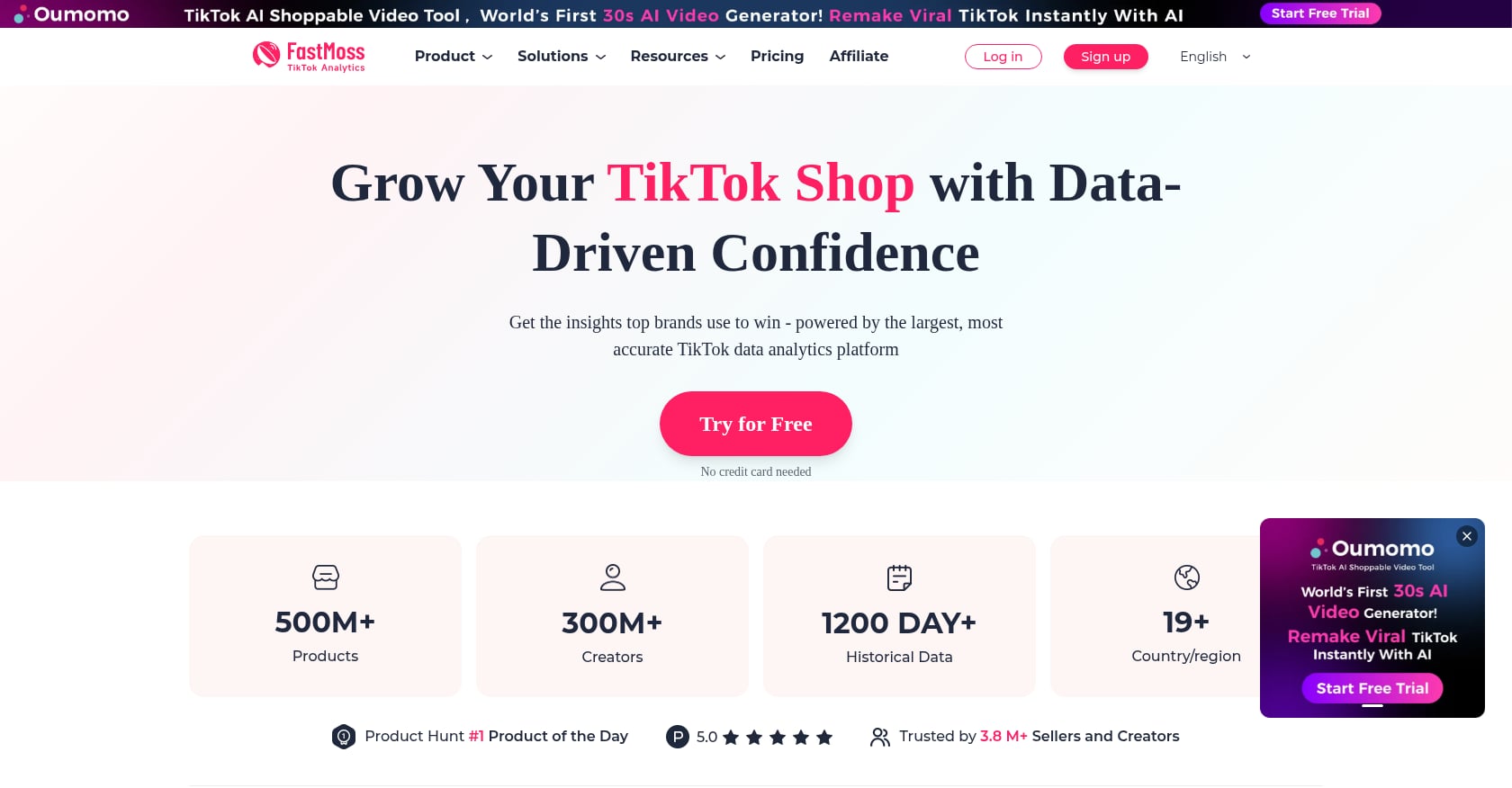
Best for: Market intelligence and creator discovery at scale, especially for agencies managing multiple brands.
FastMoss focuses on helping sellers discover trends, track competitors, and act on sales data. With 200M+ products indexed, it’s one of the largest TikTok Shop data platforms. Its Creator Discovery Engine can export up to 6,000 influencer contacts daily, making it particularly valuable for operators running aggressive creator outreach.
Key competitor analysis features:
Track specific competitor shops over time: daily sales velocity, product launches, price changes, and which creators promote them
Build watchlists with alerts
Benchmark winning TikTok ads and analyze creator strategies
Creator Discovery Engine with mass export capability
Pricing:
Introductory: $29 for the first month, then $59/month
Higher tiers push above $100/month
The introductory-to-standard price jump is the most common criticism in user reviews
Honest tradeoffs:
Steeper learning curve. Practitioners report an “overwhelming amount of data” and feel “much of the information is overkill at times.”
No mobile app (the website works on mobile, but there’s no dedicated experience).
Analytics-only. No content creation or publishing.
The price jump from $29 to $59 catches people off guard, and the most useful features sit behind more expensive tiers.
A Viva Naturals testimonial highlights the upside: “I want to contribute and encourage others to use FastMoss. It’s a really awesome tool for creators who generated millions of sales.” The FastMoss alternatives breakdown compares it against tools that cover more of the workflow.
Who should pick this: Agencies and multi-brand operators who need deep data and run heavy creator outreach. Practitioners on comparison forums consistently note that FastMoss is the better choice for operators, while Kalodata suits researchers.
4. PiPiAds
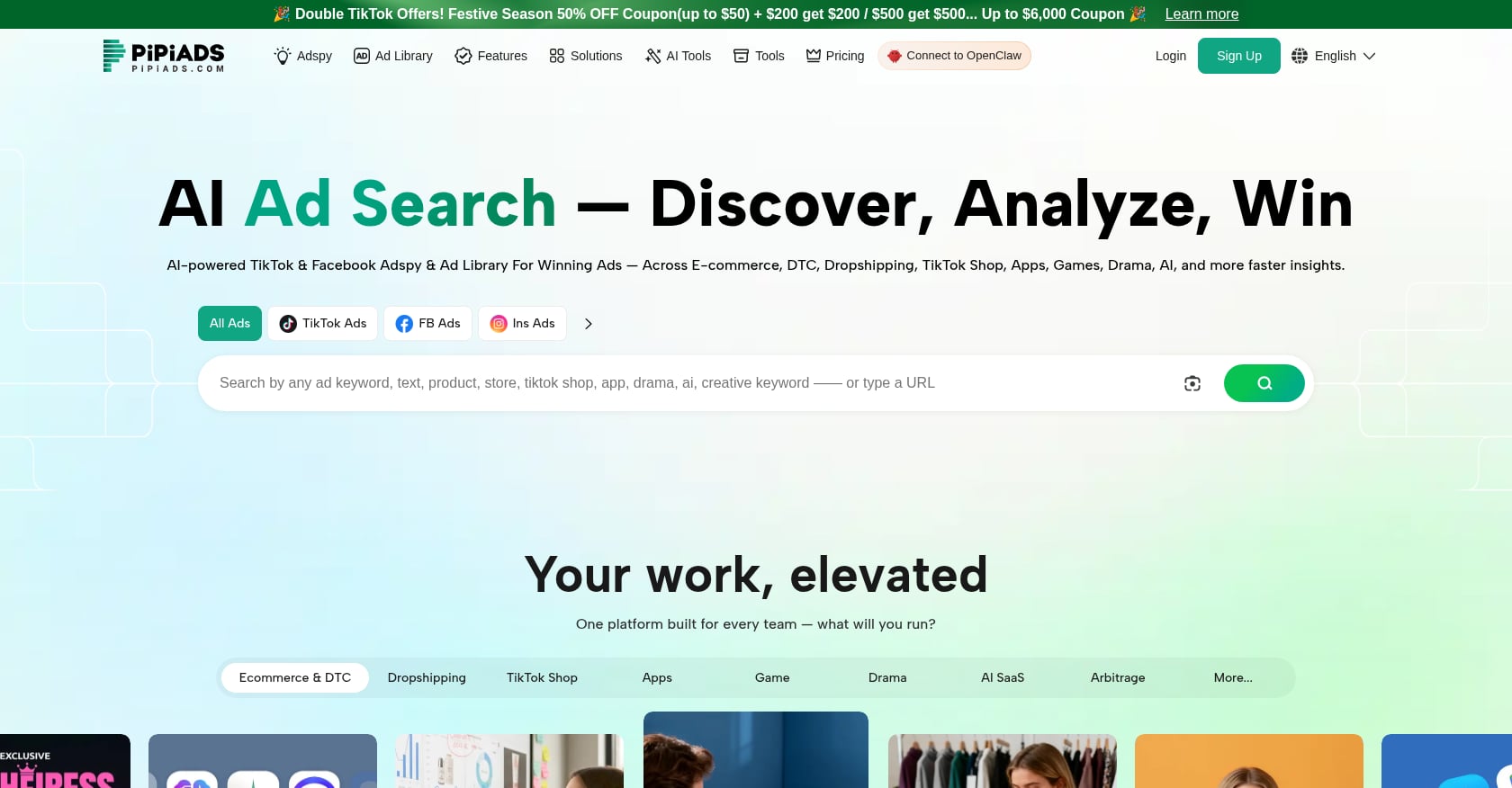
Best for: Ad creative intelligence for sellers spending $3K+ per month on TikTok or Meta ads.
PiPiAds is the largest dedicated TikTok and Meta ad intelligence platform. It indexes millions of active ads across TikTok, Facebook, Instagram, and Audience Network. If your competitive question is specifically “What ads are my competitors running and why are they working?”, PiPiAds gives the clearest answer. It has expanded to cover TikTok Shop specifically, tracking products promoted through TikTok’s integrated commerce features.
Key competitor analysis features:
Massive ad creative library with filtering by performance, duration, engagement
Competitor ad strategy reverse-engineering
TikTok Shop product ad tracking
Cross-platform coverage (TikTok + Meta)
Pricing:
Basic: $49/month
Advanced: $99/month
Flexible: Starting at $180/month (customizable)
Enterprise: $900/month
Credit-based system with 30% savings on annual billing
Free trial: 500 credits to test capabilities
Honest tradeoffs:
PiPiAds is not a shop analytics tool. It’s an ad intelligence platform. No product GMV tracking, no profit visibility, no content creation.
As one G2 reviewer put it: “Not cheap, but definitely worth it if you’re serious about TikTok ads.”
If you don’t run paid ads consistently, the platform offers limited value.
Covers only Layer 4 (creative-level analysis) of the competitor framework.
For context on how PiPiAds fits into a broader tool stack, the PiPiAds alternatives guide covers adjacent options.
Who should pick this: Intermediate and advanced sellers or dropshippers running consistent paid campaigns who need to study what ad creatives convert in their niche.
5. Shoplus
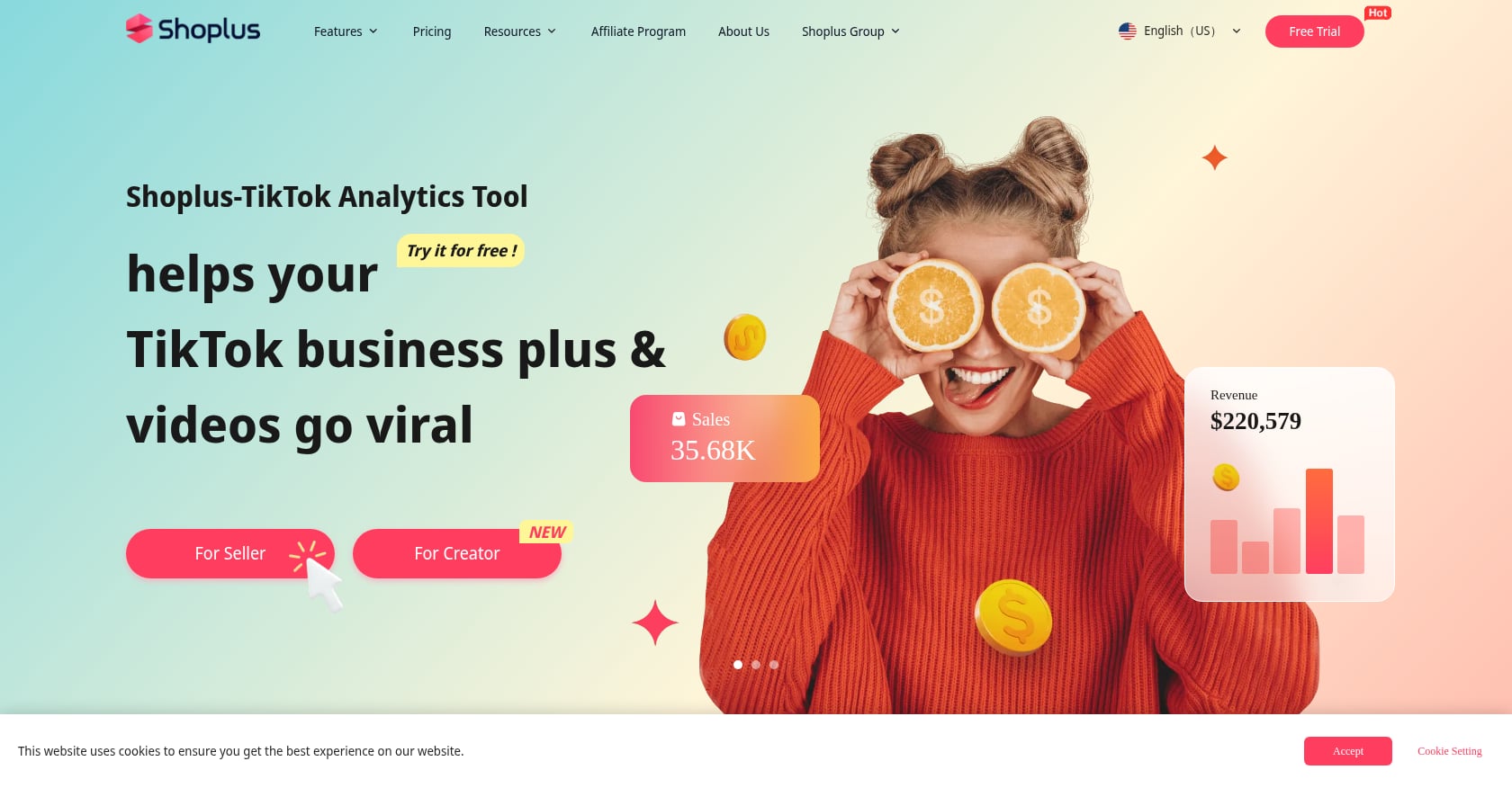
Best for: Budget-friendly TikTok Shop analytics with team collaboration features.
Shoplus is a TikTok analytics tool trusted by over 800,000 users that covers trend discovery, product opportunities, and competitor insights. It contains more than 90 million product data points from 6 countries and offers hourly data updates.
Key competitor analysis features:
Competitor insights showing how similar shops structure product lines
Reveals which products drive traffic for competitors
Promotional content tracking
Team collaboration features (sub-accounts on higher tiers)
Pricing:
Basic: $49/month (100 products daily)
Premium: $69/month (300 products daily, 2 sub-accounts)
Professional: $99/month (unlimited products, 5 sub-accounts)
Free trial available
Honest tradeoffs:
User reports mention inconsistent data accuracy. Treat it as a starting point for ideas rather than a source of truth.
One comparison review described it as “budget-tier with frequent stability issues.”
No content creation, publishing, or profit tracking built in.
Lacks the transparency and data credibility depth of Kalodata or FastMoss.
Who should pick this: Sellers who want a broad TikTok analytics overview and value team collaboration features without paying $80+ per month for research-only tools.
6. Sprout Social
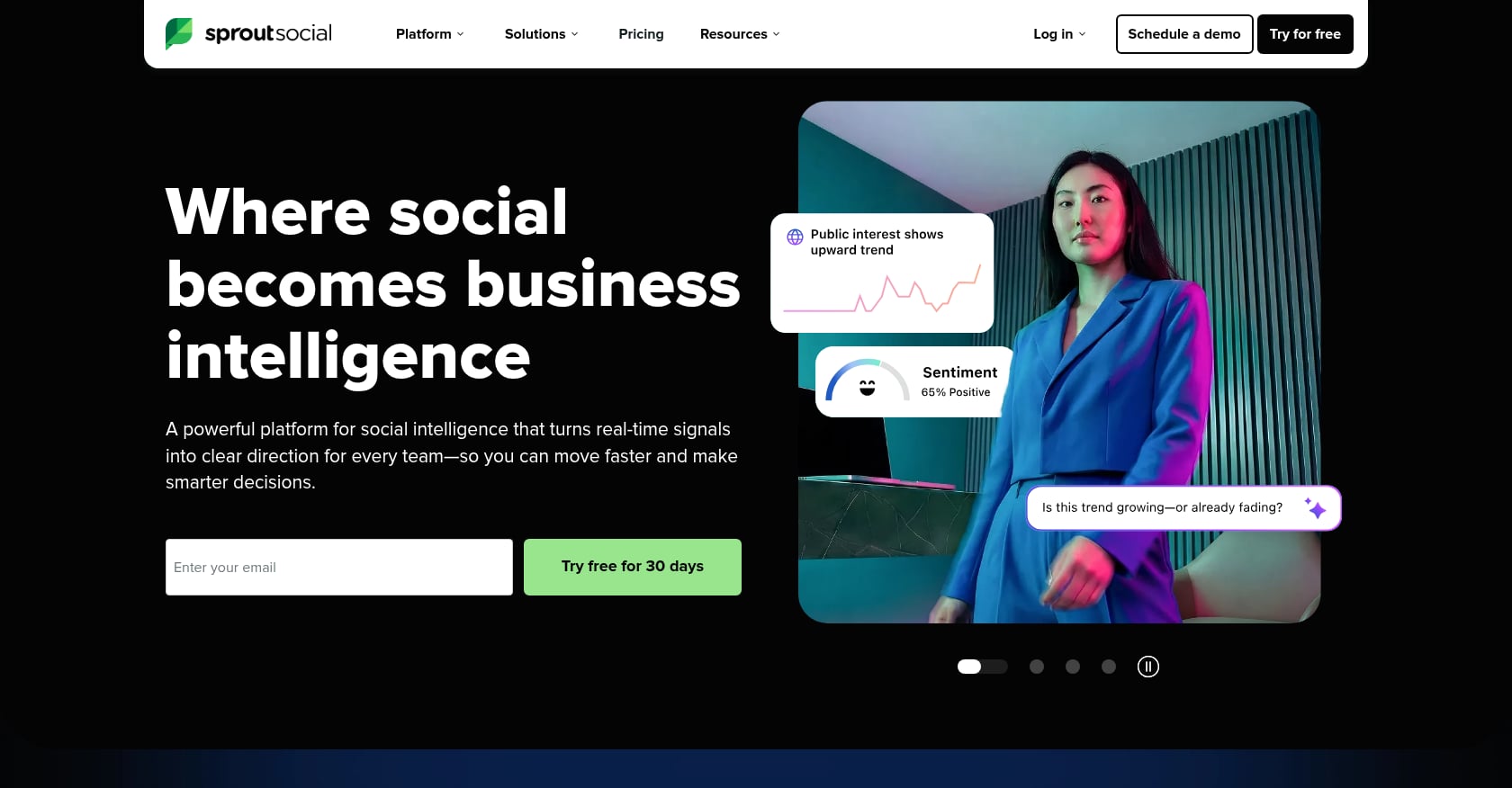
Best for: Content-side competitive benchmarking for brand social teams (not commerce-level analysis).
Sprout Social is an enterprise social media management platform that includes TikTok competitor benchmarking. It helps spot what content formats, sounds, challenges, and topics are currently resonating. By seeing what’s working for others, you can identify popular styles to adapt or find content gaps competitors aren’t addressing.
Key competitor analysis features:
Content performance benchmarking across competitors
Posting schedule and cadence analysis
Engagement rate comparison
Optimal send time recommendations
Pricing:
Professional: $99/month (annual billing)
Higher tiers available for enterprise
30-day free trial
Honest tradeoffs:
Not TikTok Shop-native. Doesn’t track GMV, product sales velocity, creator-affiliate ROI, or pricing changes.
Designed for social media marketing broadly, not social commerce specifically.
Expensive relative to what it offers for TikTok Shop sellers. The $99/month price tag makes more sense for teams managing brand presence across many platforms.
Covers content benchmarking only, not commerce intelligence.
Who should pick this: Brand social teams that already use Sprout Social for cross-platform management and want to add TikTok content benchmarking without adopting a separate tool.
7. EchoTik
Best for: New sellers validating their first niche who can’t justify $40 to $60 per month on analytics.
EchoTik runs as a Chrome extension, providing TikTok Shop insights while you browse. At $9 to $19 per month, it’s one of the most accessible entry points.
Key features:
In-browser TikTok Shop data overlays
Basic product and trend insights
Lightweight enough for casual research
Pricing: $9 to $19/month. Free trial available.
Honest tradeoffs:
The data stays surface-level, useful for quick checks but not deep analysis.
No shop-level tracking, creator analytics, or historical data.
You’ll outgrow it quickly if your shop gains traction.
Who should pick this: Absolute beginners testing their first product idea who want to spend less than $20 per month on market intelligence.
8. SimpTok
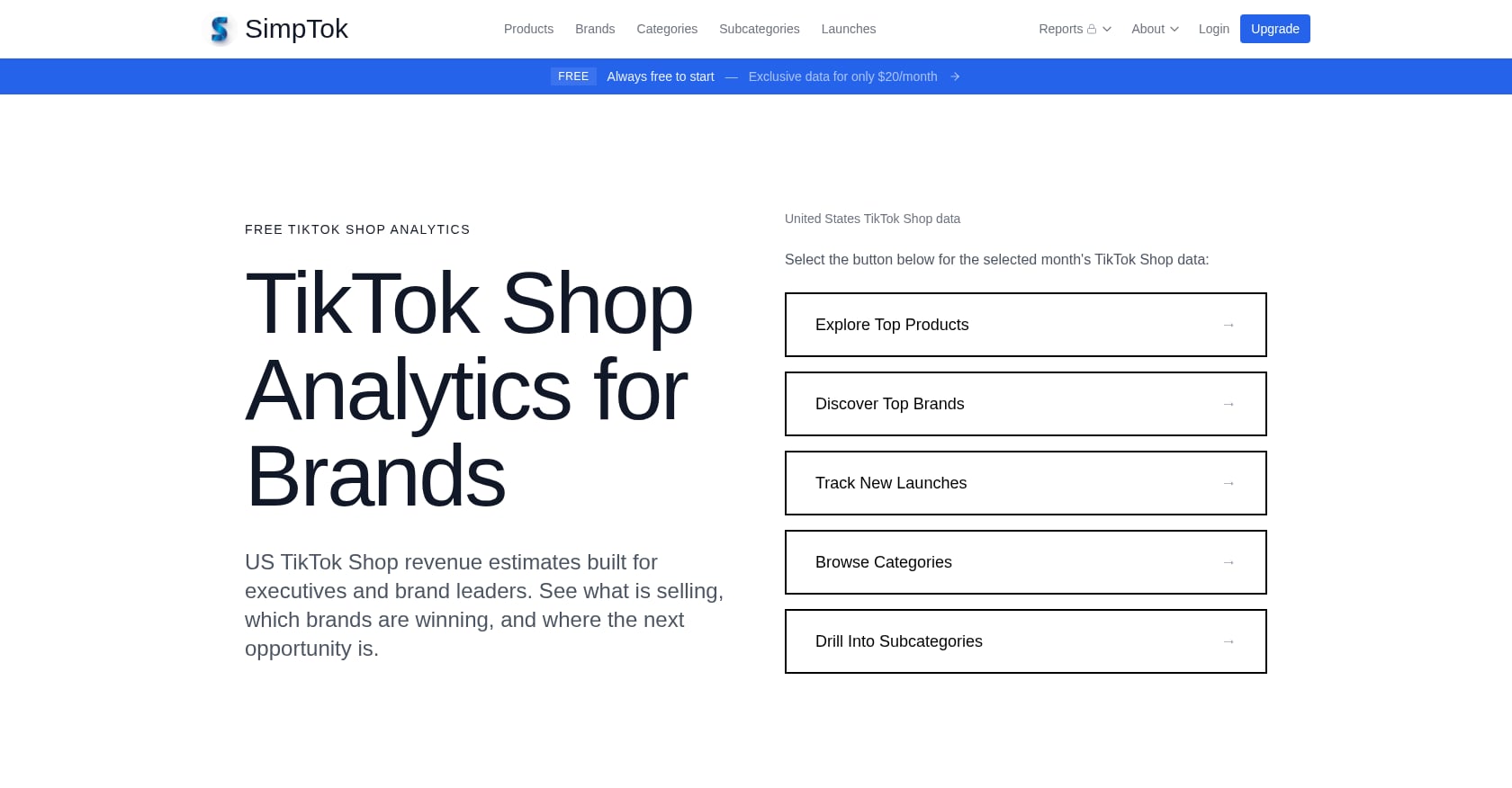
Best for: Sellers with zero analytics budget who need basic trend data at no cost.
SimpTok is the only completely free TikTok Shop analytics tool with no hidden fees, usage limits, or premium tiers. All features are available at no cost.
Honest tradeoffs:
Lacks the depth for serious competitor analysis. No shop-level tracking, no creator ROI metrics, no historical data.
“Free” comes with trade-offs in data freshness and granularity.
Better thought of as a complement to other tools, not a standalone solution.
Who should pick this: Pre-revenue sellers who need to validate whether TikTok Shop is worth entering before committing any budget to analytics.
9. TikTok Seller Center
Best for: First-party operational data (your own shop’s performance).
TikTok’s native Seller Center provides basic order data and GMV for your own shop. It’s the source of truth for settlements, orders, and account reporting.
Honest tradeoffs:
Completely blind to competitor data. You can see your own performance but nothing about the broader market.
Lacks the historical depth or contextual analysis that dedicated platforms offer.
If you rely on Seller Center alone, you stay close to your own numbers but remain blind to market-level trends, competitor moves, and creator dynamics.
That gap is why most scaling teams eventually add outside tools. The overview of TikTok Shop analytics tools explains what Seller Center misses and where external platforms fill in.
Who should pick this: Every TikTok Shop seller uses this by default. The question is what you layer on top of it.
Which TikTok Shop Competitor Analysis Tool Is Right for You?
Choose Trenz If
You want competitor research and content creation in one platform
You publish content daily
You manage multiple social channels
You need AI-generated videos and images
Choose Kalodata If
Historical product research is your priority
You mainly analyze categories and products
You already have content creation tools
Choose FastMoss If
You manage multiple brands
Creator outreach is a major growth channel
You need large-scale influencer discovery
Choose PiPiAds If
You spend heavily on paid advertising
Ad creative analysis is your primary objective
You want cross-platform ad intelligence
Choose Shoplus If
You need lower-cost analytics
Team collaboration matters
You can tolerate occasional data inconsistencies
Choose EchoTik or SimpTok If
You’re testing TikTok Shop for the first time
You have limited budget
You need basic trend validation
How to Build Your TikTok Shop Competitor Analysis Workflow
Tools are only as good as the process behind them. Here’s a practical workflow that maps to the 4-layer framework.
Step 1: Pick Your Competitors Carefully
Monitoring 30 competitors means monitoring none of them well. Select 3 to 5 direct competitors (selling similar products at similar price points) and 2 to 3 aspirational competitors (the category leaders you want to learn from). Go deep, not wide.
Step 2: Set Up Daily Market Monitoring
The 60-day product lifecycle stat means weekly check-ins aren’t fast enough. You need daily signals. Tools like Trenz’s daily Radar deliver 5 data-backed opportunities per day with GMV and growth analysis. Set up a routine where you review market-level trends every morning before making product or content decisions.
Step 3: Build Shop Watchlists
For each competitor, track their product catalog changes, pricing shifts, new launches, and promotional timing. FastMoss and Trenz both support watchlist features with alert functionality. The goal is to know when a competitor drops prices, launches a new SKU, or pulls a product before your customers notice.
Step 4: Map Competitor Creator Networks
Identify which creators drive actual revenue (not just views) for your competitors. Look at conversion rates, not follower counts. For deeper methodology on evaluating creator partnerships, the guide on finding TikTok Shop creators covers outreach strategy alongside metrics.
Step 5: Reverse-Engineer Top-Performing Content
Study competitors’ best videos: the hook style, demonstration angle, thumbnail format, caption structure, and call-to-action placement. This is Layer 4 analysis, and it’s where insights turn into revenue. PiPiAds handles the ad side. Trenz’s Creative Director agent can then generate new content angles based on what you’ve learned.
Step 6: Act Within 48 Hours
The most common failure in competitive intelligence is collecting data and never doing anything with it. Competitive intelligence has a shelf life. A pricing insight from two weeks ago is stale. An emerging product trend spotted on Monday should inform your content calendar by Wednesday.
Download the Trenz iOS app for mobile access to trend alerts and opportunity monitoring on the go.
FAQ
What is TikTok Shop competitor analysis?
TikTok Shop competitor analysis is the systematic process of identifying rival sellers, creators, and ad strategies on TikTok Shop, then evaluating their products, pricing, content performance, and creator partnerships. The goal is to find what’s working in your category so you can make faster, better-informed decisions about product selection, pricing, content creation, and creator outreach.
Can I do TikTok Shop competitor analysis for free?
Partially. SimpTok is completely free, and TikTok Seller Center gives you first-party data at no cost. Trenz offers 50 free credits with no credit card required, which is enough to test product discovery, competitor reports, and content generation. However, free options lack the depth (historical data, shop-level tracking, creator ROI) needed for serious competitive intelligence.
How often should I check competitor data?
Daily for market-level trends and new product alerts. Weekly for deeper shop-level and creator-level reviews. Given that top product listings on TikTok Shop have roughly a 60-day lifecycle, waiting even a week to spot a shift can cost you meaningful first-mover advantage.
What’s the best tool for beginners versus agencies?
Beginners should start with Trenz’s free plan or EchoTik ($9/month) to get oriented without a significant commitment. Agencies managing multiple brands benefit most from FastMoss (for scale creator outreach and deep data) or Trenz’s Scale plan (for combining research, content production, and multi-account publishing in one workspace).
Do Kalodata and FastMoss overlap?
Yes, significantly. Comparison reviews and practitioner discussions consistently estimate about 80% feature overlap between the two. The general consensus is that FastMoss suits operators who want action-oriented workflows, while Kalodata suits researchers who prioritize data depth and historical analysis. Most sellers don’t need both.
Is TikTok Seller Center enough for competitor analysis?
No. Seller Center provides your own shop’s order data and basic GMV, but it contains zero competitor data. You can’t see rival pricing, product launches, creator partnerships, or category-level trends. It’s essential for operations but useless for competitive intelligence.
What does a complete TikTok Shop competitor analysis stack look like?
A complete stack covers four layers: market-level intelligence (category GMV, blue-ocean scoring), shop-level tracking (competitor pricing and launches), creator-level analysis (affiliate ROI and availability), and creative-level intelligence (ad formats and content hooks). Trenz is currently the only platform that covers all four layers plus content creation and publishing. Most sellers using analytics-only tools end up pairing them with separate content and scheduling platforms.
Ready to stop guessing and start building your competitive edge? Start free with Trenz, no credit card required, and see how product discovery, AI content creation, and social publishing work together in one platform.
Author


